Exploring the Meaning of Merimnao in Greek
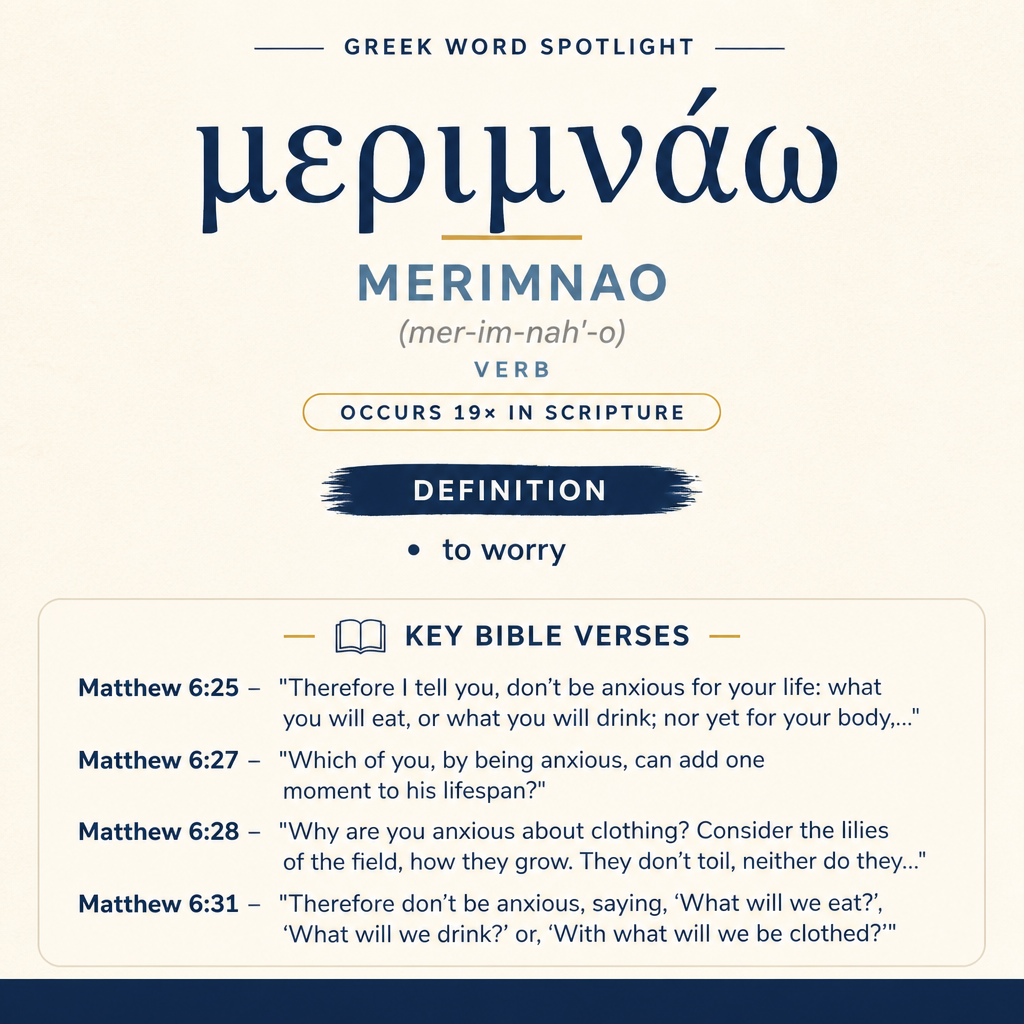
μεριμνάω means “to worry,” occurring 19 times in Scripture, including Matthew 6:25–34, Matthew 10:19, Luke 10:41, and Luke 12:11.
Core Meaning
μεριμνάω means “to worry.” In the cited verses it is rendered as being “anxious.”
Learn More →Matthew Uses
Matthew 6:25–34 repeats the command not to be anxious about life’s needs and tomorrow. Matthew 10:19 says not to be anxious about what to say when delivered up.
Learn More →Luke Uses
Luke 10:41 describes Martha as “anxious and troubled about many things.” Luke 12:11 instructs disciples not to be anxious about how or what to answer before authorities.
Learn More →μεριμνάω expresses worrying, especially the kind of inward anxiety that fixates on future needs or pressures. In the cited passages it appears in Jesus’ teaching about daily provision and in instructions for speaking under threat, and it also appears in Paul’s counsel about freedom from cares.
Occurrences
Matthew 6:25 Therefore I tell you, don’t be anxious for your life: what you will eat, or what you will drink; nor yet for your body, what you will wear. Isn’t life more than food, and the body more than clothing?
Here μεριμνάω marks worry as a preoccupation with basic necessities—food, drink, clothing. The verse frames that anxiety as narrowing “your life” to material maintenance, and counters it with a re-centering claim: “life” and “the body” exceed the immediate questions of provision. The force of the command falls on the inward posture (“be anxious”), not on responsible action in itself.
Matthew 6:27 “Which of you, by being anxious, can add one moment to his lifespan?
Worry is presented as ineffective: it cannot produce the outcome it implicitly seeks—more time. The rhetorical question portrays μεριμνάω as a mental effort aimed at control, yet powerless to secure even a “moment” of extension, exposing its futility in the face of life’s limits.
Matthew 6:28 Why are you anxious about clothing? Consider the lilies of the field, how they grow. They don’t toil, neither do they spin,
In this scene the anxious focus tightens to “clothing,” and the response points to a visible contrast: lilies “grow” without the human tasks of producing garments (“toil… spin”). The verb highlights a mismatch between anxiety and the natural example offered; worrying is shown as out of step with the observed pattern of growth that does not depend on anxious striving.
Matthew 6:31 “Therefore don’t be anxious, saying, ‘What will we eat?’, ‘What will we drink?’ or, ‘With what will we be clothed?’
μεριμνάω is linked with the speech it generates: anxious questions spill into repeated, immediate calculations of supply. The quoted worries are communal (“we”), showing how anxiety can become a shared, voiced agenda that circles around consumption and covering.
Matthew 6:34 Therefore don’t be anxious for tomorrow, for tomorrow will be anxious for itself. Each day’s own evil is sufficient.
Worry is projected forward: not merely about today’s needs but about “tomorrow.” The phrasing personifies tomorrow as having its own anxieties, and the final line (“Each day’s own evil is sufficient.”) sets a boundary on the time-range of concern. μεριμνάω thus depicts an anticipatory mental load that reaches ahead and multiplies trouble before it arrives.
Matthew 10:19 But when they deliver you up, don’t be anxious how or what you will say, for it will be given you in that hour what you will say.
Here the worry is not about material provision but about pressured speech under threat (“when they deliver you up”). The anxiety targets “how or what you will say,” the fear of failing in the moment. The verse places a promise against that inward panic: “it will be given you in that hour,” shifting the speaker’s attention from pre-planning in fear to receiving words in the crisis itself.
Luke 10:41 Jesus answered her, “Martha, Martha, you are anxious and troubled about many things,
In this domestic setting, μεριμνάω is paired with being “troubled,” and its scope expands: “many things.” The doubling of the name (“Martha, Martha”) underscores personal address and tenderness, while the diagnosis reveals anxiety as a many-sided burden rather than a single, isolated concern. The verb captures an inner fragmentation—attention pulled in multiple directions.
Luke 12:11 When they bring you before the synagogues, the rulers, and the authorities, don’t be anxious how or what you will answer, or what you will say;
The same kind of pressure as in Matthew 10:19 is pictured, now with a more detailed setting: public appearance before “synagogues… rulers… authorities.” The worry is both about “answer” and “what you will say,” covering content and manner. The command against anxiety addresses the fear of exposure and the weight of speaking under scrutiny.
Luke 12:22 He said to his disciples, “Therefore I tell you, don’t be anxious for your life, what you will eat, nor yet for your body, what you will wear.
This restates the life-and-body axis of worry: sustenance and clothing. The audience (“his disciples”) makes the instruction relational and communal. μεριμνάω again marks the inward state that reduces “life” to consumption and “body” to covering, treating these as the central questions that drive anxious thought.
Luke 12:25 Which of you by being anxious can add a cubit to his height?
Worry is again tested by its results and found powerless, now with a bodily measure (“a cubit… to his height”). Whether understood as stature or growth, the verse uses concrete measurement to expose the emptiness of anxious effort: it cannot change what it most wishes to secure or improve.
Luke 12:26 If then you aren’t able to do even the least things, why are you anxious about the rest?
μεριμνάω is portrayed as disproportionate. If certain outcomes lie beyond ability (“even the least things”), then anxiety about “the rest” becomes irrational escalation—an enlarging mental burden in response to acknowledged limits. The verb thus names the impulse to carry what one cannot actually manage.
1 Corinthians 7:32 But I desire to have you to be free from cares. He who is unmarried is concerned for the things of the Lord, how he may please the Lord;
In this pastoral counsel, μεριμνάω appears as “concerned,” set within a stated aim: “free from cares.” The verse contrasts two directions for concern: being occupied with “the things of the Lord” and the practical question “how he may please the Lord.” In this context the verb describes an organizing focus of attention—what occupies the mind and shapes priorities—within an argument about freedom from care’s entanglements.

Sense and Usage
Across these passages, μεριμνάω consistently names worry as a mental occupation that latches onto possible future needs or feared moments of exposure. In the teaching about food, drink, and clothing (Matthew 6:25, 6:28, 6:31; Luke 12:22), it targets the ordinary pressures of survival and appearance; the repeated questions (“What will we eat?” “What will we drink?” “With what will we be clothed?”) show how anxiety loops, rehearsing scarcity before it arrives. The same verb then widens to time itself (“tomorrow,” Matthew 6:34), displaying worry’s tendency to extend today’s load into an imagined future and to carry it prematurely.
Two rhetorical tests expose worry’s limits: it cannot add “one moment” to lifespan (Matthew 6:27) and cannot add “a cubit” to height (Luke 12:25). These images work because they translate anxiety into measurable outcomes—time and stature—and then deny its power to achieve either. Luke 12:26 presses the point logically: if one cannot do “even the least things,” anxious fixation on “the rest” becomes an expansion of burden rather than a solution.
In the scenes of being brought before hostile or powerful audiences (Matthew 10:19; Luke 12:11), μεριμνάω shifts from material needs to verbal performance: “how or what you will say,” “how or what you will answer.” Here worry is anticipation of failure under pressure, the dread of not knowing what to say when it matters most. The promise that words will be “given… in that hour” (Matthew 10:19) addresses the same inner dynamic: anxiety tries to control the future by rehearsing it, while the instruction redirects attention to the moment of need.
Luke 10:41 shows worry’s breadth in everyday life: “anxious and troubled about many things.” The pairing with “troubled” presents anxiety as not merely a thought but a disturbance that unsettles and scatters the person. 1 Corinthians 7:32 uses the verb in a different register, speaking of being “free from cares” and being “concerned for the things of the Lord.” The focus there is what occupies someone’s attention and energy; the verse treats concern as a shaping preoccupation that can either weigh down or direct life toward a defined aim (“how he may please the Lord”).
Imagery and Emphasis
The passages attach worry to concrete objects and situations: meals, drink, clothing, tomorrow, and the pressured moment of giving an answer before authorities. They also picture its futility with measures you can count—“one moment,” “a cubit”—and its breadth with the phrase “many things.” Together these scenes present μεριμνάω as an inward weight that multiplies questions, reaches into the future, and seeks control, yet cannot secure the very outcomes it fears to lose.
Sources: Lexical data from Strong’s Exhaustive Concordance and the Translators Brief Lexicon of Extended Strongs for Greek (STEPBible, CC BY). Occurrence data from the Translators Amalgamated Greek New Testament (STEPBible, CC BY). Scripture quotations from the World English Bible (public domain).