Exploring the Meaning of Meris in Greek
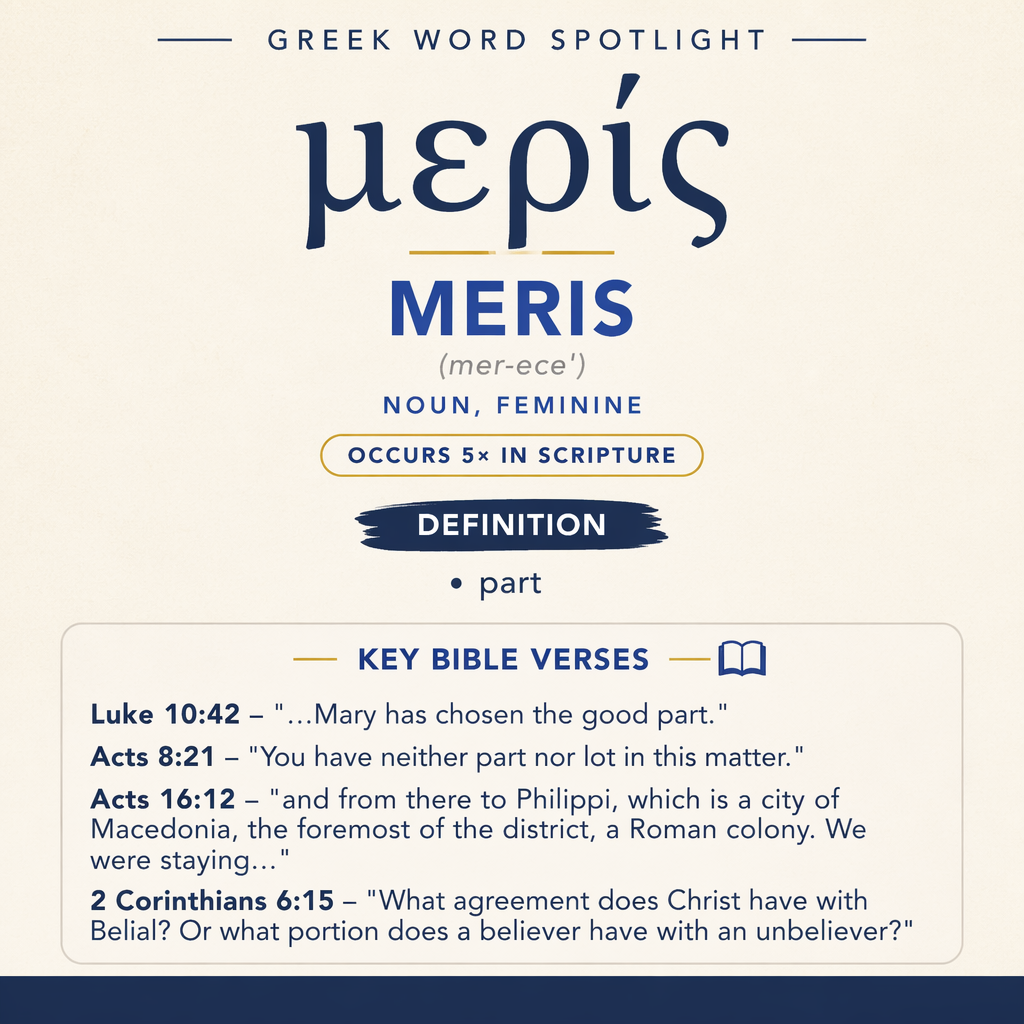
μερίς means “part” and appears five times in Scripture: Luke 10:42; Acts 8:21; Acts 16:12; 2 Corinthians 6:15; Colossians 1:12.
Core Meaning
μερίς is defined as “part.” In Luke 10:42, Mary chooses “the good part,” which will not be taken away.
Learn More →Key Contrasts
Acts 8:21 uses it negatively: “neither part nor lot in this matter.” 2 Corinthians 6:15 asks what “portion” a believer has with an unbeliever.
Learn More →Inheritance Share
Colossians 1:12 thanks the Father for making believers fit to be partakers of the inheritance of the saints in light. Acts 16:12 includes the term within the travel narrative to Philippi.
Learn More →μερίς refers to a “part,” a share or assigned portion, and it appears in five New Testament settings that range from a household choice to questions of belonging, participation, and inheritance. Across these scenes it marks what someone has—or does not have—in relation to what is at hand.
Root and Related Words
μερίς is related to meros (μέρος), “part” (Strong’s G3313).

Occurrences
Luke 10:42 — “but one thing is needed. Mary has chosen the good part, which will not be taken away from her.”
Here μερίς names what Mary has “chosen.” The saying sets her choice alongside “one thing” that “is needed,” so the “part” is presented as a selected share in what matters most in that moment. The added promise—“which will not be taken away from her”—treats this “part” as something secure: not a fleeting advantage, but a portion she truly possesses in a way that cannot be removed.

Acts 8:21 — “You have neither part nor lot in this matter, for your heart isn’t right before God.”
In this rebuke, μερίς stands in a paired expression: “neither part nor lot.” The force is exclusion from participation in “this matter.” The line explains the exclusion morally—“for your heart isn’t right before God”—so the “part” is not a neutral slice of opportunity but a share tied to fitness before God. The sentence treats a “part” as something that can be denied when a person’s inner stance is out of alignment.
Acts 16:12 — “and from there to Philippi, which is a city of Macedonia, the foremost of the district, a Roman colony. We were staying some days in this city.”
In this travel notice, μερίς helps describe Philippi’s civic placement: “the foremost of the district.” The word contributes the idea of a defined region or division in which a city can hold a leading position. The writer is situating the narrative geographically and administratively, and the “part” language supports that sense of a larger area having sections, within which Philippi is prominent.
2 Corinthians 6:15 — “What agreement does Christ have with Belial? Or what portion does a believer have with an unbeliever?”
Here μερίς is rendered “portion” and is asked as a rhetorical question: what share is held “with” someone of a fundamentally different allegiance. The parallel question about “agreement” places “portion” in the realm of shared standing or common participation. The point is not about splitting something materially, but about whether there exists any real shared part between “a believer” and “an unbeliever” in the relationship implied by the pairing.
Colossians 1:12 — “giving thanks to the Father, who made us fit to be partakers of the inheritance of the saints in light,”
Although the word is not translated with “part” in this English line, the verse’s wording turns on the same concept: being made “fit” to share. The sentence pictures salvation in terms of inclusion in an “inheritance,” and the fitness granted by the Father results in real participation in what belongs to “the saints in light.” The idea of a “part” is expressed as an entitled share in a communal possession—an inheritance—received because one has been qualified to belong among its recipients.
Sense and Usage
Across these passages, μερίς consistently points to an assigned or possessed share—what one has, holds, chooses, or is barred from. In Luke, it is personal and decisive: a “good part” chosen amid competing concerns, portrayed as lasting and secure. In Acts 8 it becomes evaluative and relational: a person may be told they have no share in a matter because their heart is not right before God, showing that a “part” can denote legitimate participation rather than mere proximity.
Acts 16 shows the term functioning descriptively in a public, geographic register. A “district” is treated as a larger whole that can be spoken of in parts, and a city can be characterized by rank within that defined area. This use sits comfortably alongside the more personal and moral uses because all assume a larger reality—whether a household setting, a spiritual work, or a territory—in which a specific share or placement can be named.
In 2 Corinthians, μερίς frames the question of commonality: whether two parties can truly share a portion together. The word works alongside “agreement” to underline that some pairings do not yield a genuine shared share. Colossians intensifies the positive side of the term by linking it to “inheritance.” There the “part” is not earned by self-assertion but received through being made fit, and it is explicitly communal (“of the saints”), presenting the share as both personal inclusion and corporate belonging.
Taken together, these uses show μερίς as a flexible noun for a share that may be chosen, granted, located, or withheld. The contexts lean on it to express boundaries—who is included or excluded—and also stability—what remains one’s portion and what cannot be claimed without the right standing.
Imagery
The word’s imagery in these verses is the imagery of allotment: a “good part” that remains with Mary (Luke 10:42), a denied share in a spiritual matter (Acts 8:21), a defined district in which a city has a place (Acts 16:12), a questioned “portion” between opposed identities (2 Corinthians 6:15), and an inheritance shared among “saints in light” (Colossians 1:12). In each case, μερίς evokes the clarity of what belongs where—and to whom.
Sources: Lexical data from Strong’s Exhaustive Concordance and the Translators Brief Lexicon of Extended Strongs for Greek (STEPBible, CC BY). Occurrence data from the Translators Amalgamated Greek New Testament (STEPBible, CC BY). Scripture quotations from the World English Bible (public domain).