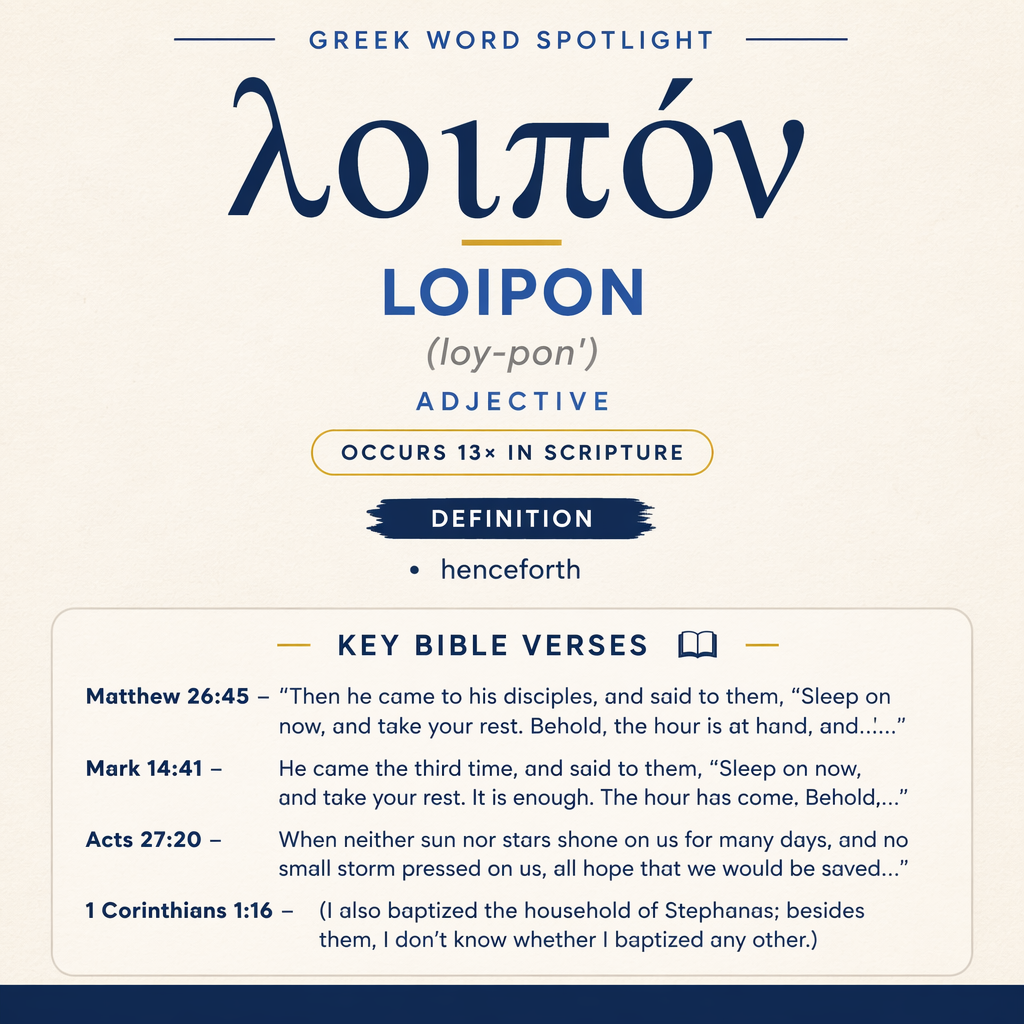
It appears in passages such as Matthew 26:45 and Mark 14:41, and also in Acts 27:20. It is also found in 1 Corinthians, 2 Corinthians, and Philippians.
λοιπόν expresses a forward-looking time reference: “henceforth,” marking what follows as the new situation from that point onward. In the passages where it appears, it either turns the scene toward the decisive moment now arriving or signals a concluding, forward-facing transition in argument and exhortation.
Occurrences
“Then he came to his disciples, and said to them, “Sleep on now, and take your rest. Behold, the hour is at hand, and the Son of Man is betrayed into the hands of sinners.” (Matthew 26:45)
In this moment the narrative pivots from waiting to the arrival of “the hour.” λοιπόν presses the scene into what must now be faced: rest and delay give way to the immediate nearness of betrayal. The “Behold” and “the hour is at hand” frame the time shift that “henceforth” conveys—events are no longer approaching in general; they are now entering their decisive phase.
“He came the third time, and said to them, “Sleep on now, and take your rest. It is enough. The hour has come. Behold, the Son of Man is betrayed into the hands of sinners.” (Mark 14:41)
Here the same turn is sharpened with finality: “It is enough. The hour has come.” λοιπόν functions as the marker that the period of watchfulness has passed and a new, unavoidable stage has begun. The statement of completion (“It is enough”) and the announcement of arrival (“has come”) together depict the “henceforth” boundary between what was happening up to this point and what now must unfold.
“When neither sun nor stars shone on us for many days, and no small storm pressed on us, all hope that we would be saved was now taken away.” (Acts 27:20)
In this sea-crisis description, λοιπόν helps situate the emotional collapse in time: after “many days” without celestial guidance and under relentless storm, the narrative reaches the point where “all hope…was now taken away.” The word contributes the sense of a grim threshold—beyond this point, hope is no longer sustained; the situation has moved into a new condition characterized by despair.
“(I also baptized the household of Stephanas; besides them, I don’t know whether I baptized any other.)” (1 Corinthians 1:16)
In this parenthetical clarification, λοιπόν supports a narrowing of what remains to be said. The speaker acknowledges one additional instance, then moves to what is left: “besides them,” there is no further recollection. “Henceforth” in this setting frames the statement as a limiting remainder—after accounting for the household of Stephanas, the discussion has no further baptisms to add.
“Here, moreover, it is required of stewards that they be found faithful.” (1 Corinthians 4:2)
With “moreover,” the discourse steps from the preceding reasoning into a practical criterion: what is required “here” of stewards. λοιπόν functions as a transition into what follows from the argument—moving forward from the point established, the relevant requirement stands: faithfulness. The temporal idea of “henceforth” is heard as “from this point in the discussion,” directing attention to the immediate implication.
“But I say this, brothers: the time is short, that from now on, both those who have wives may be as though they had none;” (1 Corinthians 7:29)
This verse explicitly voices the forward boundary: “from now on.” λοιπόν marks a new mode of living in light of compressed time: the present circumstances (“have wives”) are set alongside an altered stance (“as though they had none”). The word functions not as a denial of present realities, but as an announcement that, henceforth, the shortness of time governs how those realities are to be held.
“Finally, brothers, rejoice! Be perfected. Be comforted. Be of the same mind. Live in peace, and the God of love and peace will be with you.” (2 Corinthians 13:11)
“Finally” introduces a closing movement that is still future-facing: it gathers commands oriented toward what is to come—rejoicing, being perfected, comfort, unity of mind, peaceable living. λοιπόν contributes the sense that the letter has reached its concluding exhortations, and from here the community’s ongoing life is to be shaped by these directives.
“Finally, my brothers, rejoice in the Lord! To write the same things to you, to me indeed is not tiresome, but for you it is safe.” (Philippians 3:1)
Again “Finally” signals a transition, yet what follows is not mere wrap-up; it is a practical, continuing instruction: “rejoice in the Lord.” λοιπόν sets the stage for what the writer is about to emphasize, including the decision to repeat “the same things” for the readers’ safety. The word thus functions as a hinge: having reached this point, the discourse turns to reinforcement meant to carry forward.
“Finally, brothers, whatever things are true, whatever things are honorable, whatever things are just, whatever things are pure, whatever things are lovely, whatever things are of good report: if there is any virtue and if there is any praise, think about these things.” (Philippians 4:8)
Here “Finally” introduces a comprehensive set of categories for reflection. λοιπόν frames the list as the culminating focus for the mind: henceforth, attention is to be directed toward what is “true…honorable…just…pure…lovely…of good report,” and toward anything marked by “virtue” and “praise.” The word contributes the rhetorical sense that the writer is gathering the discussion into a forward-directed practice of thought.
“Finally then, brothers, we beg and exhort you in the Lord Jesus, that as you received from us how you ought to walk and to please God, that you abound more and more.” (1 Thessalonians 4:1)
“Finally then” acts as a strong transition into a major exhortation. λοιπόν points toward continued growth: having already “received…how you ought to walk and to please God,” the readers are urged that they “abound more and more.” The forward orientation is central—henceforth, the received instruction is to be carried into increasing practice.
“Finally, brothers, pray for us, that the word of the Lord may spread rapidly and be glorified, even as also with you,” (2 Thessalonians 3:1)
With “Finally,” the writer turns to a request that extends beyond the letter into ongoing intercession. λοιπόν frames what follows as the concluding appeal: prayer “for us,” aimed at the continuing advance of “the word of the Lord” so that it “may spread rapidly and be glorified.” The word’s force is to move from instruction to sustained action that begins now and continues.
“From now on, the crown of righteousness is stored up for me, which the Lord, the righteous judge, will give to me on that day; and not to me only, but also to all those who have loved his appearing.” (2 Timothy 4:8)
This occurrence places the time boundary in a personal horizon: “From now on” there is something “stored up.” λοιπόν marks the present as the point from which the future gift is secured—awaiting “that day” when “the Lord, the righteous judge” will give it. The phrase sets a line between earlier struggle and the settled expectation that now defines the speaker’s outlook, while still pointing ahead to the moment of giving.
Sense and Usage
Across these passages, λοιπόν works as a boundary word. In narrative settings it presses the moment into a new stage: in the garden scenes, it draws a sharp line between continued rest and the immediate arrival of “the hour”; on the storm-tossed voyage, it marks the point at which prolonged hardship results in hope being “taken away.” In these contexts, the word’s “henceforth” sense is felt as an irreversible shift: what comes next is determined by what has just become true.
In the letters, λοιπόν frequently appears at transitions that are formally “final,” yet functionally practical. It introduces concluding exhortations that are meant to govern life going forward: rejoicing, mental focus, prayer, walking in ways that please God, and living in peace. Even when the tone is closing, the word does not simply end discussion; it turns the reader outward from the letter to what should characterize the community’s continuing conduct “from now on.”
In a few places it serves a clarifying or inferential role: the parenthetical about baptizing (1 Corinthians 1:16) uses it to delimit what else remains to be added, while the requirement for stewards (1 Corinthians 4:2) uses it as a step into the implication that follows. In every setting, the common effect is to locate the reader at a point of transition—after this point, the situation, the argument, or the obligation stands in a new relation to what precedes.
Closing Imagery
The passages attach λοιπόν to vivid turning points: a quiet moment that yields to betrayal (“the hour is at hand…has come”), a sky without “sun or stars” where endurance collapses into the loss of hope, and an outlook that moves from present life into what is “stored up…on that day.” In the letters, the same forward marker gathers instruction into a final push toward ongoing practice—henceforth shaped by rejoicing, disciplined thought, prayer, and peace.
Sources:
Lexical data from Strong’s Exhaustive Concordance and the Translators Brief Lexicon of Extended Strongs for Greek (STEPBible, CC BY). Occurrence data from the Translators Amalgamated Greek New Testament (STEPBible, CC BY). Scripture quotations from the World English Bible (public domain).