Exploring the Meaning of Loipou in Greek
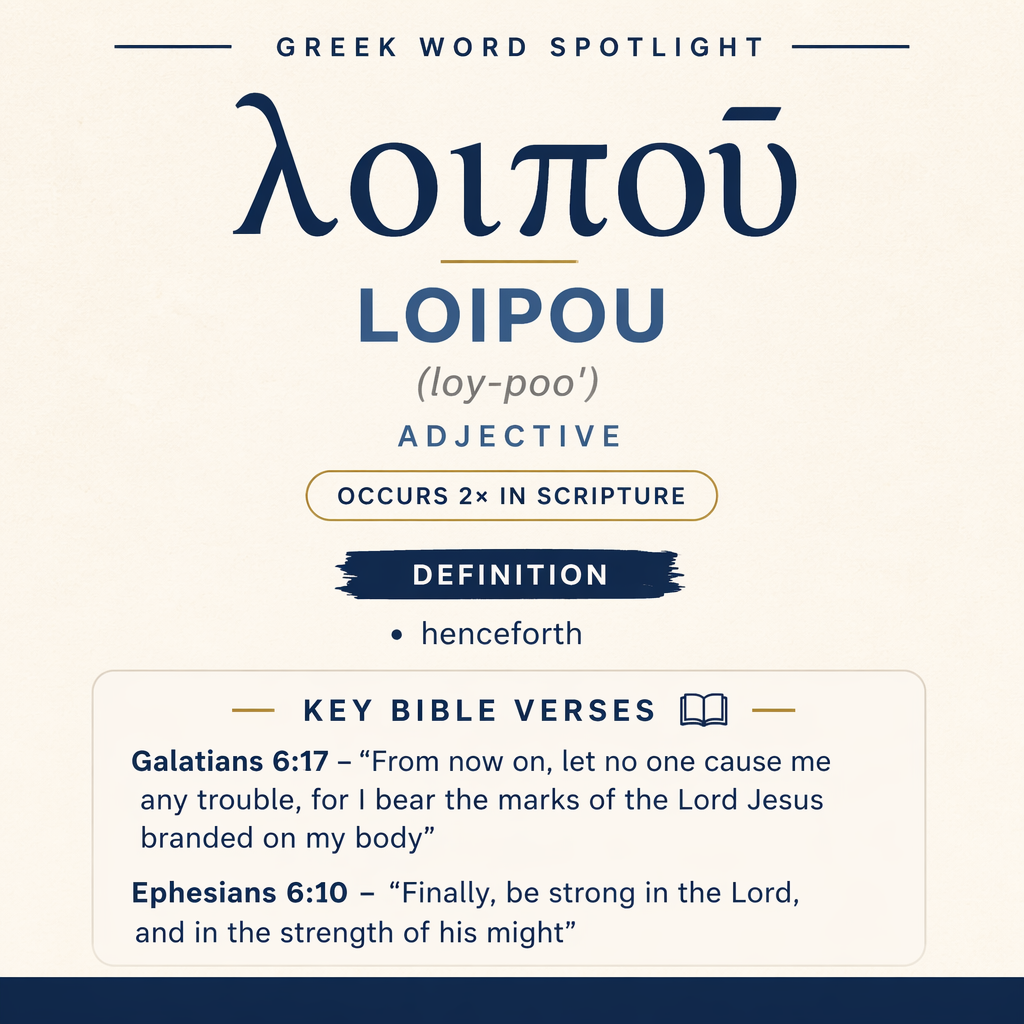
λοιποῦ means “henceforth” and appears in Galatians 6:17 and Ephesians 6:10.
Scripture Occurrences
It occurs 2 times in Scripture: Galatians 6:17 and Ephesians 6:10.
Learn More →Verse Contexts
In Galatians 6:17, it introduces “From now on.” In Ephesians 6:10, it appears in “Finally, be strong in the Lord.”
Learn More →λοιποῦ expresses a time-oriented pivot: “henceforth.” It appears in two Pauline contexts where the speaker marks a decisive point forward—once to close off further opposition, and once to move into a final exhortation to strength.
Root and Related Words
λοιποῦ corresponds to the related form loipoi (λοιπός), glossed “remaining” (Strong’s G3062). The relationship ties λοιποῦ to language that can mark what is left or what follows, which fits its function in discourse as a boundary line between what has been and what comes next.

Occurrences
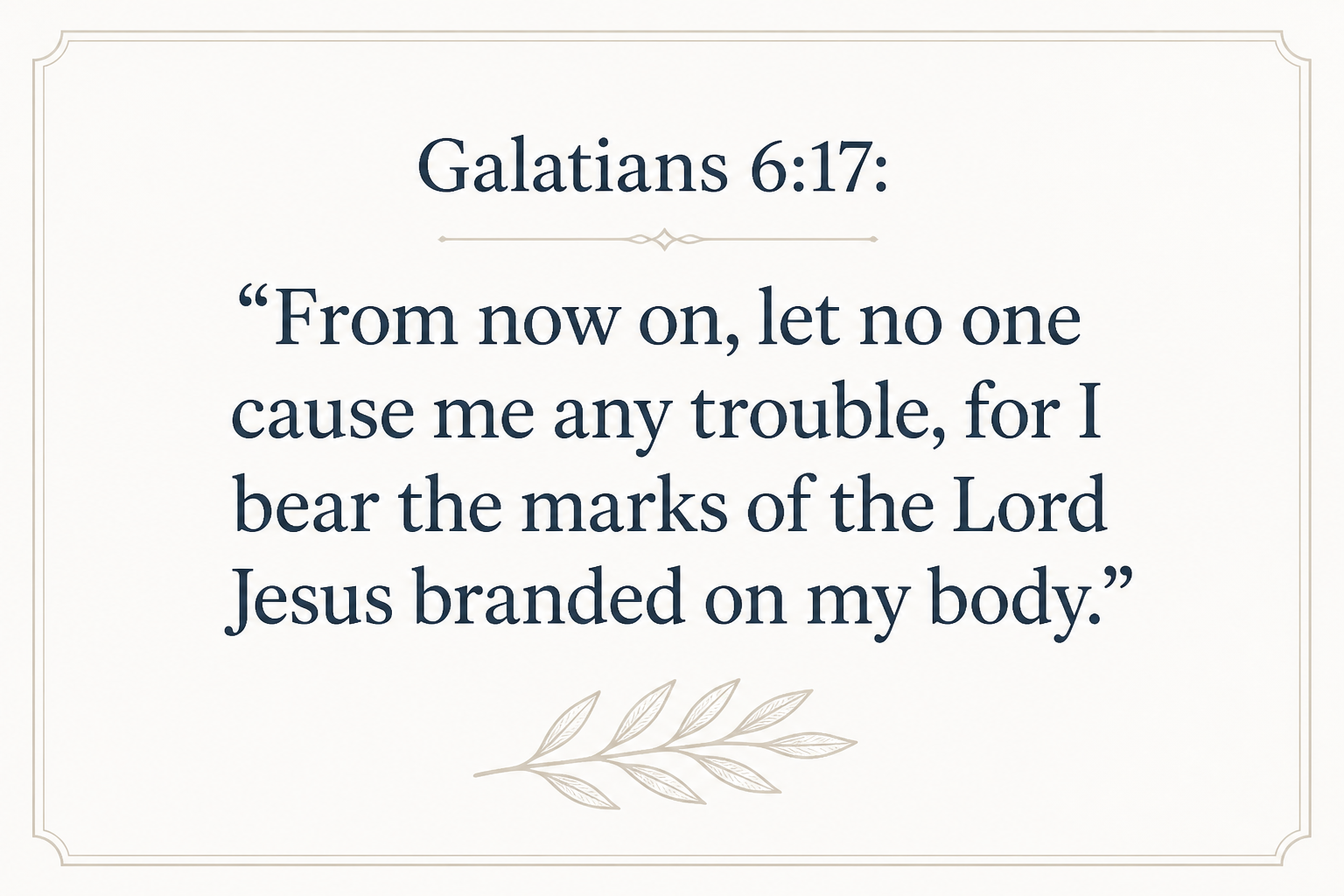
Galatians 6:17: “From now on, let no one cause me any trouble, for I bear the marks of the Lord Jesus branded on my body.”
In this closing declaration, λοιποῦ (rendered “From now on”) sets a firm temporal boundary for the request that follows: “let no one cause me any trouble.” The phrase is not merely a polite wish; it is framed as a forward-looking insistence that a certain kind of harassment is to stop at this point. The reason given is personal and concrete: “for I bear the marks of the Lord Jesus branded on my body.” The temporal marker pushes the reader to hear the line as a settled conclusion drawn from what Paul carries in his own body. In the flow of the sentence, λοιποῦ binds together two elements: a prohibition aimed at others (“let no one cause me any trouble”) and a justification rooted in embodied evidence (“I bear the marks…”). The time-word gives the prohibition its procedural force: not an abstract rule for all situations, but a claim that the matter should be closed going forward. It signals that the argument has reached a point where further contest is out of place, because Paul’s bodily “marks” stand as a decisive credential that, in his view, should end the dispute.
Within the verse, the shift created by “From now on” also contributes a rhetorical tone of finality. The speaker is not opening a new debate but drawing a line under “trouble” that has already been experienced or threatened. By placing the temporal boundary at the front, the statement begins with the forward-looking limit before it gives the rationale; the reader hears first the demand for future peace and only then the grounding fact of the “marks.” λοιποῦ thus functions as a hinge from the letter’s contentious pressures into an intended quietness that respects the speaker’s suffering and allegiance.
Ephesians 6:10: “Finally, be strong in the Lord, and in the strength of his might.”
Here λοιποῦ is represented by “Finally,” introducing the exhortation: “be strong in the Lord, and in the strength of his might.” The word signals that what follows is positioned as a concluding movement. It does not add new content to the command itself (“be strong”), but it frames the command as the next step from this point in the discourse: the reader is being brought to an ending section that gathers attention and directs it toward the central imperative. The force of the exhortation is intensified by its placement under a “finally” marker, which can feel like a last, weight-bearing instruction.
In the wording of the verse, the content after λοιποῦ is entirely oriented toward strength, but the strength is located “in the Lord” and “in the strength of his might.” The temporal-discourse marker helps the reader take this as a decisive forward instruction rather than as a passing comment. “Finally” does not merely indicate sequence; it cues a posture: the writer is now pressing toward what should be carried out from this point. The paired phrases—“in the Lord” and “in the strength of his might”—are set under the umbrella of this concluding marker, so that the closing direction is not self-reliance but a continued stance within divine strength. λοιποῦ therefore contributes to how the command is heard: as a culminating push toward steadfastness, situated at the end of an argument or set of teachings.
Sense and Usage
The gloss “henceforth” fits both contexts as a forward-facing boundary word, but it plays out with slightly different rhetorical effects. In Galatians 6:17 it marks a decisive cutoff: the speaker seeks an end to “trouble” beginning now. The time-line is drawn sharply, and the appeal is backed by an embodied reason (“I bear the marks…”). The word’s force is almost procedural: going forward, a behavior is to cease. The sentence uses the future-oriented turn to protect the speaker from continued disturbance, presenting the past as having supplied sufficient proof to end the matter.
In Ephesians 6:10, the same temporal-forward function is expressed as “Finally,” which treats the ensuing instruction as what should be taken up at this concluding point. Rather than shutting down opposition, it turns the reader toward a finishing imperative. The “henceforth” nuance is heard as an onward movement: having arrived at the closing segment, the community is to adopt a stance of strength “in the Lord.” The forward-looking element is still present, but it points not to a prohibition against others but to an abiding posture that must begin and continue after this moment of instruction.
Across both verses, λοιποῦ serves as a discourse marker that changes how the reader relates to what follows: it signals that the next clause has special weight for what comes next. In one case, it is a boundary that blocks further trouble; in the other, it is a concluding summons that directs conduct forward. Because the word points the reader toward what is to be true from this point onward, it naturally pairs with imperatival language (“let no one…,” “be strong…”). The effect is to make the following command sound not optional but time-bound: the moment has come, and the future is now to be shaped accordingly.
Imagery and Force
Though λοιποῦ is a small word, it carries a clear sense of movement along a line: a “now” that divides what lies behind from what is expected ahead. In Galatians 6:17 that line is drawn across the speaker’s life, where “the marks of the Lord Jesus” on his body stand as a tangible witness that demands peace going forward. In Ephesians 6:10 the line is drawn at the threshold of a final exhortation, urging a strength anchored “in the Lord” as the way ahead. In both, λοιποῦ gives the surrounding words a forward pressure—language meant to govern what happens next.
Sources: Lexical data from Strong’s Exhaustive Concordance and the Translators Brief Lexicon of Extended Strongs for Greek (STEPBible, CC BY). Occurrence data from the Translators Amalgamated Greek New Testament (STEPBible, CC BY). Scripture quotations from the World English Bible (public domain).