Exploring the Meaning of Loimos in Greek
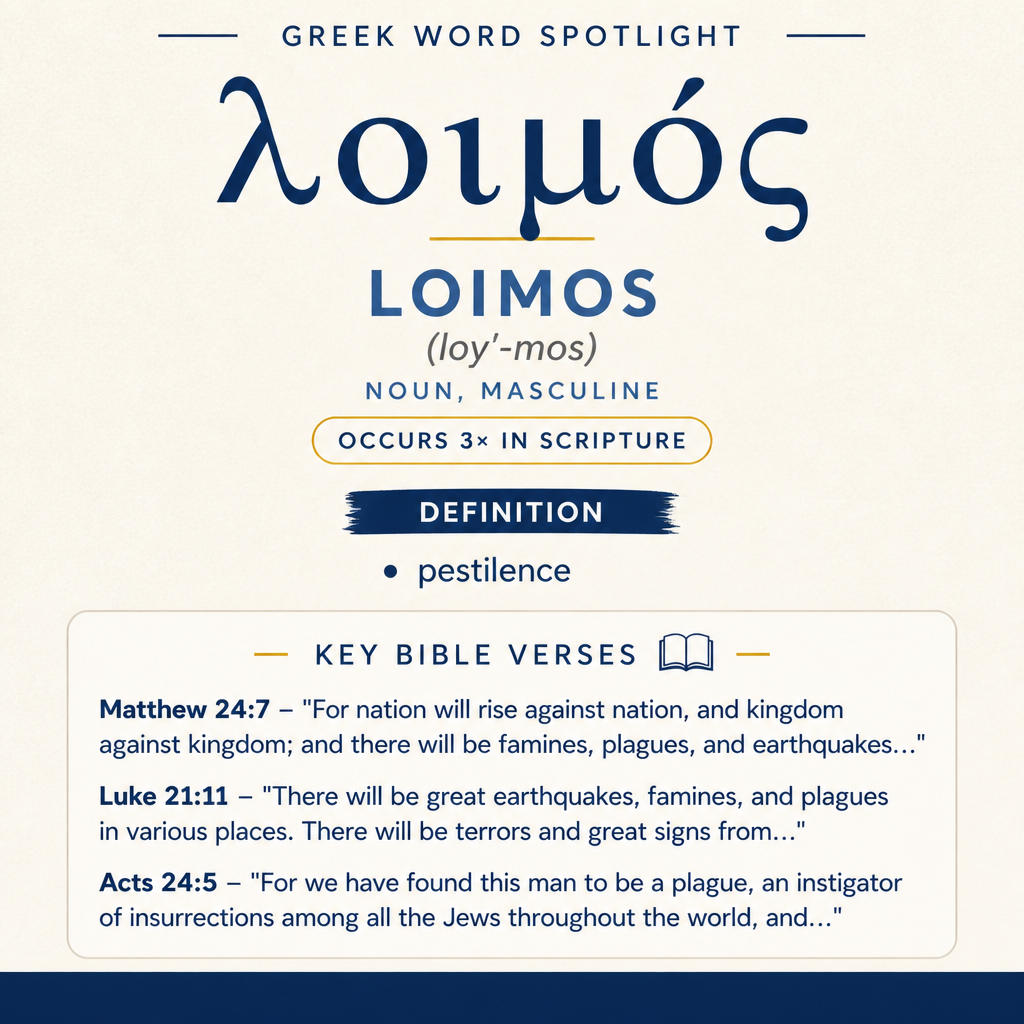
λοιμός (Loimos) means “pestilence” and appears three times in Scripture: Matthew 24:7, Luke 21:11, and Acts 24:5.
Core Meaning
λοιμός means “pestilence,” translated as “plagues” in Matthew 24:7 and Luke 21:11.
Learn More →Gospel Context
In Matthew 24:7 and Luke 21:11, λοιμός is listed alongside famines and earthquakes.
Learn More →λοιμός denotes “pestilence.” It appears in Jesus’ eschatological warnings where it stands alongside other wide-ranging calamities, and it also appears in courtroom speech as a pointed label applied to a person.
Occurrences
“For nation will rise against nation, and kingdom against kingdom; and there will be famines, plagues, and earthquakes in various places.” (Matthew 24:7)
Here λοιμός names one of several disruptions that are portrayed as affecting many places rather than being confined to a single locale. The wording places “plagues” in a list framed by conflict (“nation will rise against nation, and kingdom against kingdom”) and by large-scale distress (“famines… and earthquakes”), so λοιμός contributes the idea of a sweeping affliction that belongs to the same horizon of public upheaval. The plural “plagues” presents pestilence not as an isolated episode but as recurrent or multiple instances, and the phrase “in various places” ties the term to a geographically scattered pattern of suffering. In the flow of the sentence, λοιμός functions as a concrete marker of instability in ordinary life: not merely political turmoil and not merely environmental disturbance, but a harmful outbreak that strikes populations.

“There will be great earthquakes, famines, and plagues in various places. There will be terrors and great signs from heaven.” (Luke 21:11)
In this parallel warning, λοιμός again occurs in the plural and again with “in various places,” reinforcing the portrayal of pestilence as something that can break out across multiple settings. Luke’s sentence structure gives the term a clear place in a sequence: first, a triad of calamities experienced on earth (“great earthquakes, famines, and plagues”), then a second set of phenomena described as “terrors and great signs from heaven.” Within that arrangement, λοιμός belongs to the tangible, societal sphere of distress—events that affect bodies and communities—before the saying turns to fear-inducing and heavenly signs. The adjective “great” modifies “earthquakes,” but even without a direct modifier, “plagues” shares the weight of the list: they are part of the kind of events that make the period recognizable as extraordinary. The term thus helps form the texture of the warning by naming pestilence as one of the public crises that people can encounter in daily life across many regions.
“For we have found this man to be a plague, an instigator of insurrections among all the Jews throughout the world, and a ringleader of the sect of the Nazarenes.” (Acts 24:5)
In Acts, λοιμός is used in a sharply rhetorical way: it is applied to “this man” as a character judgment within an accusation. The sentence sets up three descriptions: “a plague,” “an instigator of insurrections… throughout the world,” and “a ringleader of the sect of the Nazarenes.” Calling someone “a plague” frames him as a harmful presence, and in this setting it functions as a kind of verbal indictment that prepares the hearer to accept the subsequent claims of widespread disruption. The charge “throughout the world” echoes the expansive scope heard in the Gospel occurrences (“in various places”), but now the spread is attributed to a person’s influence rather than to outbreaks among populations. Within this legal and political context, λοιμός is not presented as an event that happens to societies; it becomes a label meant to stigmatize the accused as if he himself were an affliction that threatens the social body.

Sense and Usage
The three occurrences display two distinct but connected ways the word functions while staying within its core sense of pestilence. In Matthew 24:7 and Luke 21:11, λοιμός appears in the plural and is coordinated with “famines” and “earthquakes.” This coordination gives the term a place among major, visible crises that affect communities broadly. In both Gospel sayings, the phrase “in various places” attaches to the cluster and turns the reader’s attention to distribution and recurrence: pestilence is imagined as something that can arise here and there, contributing to a landscape of instability that is not confined to one city or region.
Luke 21:11 adds a contrast that helps sharpen how pestilence is being conceptualized. “Great earthquakes, famines, and plagues” occupy the first sentence, while “terrors and great signs from heaven” occupy the second. The result is a pairing of terrestrial distress with awe-inducing phenomena; λοιμός sits firmly on the side of concrete suffering within human societies. Even without elaboration on symptoms or causes, the term carries an implied social dimension: pestilence is the kind of calamity that does not remain private. It belongs to the same category of events as famine and earthquake—crises that become shared public realities, affecting multiple people at once and shaping the atmosphere of an entire region.
Acts 24:5 demonstrates how a word with a concrete reference can be extended into a forceful metaphor in polemical speech. The accuser’s sequence moves from the label (“a plague”) to alleged effects (“an instigator of insurrections… throughout the world”) and then to alleged leadership (“a ringleader…”). In that rhetorical pattern, λοιμός functions as an opening characterization that casts the accused as intrinsically harmful, preparing the audience to hear his activities as contagious or damaging to the wider community. The word’s power in this setting lies in its ability to compress a whole verdict into a single noun: it implies that the person is not merely mistaken but dangerous, like an affliction that spreads and harms. Thus, the term’s semantic value in Acts is not to report an outbreak but to intensify accusation by borrowing the public dread and social disruption associated with pestilence.
Taken together, these passages show λοιμός operating on two levels: as a named calamity among other large-scale disasters, and as a stigmatizing label for a person accused of stirring unrest. The Gospel uses emphasize breadth (“in various places”) and plurality (“plagues”), depicting pestilence as one of several public shocks that can occur across the world’s many regions. The Acts use emphasizes personal blame and social threat, portraying one man as if he were a pestilence—an affliction in human form—within an adversarial setting where language is used to persuade.
Imagery
In the Gospel warnings, λοιμός contributes to a stark picture of repeated crises arriving across many places: along with famine and earthquakes, it evokes conditions that unsettle the routines of communities and make ordinary life feel precarious. In Acts 24:5, the imagery shifts from events to accusation: the word becomes a verbal weapon that frames the accused as a dangerous source of harm within society, setting a tone of alarm before the details of the charge are spelled out.
Sources: Lexical data from Strong’s Exhaustive Concordance and the Translators Brief Lexicon of Extended Strongs for Greek (STEPBible, CC BY). Occurrence data from the Translators Amalgamated Greek New Testament (STEPBible, CC BY). Scripture quotations from the World English Bible (public domain).