
Exploring the Meaning of Loidoreo in Greek
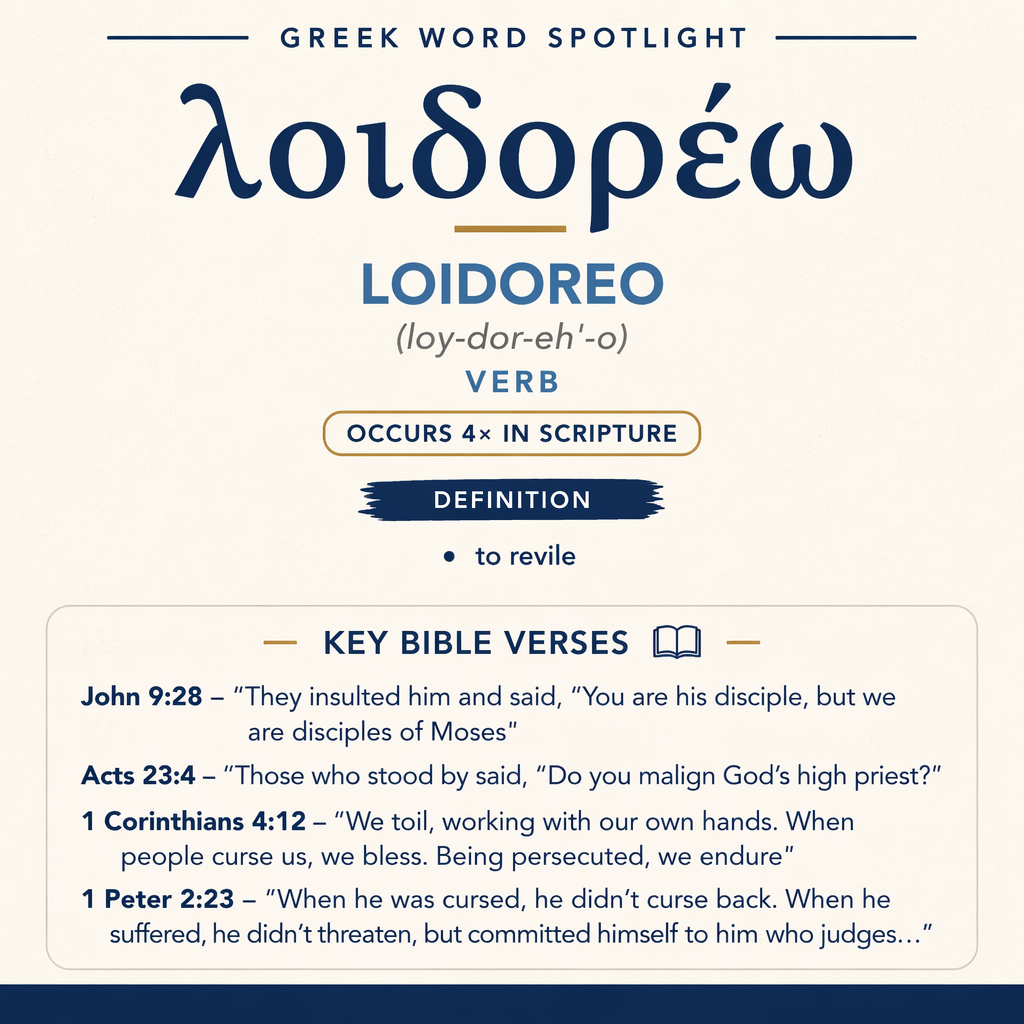
λοιδορέω means “to revile” and appears four times in Scripture: John 9:28; Acts 23:4; 1 Corinthians 4:12; 1 Peter 2:23.
Core Meaning
λοιδορέω means “to revile.” In its occurrences, it describes hostile speech such as insulting, maligning, or cursing.
Learn More →Scripture Occurrences
John 9:28 uses it of insulting the healed man. Acts 23:4 uses it in the charge, “Do you malign God’s high priest?”
Learn More →Response to Reviling
1 Corinthians 4:12 contrasts being cursed with blessing in return. 1 Peter 2:23 notes that Jesus did not curse back when cursed.
Learn More →λοιδορέω expresses the act of reviling—directed verbal abuse that treats its target with contempt. In the New Testament it appears in scenes of conflict and testing, where speakers use speech to shame, discredit, or wound, and where the response to such speech becomes morally revealing.
Root and Related Words
λοιδορέω corresponds to the related word loidoros (λοίδορος), “reviler” (Strong’s G3060), describing a person characterized by reviling speech.

Occurrences
John 9:28: “They insulted him and said, “You are his disciple, but we are disciples of Moses.”
Here the verb is the hostile speech-act that frames the interrogators’ dismissal of the healed man. The quoted words show how the reviling functions: it is not merely disagreement but an attempt to shame him by labeling his allegiance (“You are his disciple”) and contrasting it with their own claim to authority (“we are disciples of Moses”). In this setting, λοιδορέω marks a move from investigation to intimidation, using insult to delegitimize the man’s testimony and to pressure him into social and religious isolation.

Acts 23:4: “Those who stood by said, “Do you malign God’s high priest?””
In this courtroom-like moment, the verb appears as an accusation about speech directed toward a recognized office: “God’s high priest.” The bystanders’ question treats such words as an offense not only against an individual but against the sanctity implied by the title. λοιδορέω therefore carries the force of public dishonor—language that crosses a boundary of respect expected in a formal, religiously charged setting. The reaction (“Do you malign…?”) shows that the community present can police speech as a moral and procedural issue, not merely a personal quarrel.
1 Corinthians 4:12: “We toil, working with our own hands. When people curse us, we bless. Being persecuted, we endure.”
In Paul’s first-person plural account of apostolic life, the verb is part of a triad of pressures: verbal hostility (“curse”), active opposition (“persecuted”), and the demand for resilience (“we endure”). The reviling is portrayed as something done “to us,” a recurring experience that accompanies labor and lowliness (“working with our own hands”). The crucial contribution of λοιδορέω in this line is the contrast it enables: the apostles answer abusive speech with a contrary form of speech—“we bless.” The verb thus highlights the ethical test embedded in verbal attack: it provokes a response, and the response is presented as deliberate and shaped by conviction rather than reflex.
1 Peter 2:23: “When he was cursed, he didn’t curse back. When he suffered, he didn’t threaten, but committed himself to him who judges righteously.”
This occurrence places reviling alongside suffering and threats, weaving speech and violence into a single portrait of mistreatment. The first clause sets the scene: he is the object of abusive words (“When he was cursed”), yet his response refuses symmetry (“he didn’t curse back”). The second clause parallels it: suffering could tempt retaliation (“he didn’t threaten”), but instead he entrusts himself to divine judgment (“committed himself to him who judges righteously”). Here λοιδορέω serves to identify verbal abuse as a real form of harm—something endured—while also spotlighting restraint as a purposeful act. The refusal to answer reviling with reviling becomes part of the passage’s larger emphasis on entrusting justice to the right judge rather than seizing it through speech.
Sense and Usage
Across these passages, λοιδορέω consistently names reviling as a relational weapon: speech used to diminish a person, undermine credibility, or assert dominance. In John 9:28, it is a tactic of social control; the insult is coupled with identity labeling (“disciple”) and an appeal to recognized tradition (“Moses”), suggesting that reviling often rides on claims of authority. In Acts 23:4, the same kind of speech is framed as an actionable breach—words that violate communal expectations of honor toward an office. In 1 Corinthians 4:12 and 1 Peter 2:23, the verb is set within patterns of opposition, showing reviling as one strand in a wider net of hostility that can include persecution and suffering.
These contexts also show that the significance of reviling is not confined to the attacker’s intent; it is measured by the response it elicits or fails to elicit. Paul’s line, “When people curse us, we bless,” treats reviling as a predictable pressure point that can either escalate conflict or be met with a different kind of speech. Likewise, “he didn’t curse back… he didn’t threaten” portrays restraint not as silence but as a chosen refusal to mirror the aggressor’s mode of speech. In both texts, the verb helps define an ethical contrast: reviling aims to provoke, but the righteous response is described as endurance, blessing, and entrusting judgment to God.
Finally, the occurrences suggest that reviling can be public and socially consequential. The insult in John is delivered by a group (“They insulted him”), and the rebuke in Acts comes from “Those who stood by,” implying an audience that recognizes and reacts to the speech. λοιδορέω therefore often functions in communal spaces—interrogation, assembly, public dispute—where words do more than express emotion; they shape reputations, standings, and perceived legitimacy.
Imagery in Context
The passages give reviling a concrete verbal shape: an insult spoken in a dispute (“They insulted him”), a charge of maligning an official (“Do you malign God’s high priest?”), and curses hurled at the faithful (“When people curse us”). Alongside these, the same texts set opposing images of speech: “we bless,” and “he didn’t curse back… he didn’t threaten.” The imagery is therefore not only of harsh words thrown like blows, but of restrained speech that refuses retaliation and instead yields the final verdict to “him who judges righteously.”
Sources: Lexical data from Strong’s Exhaustive Concordance and the Translators Brief Lexicon of Extended Strongs for Greek (STEPBible, CC BY). Occurrence data from the Translators Amalgamated Greek New Testament (STEPBible, CC BY). Scripture quotations from the World English Bible (public domain).




