Exploring the Meaning of Krauge in Greek
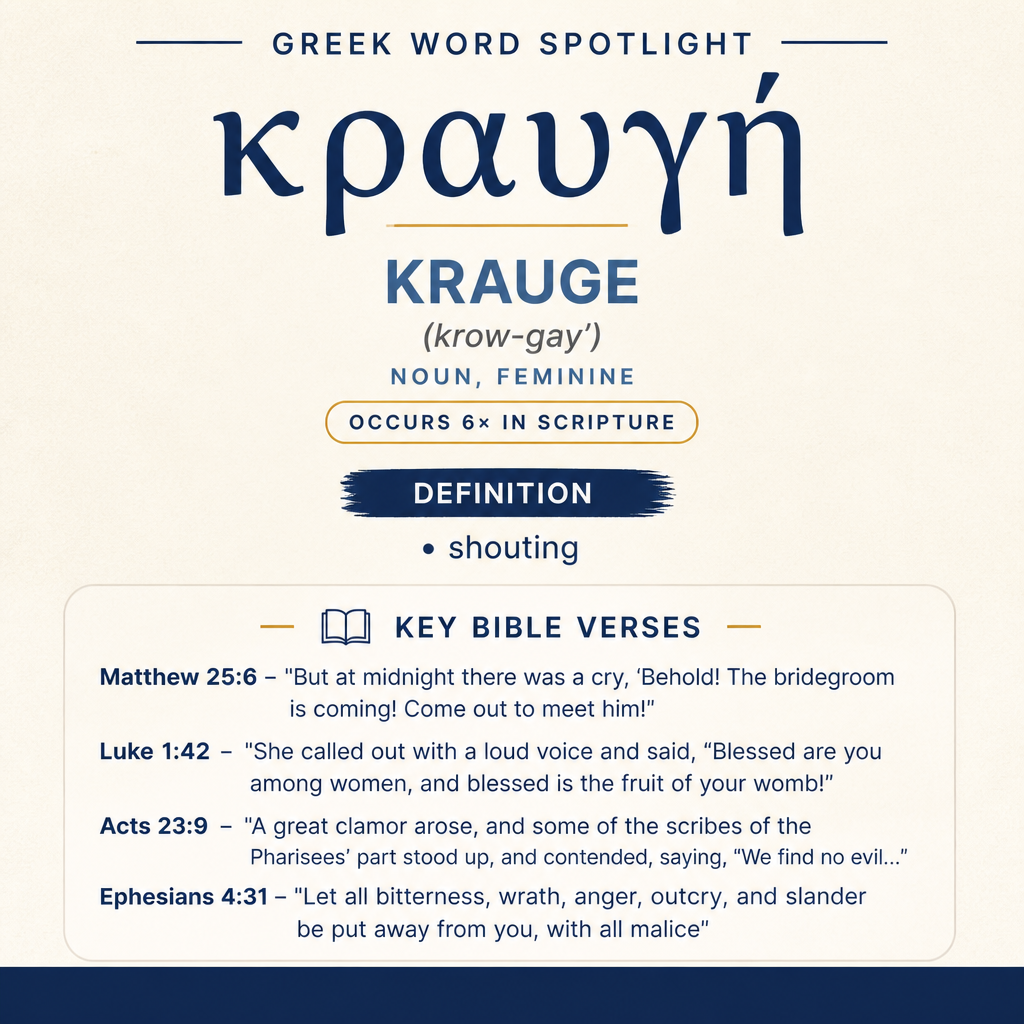
κραυγή means “shouting” and occurs 6 times in Scripture, including Matthew 25:6, Luke 1:42, Acts 23:9, Ephesians 4:31, Hebrews 5:7, and Revelation 21:4.
Core Meaning
κραυγή is defined as “shouting.” It describes a raised cry or outcry in the cited passages.
Learn More →Narrative Scenes
It appears in events like the midnight cry announcing the bridegroom (Matthew 25:6) and Elizabeth’s loud call (Luke 1:42). It also names the great clamor in Acts 23:9.
Learn More →Ethical & Future
Believers are told to put away “outcry” in Ephesians 4:31. In Revelation 21:4, “crying” is among the things that will be no more.
Learn More →κραυγή expresses a shouted cry—an audible outburst that breaks into a scene with force. Across the passages where it appears, it can announce urgent news, intensify blessing or dispute, describe spiritual agony, mark harmful speech to be removed, and name a kind of distress that will finally disappear.
Occurrences
Matthew 25:6 — “But at midnight there was a cry, ‘Behold! The bridegroom is coming! Come out to meet him!’”
Here κραυγή is the sudden public shout that interrupts the stillness of “midnight.” The content of the cry is an announcement (“Behold! The bridegroom is coming!”) paired with a command (“Come out to meet him!”). In this setting, the word carries the idea of an alarm-like summons: not a quiet report but a loud proclamation that calls hearers into immediate action, turning information into an event that demands response.
Luke 1:42 — “She called out with a loud voice and said, “Blessed are you among women, and blessed is the fruit of your womb!”
In this scene, κραυγή belongs to joyful speech that bursts out “with a loud voice.” The shout introduces a spoken blessing and frames it as something publicly voiced rather than privately thought. The word contributes the sense of overflowing expression: the blessing is not delivered in a measured tone but as an audible outcry that matches the weight of what is being said.
Acts 23:9 — “A great clamor arose, and some of the scribes of the Pharisees’ part stood up, and contended, saying, “We find no evil in this man. But if a spirit or angel has spoken to him, let’s not fight against God!””
Here κραυγή is the “great clamor” that rises in a contentious setting. The verse portrays escalation: noise swells, a group “stood up,” and they “contended.” The shout is not merely volume; it is the audible sign of conflict spilling into the open, accompanying vigorous argument and factional response. The word thus marks the atmosphere of a dispute that has become loud and hard to contain.
Ephesians 4:31 — “Let all bitterness, wrath, anger, outcry, and slander be put away from you, with all malice.”
In this list, κραυγή (“outcry”) is grouped with dispositions and expressions that fracture community life: “bitterness, wrath, anger… slander… malice.” The word points to a kind of shouting that belongs with hostile emotional heat and harmful speech. The instruction “be put away from you” treats such shouting as something to be removed, not indulged—suggesting that the cry in view is a noisy eruption tied to resentment and verbal harm.
Hebrews 5:7 — “He, in the days of his flesh, having offered up prayers and petitions with strong crying and tears to him who was able to save him from death, and having been heard for his godly fear,”
Here κραυγή appears in a solemn register: “strong crying and tears” accompany “prayers and petitions.” The cry is integrated with supplication directed “to him who was able to save him from death.” In this verse, shouting is not argumentative or abusive; it is the vocal intensity of pleading in distress. The pairing with “tears” gives the cry a bodily immediacy, and the description “strong” underscores that this is not mild emotion but strenuous, urgent expression within prayer.
Revelation 21:4 — “He will wipe away every tear from their eyes. Death will be no more; neither will there be mourning, nor crying, nor pain, any more. The first things have passed away.”
Here κραυγή (“crying”) is named as one of the bitter features of the former order of life—set beside “mourning” and “pain.” The promise is not merely that people will restrain their voices, but that the realities which generate such cries will no longer produce them: “Death will be no more.” The word functions as a shorthand for audible human distress, the kind of crying that belongs to a world marked by loss and suffering, now declared finished.

Sense and Usage
Across these texts, κραυγή consistently denotes shouting as a recognizable vocal event—something heard, often shared, and capable of shaping the moment. In Matthew 25:6 it is the public announcement that gathers people; the shout carries news into the open and makes it urgent. In Luke 1:42 the shout intensifies a blessing; it is praise voiced with volume, as though quiet speech would be too small for the content.
Acts 23:9 shows how shouting can be the sound-track of conflict: a “clamor” that rises when people contend. The word fits a crowd setting where speech becomes loud enough to be described as a collective outcry, not simply individual speaking. Ephesians 4:31 then places shouting on the moral plane, treating “outcry” as one of several behaviors and speech-forms that belong with anger and malice. The word therefore can describe not only the fact of loudness but the social effect of loud, heated expression—something that harms rather than helps when it becomes a vehicle for bitterness and slander.
Hebrews 5:7 shows another side: shouting can also be the language of desperate prayer. The verse binds vocal intensity (“strong crying”) to “prayers and petitions,” locating κραυγή within devotion under pressure. The word’s value here is its realism: prayer can include not only words but the raised voice of grief and urgency, accompanied by tears. Revelation 21:4 finally uses the term in a comprehensive promise: “crying” names a kind of human suffering made audible, grouped with mourning and pain. In that vision, the end of crying signals a transformation of conditions—an end to the causes that make such shouts of distress necessary.
Taken together, these occurrences show how shouting can announce, bless, dispute, wound, plead, and lament. The contexts specify the moral and emotional coloring: the same kind of vocal outburst can be fitting (a loud blessing), destructive (outcry tied to anger and slander), or anguished (strong crying with tears). Even when the word is used negatively, it still describes something concrete and audible: an eruption of the voice that others can hear and that affects the community around it.
Imagery
The passages collectively paint κραυγή as a sound that fills space and reveals what is happening inside a moment. At midnight it becomes a summons that wakes and gathers; in a house it becomes a blessing that spills out loudly; in an assembly it becomes clamor as people contend; in instruction it becomes a practice to put away; in prayer it becomes strong crying with tears; and at the end it becomes one of the former things—named, remembered, and then removed when “Death will be no more.”
Sources: Lexical data from Strong’s Exhaustive Concordance and the Translators Brief Lexicon of Extended Strongs for Greek (STEPBible, CC BY). Occurrence data from the Translators Amalgamated Greek New Testament (STEPBible, CC BY). Scripture quotations from the World English Bible (public domain).