
Exploring the Meaning of Krateo in Greek
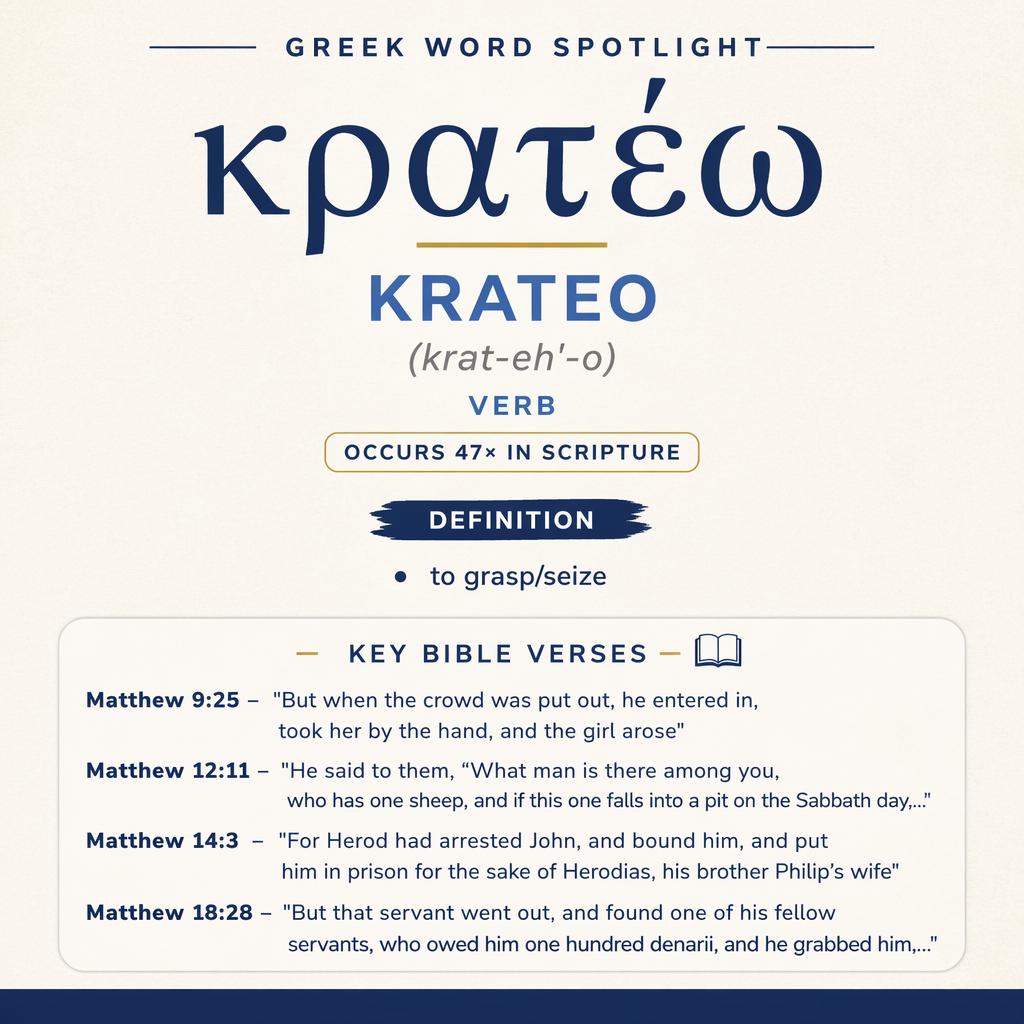
κρατέω means “to grasp/seize” and appears 47 times in Scripture, including Matthew 9:25; 12:11; 14:3; 18:28; 21:46; 22:6; 26:4; 26:48.
Core Meaning
κρατέω means “to grasp/seize.” In Matthew it is used for taking hold of someone, including by the hand.
Learn More →Matthew Examples
It appears in Matthew in scenes of arrest or restraint (Matthew 14:3; 26:48). It also describes grabbing or seizing in conflict (Matthew 18:28; 21:46; 22:6).
Learn More →Scripture Frequency
κρατέω occurs 47 times in Scripture. The listed occurrences include multiple uses across Matthew 9–26.
Learn More →κρατέω expresses a forceful, deliberate taking—grasping or seizing—in scenes that range from healing touch to arrest and violence. In the passages below it marks moments where someone exerts control by taking hold of a person, an animal, or even a body part in a way that changes what happens next.
Occurrences
Matthew 9:25 But when the crowd was put out, he entered in, took her by the hand, and the girl arose.
Here the verb describes a direct physical grasp: Jesus “took her by the hand.” The grasp is not incidental; it is the decisive action that accompanies the girl’s rising. The scene portrays taking hold as personal contact that initiates a reversal—from deathlike stillness to standing up.
Matthew 12:11 He said to them, “What man is there among you, who has one sheep, and if this one falls into a pit on the Sabbath day, won’t he grab on to it, and lift it out?
In this rhetorical question, the verb depicts a practical rescue grip: grabbing a sheep that has fallen into a pit. The grasp is paired with “lift it out,” so the seizing is the necessary first step for removal from danger. The action is portrayed as ordinary and instinctive—what someone naturally does when a valuable creature is trapped.
Matthew 14:3 For Herod had arrested John, and bound him, and put him in prison for the sake of Herodias, his brother Philip’s wife.
Here the verb is translated “arrested,” framing seizing as an act of authority and constraint. The sequence that follows—“bound him, and put him in prison”—shows what this taking hold leads to: John’s movement is controlled, and his freedom is removed. The grasp is institutionalized: the moment of seizure becomes custody.
Matthew 18:28 “But that servant went out, and found one of his fellow servants, who owed him one hundred denarii, and he grabbed him, and took him by the throat, saying, ‘Pay me what you owe!’
The verb describes aggressive seizure. The servant “grabbed him” and intensifies it by “took him by the throat,” using physical force to demand payment. In this scene, taking hold functions as coercion: the grip becomes a means of extracting what is owed, with the body (the throat) turned into a point of pressure.
Matthew 21:46 When they sought to seize him, they feared the multitudes, because they considered him to be a prophet.
“Sought to seize him” portrays an intended act of force that is not carried out because of fear. The verb highlights the contrast between desire and restraint: the leaders’ aim is to take hold of Jesus, yet the presence of “the multitudes” prevents the act. Seizing here is a public risk, checked by the crowd’s opinion of Jesus as “a prophet.”
Matthew 22:6 and the rest grabbed his servants, and treated them shamefully, and killed them.
The verb marks the initial move in escalating violence. The servants are first “grabbed,” then “treated… shamefully,” then “killed.” The seizure is the opening physical domination that enables the subsequent abuse; it is the transition from refusal to active harm.
Matthew 26:4 They took counsel together that they might take Jesus by deceit, and kill him.
This occurrence links taking hold to planning and deception. The verb is set alongside “by deceit” and “kill him,” so the seizure envisioned is not a spontaneous arrest but a calculated capture. The grasp is something to be engineered—an act requiring strategy to secure the desired outcome.
Matthew 26:48 Now he who betrayed him gave them a sign, saying, “Whoever I kiss, he is the one. Seize him.”
The command “Seize him” makes the verb a direct order. The kiss functions as identification, and the seizure is the immediate response expected from the group. The word thus carries the urgency of coordinated action: once the right person is marked out, hands are to be laid upon him.
Matthew 26:50 Jesus said to him, “Friend, why are you here?” Then they came and laid hands on Jesus, and took him.
Here the verb is the culmination of “laid hands on Jesus”: the physical contact becomes an effective taking. The wording portrays a collective action (“they came”) resulting in Jesus being controlled and removed. The seizure is presented plainly, without embellishment, as the moment Jesus is physically overtaken.
Matthew 26:55 In that hour Jesus said to the multitudes, “Have you come out as against a robber with swords and clubs to seize me? I sat daily in the temple teaching, and you didn’t arrest me.
Jesus contrasts the manner of their approach with his public presence. “With swords and clubs to seize me” emphasizes a forceful, weapon-backed taking, as if he were dangerous. The same verb underlies “arrest me,” so the point is not only that they did not take him earlier, but that their present seizure is framed as an armed operation rather than a straightforward public apprehension.
Matthew 26:57 Those who had taken Jesus led him away to Caiaphas the high priest, where the scribes and the elders were gathered together.
“Those who had taken Jesus” identifies the group by the act of seizure they have completed. The taking is not an isolated event; it establishes custody that enables the next action: “led him away.” The verb thus marks transfer of control—Jesus is now in the hands of others who direct his movement toward an assembled council.
Matthew 28:9 As they went to tell his disciples, behold, Jesus met them, saying, “Rejoice!” They came and took hold of his feet, and worshiped him.
In this final scene the verb portrays a different kind of grasp: “took hold of his feet” as an act joined with worship. The taking is still physical and intentional, but it is not coercive; it is reverent closeness. The feet, a low and humble point of contact, underscore the posture implied by worship, while the grasp conveys immediacy and certainty—holding on to the one who meets them alive.

Sense and Usage
Across these passages κρατέω consistently depicts taking hold as an exertion of control that has consequences. In Matthew 9:25 and 28:9, the grasp is relational and bodily: a hand taken that accompanies rising, and feet held in worship. Both scenes show a grip that does not harm; it secures connection at moments of profound change—life restored and Jesus encountered.
In Matthew 12:11 the verb belongs to the world of ordinary physical effort: a rescue hold on a sheep in a pit. The grasp is purposeful and directed toward lifting; it is not merely contact but an action that enables removal from a threatening place.
Most occurrences cluster around conflict, where taking hold becomes a tool of domination. Matthew 14:3 shows seizure as the first move of imprisonment, followed by binding and confinement. Matthew 18:28 portrays a grasp that escalates into choking—a grip applied to force compliance. Matthew 22:6 similarly makes seizure the opening act that allows humiliation and murder. In these scenes, the verb highlights how physical control over another person can be used to inflict, coerce, and destroy.
In Matthew 21:46 and 26:4 the verb also operates at the level of intention and planning. To “seek to seize” is to aim at taking hold but be prevented by circumstances, and to “take… by deceit” portrays seizure as something arranged through hidden means. The word can therefore mark not only the moment hands close, but the goal that drives plotting and the calculation behind it.
Matthew 26:48–57 presents a chain in which identification leads to command, command to physical contact, contact to custody, and custody to being led away. The verb sits at the center of that chain: it is the pivot from suspicion and pursuit into actual possession of the person. Even when “laid hands on Jesus” is stated, the verb confirms the outcome—he is taken, and those who took him now direct him.
Imagery
The word’s imagery in these passages is tactile: hand, throat, and feet are places where grasping becomes visible and concrete. Whether the grip is rescue from a pit, coercion for debt, the force of arrest, or the clinging of worship, κρατέω depicts decisive moments when a situation turns because someone takes hold.
Sources: Lexical data from Strong’s Exhaustive Concordance and the Translators Brief Lexicon of Extended Strongs for Greek (STEPBible, CC BY). Occurrence data from the Translators Amalgamated Greek New Testament (STEPBible, CC BY). Scripture quotations from the World English Bible (public domain).




