
Exploring the Meaning of Kraugazo in Greek
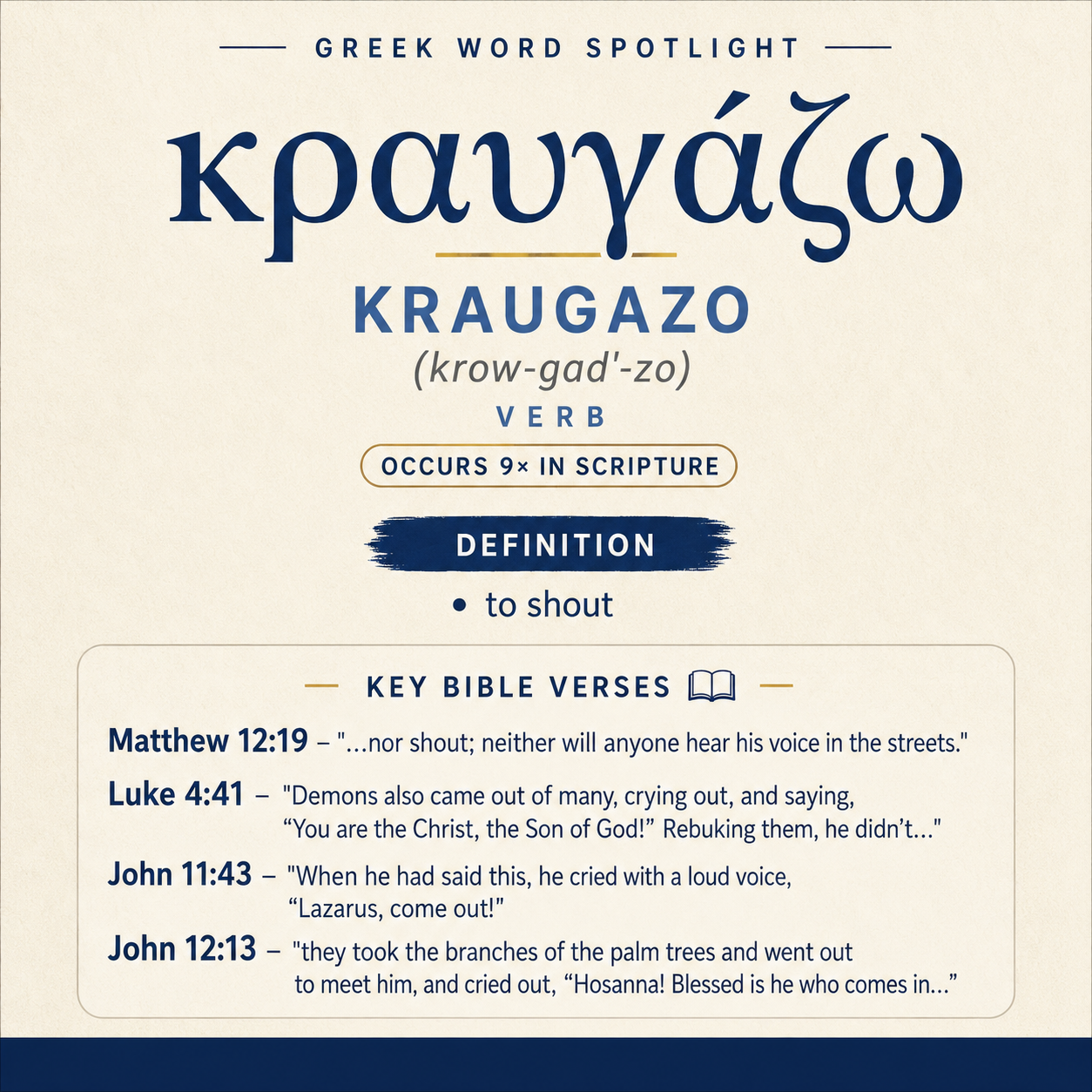
κραυγάζω means “to shout” and occurs 9 times in Scripture, including Matthew 12:19; Luke 4:41; and multiple passages in John.
Core Meaning
κραυγάζω is defined as “to shout.” In John 11:43 it describes a loud cry: “Lazarus, come out!”.
Learn More →Gospel Occurrences
It appears in Matthew 12:19 and Luke 4:41. It also occurs repeatedly in John (11:43; 12:13; 18:40; 19:6, 19:12, 19:15).
Learn More →Shouted Words
It introduces cries like “Hosanna!” (John 12:13) and demands like “Crucify! Crucify!” (John 19:6). In Luke 4:41 demons cry out, “You are the Christ, the Son of God!”.
Learn More →κραυγάζω expresses the act of shouting, a raised voice that breaks into public space and demands to be heard. In the passages where it appears, it covers both spontaneous acclamation and hostile outcry, as well as urgent speech directed toward Jesus or issued by him.
Occurrences
Matthew 12:19 — “He will not strive, nor shout; neither will anyone hear his voice in the streets.”
Here κραυγάζω is placed in a denial: the figure in view is characterized by the absence of shouting. The line contrasts noisy public contention (“strive”) with a quieter presence whose voice is not projected into “the streets.” In this setting, shouting is the audible marker of public dispute and self-assertion, and the verse defines the figure’s manner by excluding it.
Luke 4:41 — “Demons also came out of many, crying out, and saying, “You are the Christ, the Son of God!” Rebuking them, he didn’t allow them to speak, because they knew that he was the Christ.”
In Luke’s scene, κραυγάζω is the demons’ loud eruption as they exit “many.” Their shouting is immediately paired with direct speech—an explicit identification: “You are the Christ, the Son of God!” The narrative then frames this shouted confession as something Jesus restrains: he rebukes them and “didn’t allow them to speak.” The shouting thus functions as an uncontrolled proclamation that presses into the open, even when the speaker is silenced afterward.
John 11:43 — “When he had said this, he cried with a loud voice, “Lazarus, come out!””
John intensifies the verb by adding “with a loud voice,” presenting κραυγάζω as a deliberate, forceful command. The shout is not mere noise but a targeted address—“Lazarus, come out!”—aimed at producing a response. In this context, shouting marks the public, unmistakable audibility of Jesus’ call, a voice projected so that the summons is clear and authoritative within the scene.
John 12:13 — “they took the branches of the palm trees and went out to meet him, and cried out, “Hosanna! Blessed is he who comes in the name of the Lord, the King of Israel!””
Here κραυγάζω is the crowd’s acclamation as they “went out to meet him” with palm branches. The shouted words are celebratory and formulaic, piling titles and blessing into a public welcome: “Hosanna! Blessed is he who comes… the King of Israel!” Shouting is the vehicle for communal acclaim, turning the approach to Jesus into a loud, shared event rather than a private greeting.
John 18:40 — “Then they all shouted again, saying, “Not this man, but Barabbas!” Now Barabbas was a robber.”
In the courtroom-like tension of John 18, κραυγάζω is collective insistence: “they all shouted again.” The content of the shout is a demand framed as a choice—“Not this man, but Barabbas!”—and the note about Barabbas (“a robber”) sharpens the moral contrast within the narrative without changing the function of the verb. Shouting here signals pressure from the group, a loud refusal that seeks to drive the decision.
John 19:6 — “When therefore the chief priests and the officers saw him, they shouted, saying, “Crucify! Crucify!” Pilate said to them, “Take him yourselves, and crucify him, for I find no basis for a charge against him.””
κραυγάζω in John 19:6 is the shouted chant of accusation and desired outcome: “Crucify! Crucify!” The scene names the specific agents—“the chief priests and the officers”—and places their shout in immediate confrontation with Pilate’s response. The shout functions as an attempted verdict rendered by volume and repetition, pressing for an execution even as Pilate voices dissent: “I find no basis for a charge against him.”
John 19:12 — “At this, Pilate was seeking to release him, but the Jews cried out, saying, “If you release this man, you aren’t Caesar’s friend! Everyone who makes himself a king speaks against Caesar!””
Here shouting is strategic escalation. As Pilate “was seeking to release him,” the crowd’s κραυγάζω introduces a political threat: “you aren’t Caesar’s friend!” The shouted argument adds a generalizing maxim—“Everyone who makes himself a king speaks against Caesar!”—designed to trap the judge. The shout therefore serves not only as loudness but as public leverage: a forceful accusation meant to sway an official decision through the fear of disloyalty.
John 19:15 — “They cried out, “Away with him! Away with him! Crucify him!” Pilate said to them, “Shall I crucify your King?” The chief priests answered, “We have no king but Caesar!””
κραυγάζω here carries the sound of rejection and expulsion: “Away with him! Away with him!” followed by the repeated demand, “Crucify him!” The shouted words drive the scene forward into a stark exchange about kingship—Pilate’s “your King” versus the chief priests’ “We have no king but Caesar!” In this setting, shouting is the crowd’s means of asserting a public stance, turning the proceedings into a loud repudiation that leaves little space for deliberation.
Acts 22:23 — “As they cried out, threw off their cloaks, and threw dust into the air,”
In Acts, κραυγάζω is joined to visible gestures of agitation: throwing off cloaks and hurling dust upward. The verse portrays shouting as part of a larger eruption of disorder, where sound and movement reinforce each other. Even without the content of the words in this line, the shout functions as the audible sign of an inflamed crowd, matched by actions that intensify the public disturbance.

Sense and Usage
Across these occurrences, κραυγάζω consistently marks speech that is projected beyond normal conversation—voice made public, heightened, and hard to ignore. In Matthew 12:19, the significance lies in its negation: not shouting becomes a defining trait, suggesting that shouting belongs to the toolkit of public contention and self-display that this figure refuses. Luke 4:41 shows the verb attached to involuntary, disruptive disclosure: the shout bursts out with a confession and is then curtailed, so that loudness does not guarantee permission to speak. John 11:43 demonstrates shouting as purposeful command; the verb can describe a controlled, intentional raising of the voice when a decisive summons is given.
John’s Gospel then concentrates the verb in scenes where crowds and officials compete to shape an outcome by audibility. In John 12:13 the shout is celebratory acclaim, the loud chorus of welcome. In John 18:40 and throughout John 19 (vv. 6, 12, 15), the same kind of raised voice becomes a weapon of opposition: collective shouting expresses refusal (“Not this man”), demands punishment (“Crucify!”), and adds coercive argumentation (“you aren’t Caesar’s friend”). These scenes show how shouting can unify a group into a single audible force; the repeated, formula-like phrases (“Crucify! Crucify!”; “Away with him! Away with him!”) give the shout the shape of a chant, suited to sustaining pressure. Acts 22:23 extends the picture into civic unrest: shouting accompanies bodily displays that broadcast anger and intensify commotion. Taken together, the passages present κραυγάζω as a verb of heightened public voice—sometimes restrained, sometimes commanded, sometimes celebratory, and often mobilized to compel others.
Imagery
The repeated settings for κραυγάζω are open and public: “the streets” (Matthew 12:19), a place where voices carry; a crowd meeting someone in motion (John 12:13); a judicial scene where competing claims are voiced before an official (John 18:40; 19:6, 12, 15); and a volatile assembly whose shouting is matched by thrown cloaks and dust (Acts 22:23). Even when a single speaker is in view, the loud voice is staged to be unmistakable, as when Jesus “cried with a loud voice” (John 11:43). In these texts, shouting is not background sound; it is an audible act that defines the moment, either by being refused (Matthew), rebuked (Luke), or wielded to acclaim or to condemn (John, Acts).
Sources: Lexical data from Strong’s Exhaustive Concordance and the Translators Brief Lexicon of Extended Strongs for Greek (STEPBible, CC BY). Occurrence data from the Translators Amalgamated Greek New Testament (STEPBible, CC BY). Scripture quotations from the World English Bible (public domain).




