
Exploring the Meaning of Kraipale in Greek
κραιπάλη means dissipation and appears once in Scripture, in Luke 21:34.
Biblical Occurrence
This word occurs 1 time in Scripture. Its single occurrence is in Luke 21:34.
Learn More →Verse Context
In Luke 21:34 it appears in a warning about hearts being weighed down. The verse lists “carousing, drunkenness, and cares of this life.”
Learn More →κραιπάλη denotes “dissipation” and appears once in the New Testament, in Jesus’ warning discourse in Luke 21:34. There it stands alongside other pressures that can weigh on the inner life and leave a person unprepared for a decisive day that arrives suddenly.

Root and Related Words
Strong’s connects κραιπάλη with the verb harpazō (ἁρπάζω), “to seize” (Strong’s G726). In Luke 21:34 the noun functions as one of the forces that can take hold of the heart and weigh it down, matching the verse’s imagery of an inner condition being overtaken rather than kept watchful.

Occurrences
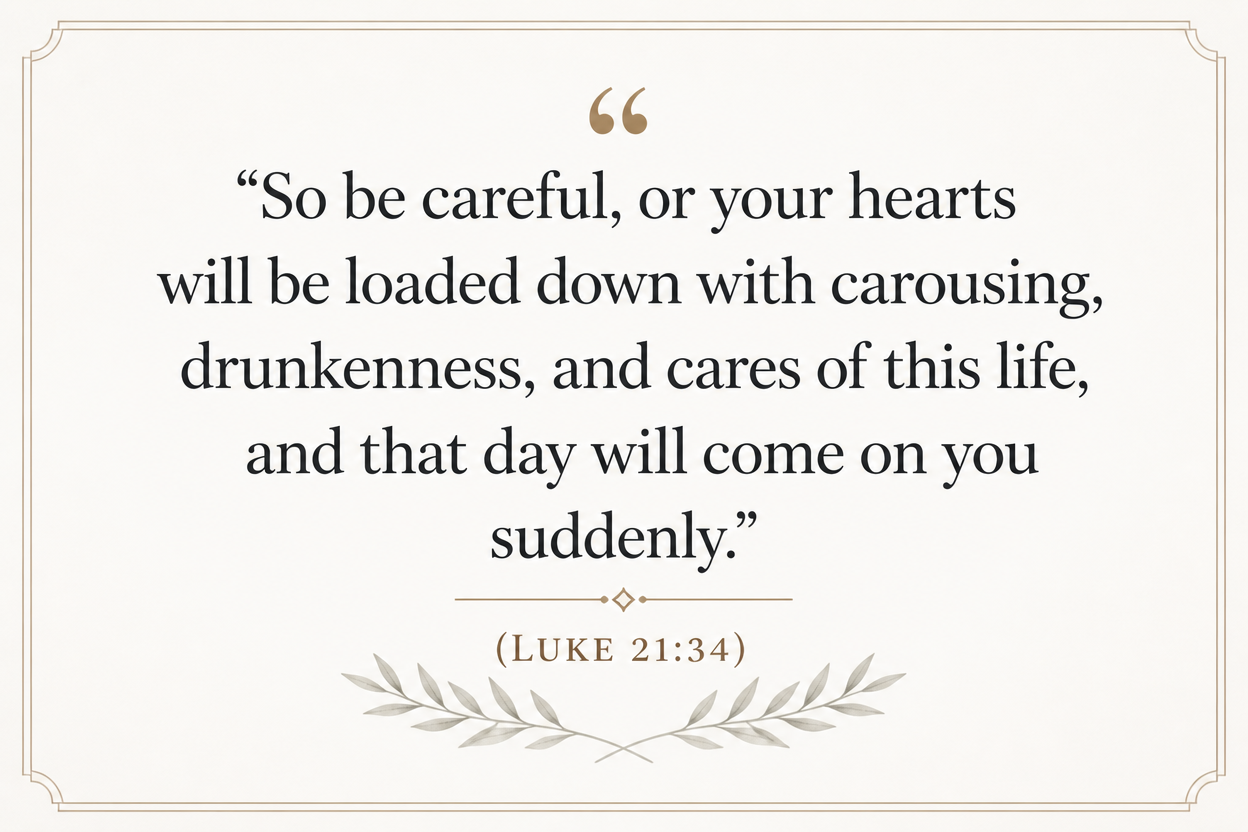
“So be careful, or your hearts will be loaded down with carousing, drunkenness, and cares of this life, and that day will come on you suddenly.” (Luke 21:34)
In this warning, κραιπάλη is rendered “carousing” and is placed first in a triad: “carousing, drunkenness, and cares of this life.” The sentence frames all three as weights that can “load down” the “hearts” of Jesus’ hearers. Within the logic of the verse, dissipation is not presented as a neutral pastime but as a burdening condition that affects alertness and readiness. The result described is practical and time-sensitive: when the heart is weighed down, “that day” does not merely arrive; it “will come on you suddenly.”
The immediate context inside the verse highlights the inner target (“your hearts”) and the cumulative effect (“loaded down”). κραιπάλη therefore contributes to a picture of moral and mental heaviness: something that presses on the center of attention, desire, and decision. It is paired with “drunkenness,” another form of impairment, and with “cares of this life,” which can be entirely ordinary yet still consuming. By grouping κραιπάλη with both intoxication and everyday anxieties, the saying presents dissipation as one among several pressures that can blunt watchfulness, whether through indulgence or distraction.
The verse also gives κραιπάλη an eschatological edge: the issue is not only the intrinsic disorder of dissipation but its timing and consequences. The warning “be careful” sets an active posture over against passivity, as though dissipation is a force that can gradually accumulate until the heart is “loaded down.” In that state, the person is exposed to sudden surprise when the decisive moment arrives.
Sense and Usage
The definition “dissipation” in Luke 21:34 is expressed through the metaphor of weight and surprise. Dissipation is treated as something that adds heaviness to the heart, not something that merely takes place externally. The phrase “loaded down” implies a diminishing capacity: when the heart carries such weight, it becomes less able to respond with clarity and readiness when circumstances change quickly.
Luke 21:34 gives several cues for how dissipation operates. First, it is listed with behaviors and concerns that share a common outcome—dulling attention. “Drunkenness” suggests impairment by excess; “cares of this life” suggests absorption in ordinary pressures; dissipation sits alongside them as another path to the same end: the heart becomes encumbered. The verse does not treat dissipation as a private matter with private effects. Instead, it is portrayed as shaping one’s stance toward “that day,” a future event that comes “suddenly.” Dissipation thus has a directional effect: it bends a person away from vigilant awareness and toward unpreparedness.
Second, dissipation is presented as a condition that can accumulate. The warning anticipates a gradual loading—an incremental burden—rather than a single, isolated act. This aligns with the verse’s emphasis on the heart’s state (“your hearts will be loaded down”), where the issue is not just outward action but the inward heaviness it produces. In this one occurrence, dissipation is therefore closely tied to the concept of being weighed down: it is a form of life that presses inwardly, making a person less responsive when the decisive moment arrives without warning.
Third, dissipation is one of multiple pressures, suggesting that watchfulness can be undermined from different directions. The juxtaposition of dissipation with “cares” broadens the warning beyond obviously reckless behavior and shows how the heart can be burdened by both indulgence and anxiety. In this setting, dissipation functions as a representative of a kind of living that loosens attentiveness and increases vulnerability to being caught off guard.
Imagery
Luke 21:34 attaches κραιπάλη to a vivid internal image: a heart weighed down like a body carrying an overload. Against that heaviness stands the suddenness of “that day,” which “will come on you suddenly.” Dissipation is thereby associated with sluggishness and surprise—an inner state that makes a person slow to perceive and slow to respond at the very moment when readiness matters most.
Sources: Lexical data from Strong’s Exhaustive Concordance and the Translators Brief Lexicon of Extended Strongs for Greek (STEPBible, CC BY). Occurrence data from the Translators Amalgamated Greek New Testament (STEPBible, CC BY). Scripture quotations from the World English Bible (public domain).




