
Exploring the Meaning of Krataios in Greek
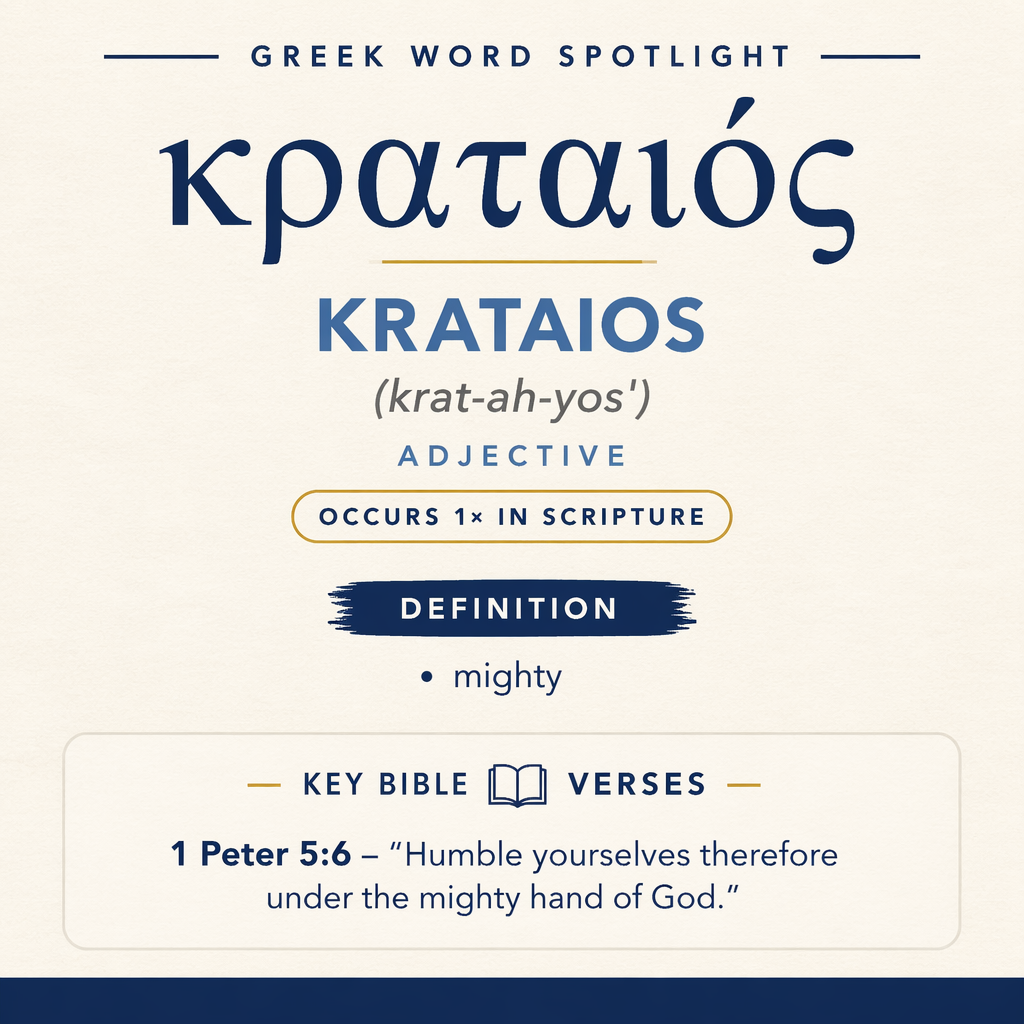
κραταιός means “mighty” and appears once in Scripture in 1 Peter 5:6.
Verse Context
In 1 Peter 5:6 it describes “the mighty hand of God” under which believers are to humble themselves.
Learn More →κραταιός means “mighty” and appears once in the New Testament, in the exhortation of 1 Peter 5:6. There it qualifies God’s “hand,” shaping the verse’s picture of God’s active strength in relation to humility and exaltation.
Root and Related Words
κραταιός is related to kratos (κράτος), “power” (Strong’s G2904). The relationship keeps the adjective closely tied to the idea of effective strength: it is the kind of might that can act and prevail, fitting naturally with concrete imagery such as a “hand.”
Occurrences
“Humble yourselves therefore under the mighty hand of God, that he may exalt you in due time,” (1 Peter 5:6)
In this verse, κραταιός attaches to the phrase “the … hand of God,” presenting God’s hand as mighty. The line begins with a command—“Humble yourselves therefore”—and the adjective helps define the posture expected: humility is not merely an attitude adopted in general, but one taken “under” God’s hand as it is described here. The “hand” image suggests a personal, active involvement; calling that hand “mighty” intensifies the sense that God’s involvement is not weak, hesitant, or merely symbolic. The exhortation is grounded in the recognition of God’s strength as something real and decisive.

The adjective also supports the verse’s movement from humility to reversal: “that he may exalt you in due time.” The same God whose hand is characterized as mighty is the one who can “exalt.” In the logic of the sentence, the might of God’s hand provides the setting in which humility makes sense and the basis on which exaltation is possible. The word thus contributes to the sentence’s moral and rhetorical force: humility is framed as a fitting response to an overwhelmingly strong divine agency, and the promise of being lifted up is anchored in that same strength.
Additionally, the placement of “therefore” ties the instruction to preceding reasoning (without reproducing it here). Within the verse itself, the adjective helps carry that inferential weight: the reader is asked to accept humility as the reasonable consequence of living beneath a hand that is not merely present but mighty. The phrase does not depict God’s might in abstraction; it locates might in a concrete, relational picture—God’s hand over the humbled person—so that the exhortation engages the imagination as well as the will.
Sense and Usage
With the definition “mighty,” κραταιός expresses strength in a way that is immediately practical within its only context. The verse does not use the word to describe a general attribute detached from action; rather, it appears inside an idiom of interaction: a person can be “under” a hand, and that hand can, in time, “exalt.” In that setting, “mighty” functions to color the entire relationship between the human response (“Humble yourselves”) and the divine action (“he may exalt you”). God’s might is not presented as an ornamental title; it is presented as the reality under which humility is adopted and from which exaltation proceeds.
The verse’s temporal phrase, “in due time,” also benefits from the adjective’s presence. “Mighty” does not itself mean “timely,” but it strengthens the coherence of waiting: if the one acting is mighty, then delay does not imply inability. The exhortation can press the reader toward humility and patience because the hand involved is described as powerful enough to carry out exaltation when the appointed time arrives. In other words, the adjective supports the trustworthiness of the promise within the sentence, not by adding a new concept, but by intensifying the capability implied by God’s “hand.”
Because κραταιός modifies “hand,” it carries a tactile, embodied quality. “Mighty” here is not a distant force; it is power portrayed through an image associated with grasping, guiding, restraining, or lifting. The definition “mighty” is therefore experienced in the verse as something that can be over a person (“under the … hand”) and that can change a person’s situation (“exalt you”). The word’s function is to make the exhortation weighty: humility is urged not before a vague divinity, but beneath a hand depicted as strong.
Imagery
In 1 Peter 5:6, κραταιός contributes to a simple but forceful picture: a person positioned “under” God’s hand. The adjective “mighty” makes that hand feel substantial and commanding, while the promise of exaltation shows that the same strength that calls for humility is also able to lift up “in due time.”
Sources: Lexical data from Strong’s Exhaustive Concordance and the Translators Brief Lexicon of Extended Strongs for Greek (STEPBible, CC BY). Occurrence data from the Translators Amalgamated Greek New Testament (STEPBible, CC BY). Scripture quotations from the World English Bible (public domain).




