
Exploring the Meaning of Krataioo in Greek
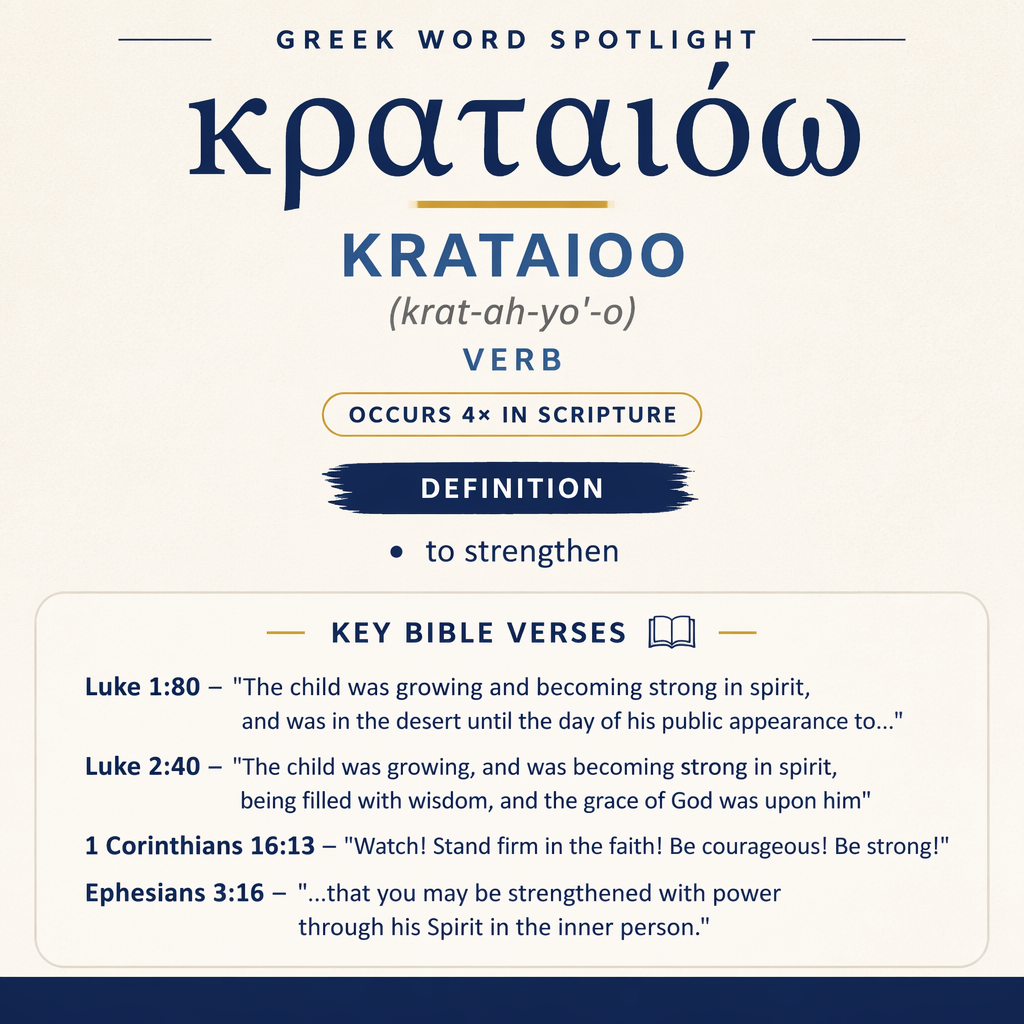
κραταιόω means “to strengthen” and occurs four times in Scripture: Luke 1:80; Luke 2:40; 1 Corinthians 16:13; Ephesians 3:16.
Gospel Occurrences
In Luke 1:80 and 2:40, it describes a child growing and becoming strong in spirit.
Learn More →Epistle Usage
In 1 Corinthians 16:13 it appears as an exhortation to “be strong,” and in Ephesians 3:16 it refers to being strengthened with power through his Spirit.
Learn More →κραταιόω means “to strengthen.” In the New Testament it appears in two infancy narratives describing a child’s growth, in an exhortation to steadfast courage, and in a prayer that inner life be fortified through the Spirit.
Root and Related Words
κραταιόω derives from krataios (κραταιός), “mighty” (Strong’s G2900). The verb form expresses becoming or being made to share in that might.

Occurrences
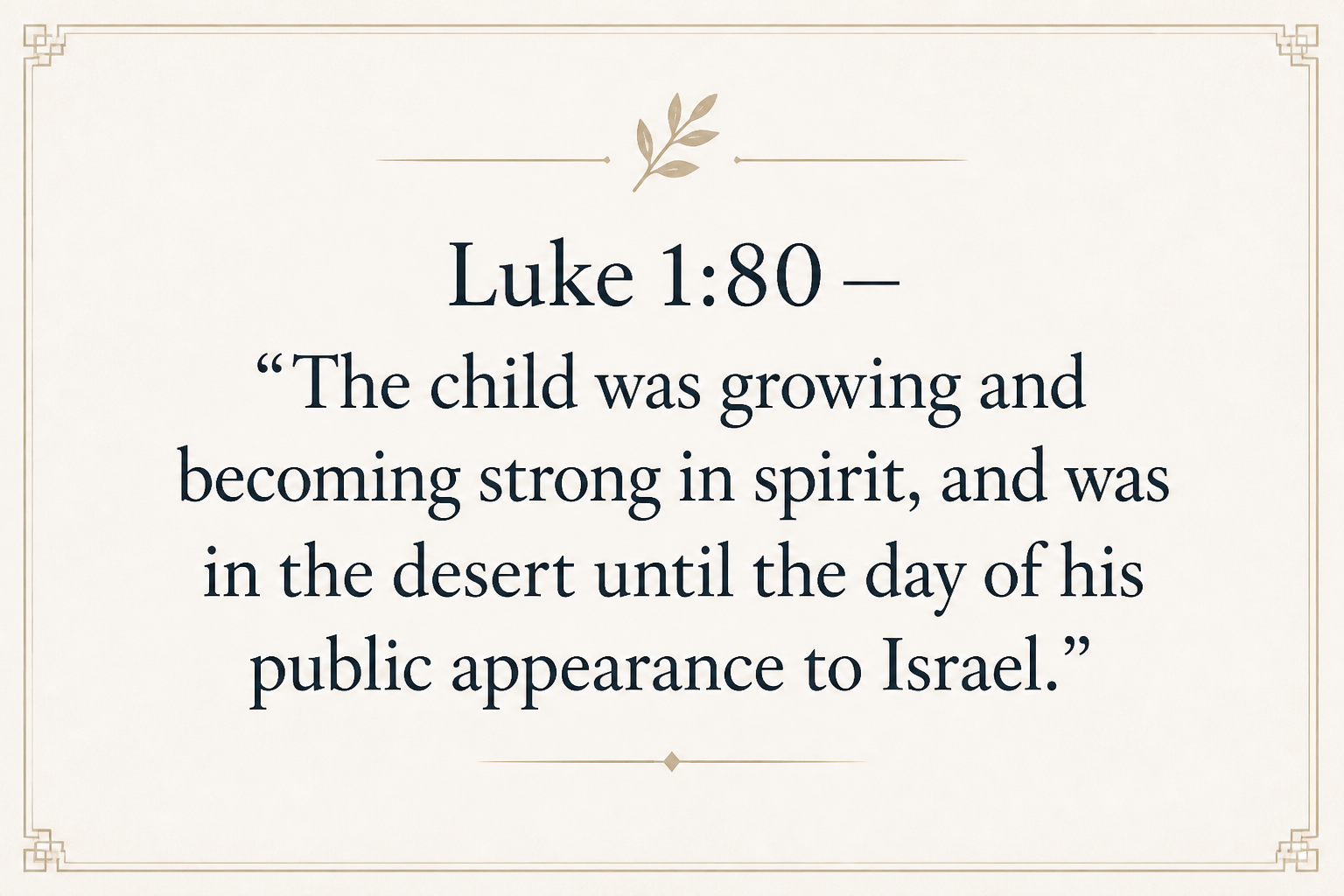
Luke 1:80 — “The child was growing and becoming strong in spirit, and was in the desert until the day of his public appearance to Israel.”
Here the strengthening is paired with visible, ordinary growth (“was growing”) and located specifically “in spirit.” The line presents strength as something that develops over time alongside maturation, not merely as an instant capacity. The setting (“in the desert”) places this strengthening in a context of hiddenness and waiting; the child’s strengthening continues during the period before “his public appearance to Israel.” The verb therefore contributes the idea of an inward fortifying that accompanies preparation for later public ministry, while remaining anchored in the phrase “strong in spirit” rather than in bodily power or social standing.
Luke 2:40 — “The child was growing, and was becoming strong in spirit, being filled with wisdom, and the grace of God was upon him.”
Again, strengthening is joined to growth, but the sentence expands the surrounding picture: the child is “being filled with wisdom,” and “the grace of God was upon him.” In this scene, strengthening sits among descriptions of internal formation. The phrase “strong in spirit” remains the explicit sphere, but the verse sets that strengthening alongside an increasing fullness of wisdom and a resting divine favor. The verb thus works as part of a cluster of developmental language: growth, strengthening, filling, and gracious presence. It frames strength not as a standalone trait, but as an aspect of a larger pattern of formation marked by wisdom and grace.
1 Corinthians 16:13 — “Watch! Stand firm in the faith! Be courageous! Be strong!”
In this concise series of commands, strengthening is expressed as a direct exhortation: “Be strong!” The surrounding imperatives clarify what kind of situation calls for such strengthening. “Watch!” conveys alertness; “Stand firm in the faith!” emphasizes stability and perseverance; “Be courageous!” points to boldness in the face of pressure. Within that chain, the verb contributes a call to steadied resolve. The strengthening here is not described as gradual growth (as in Luke), but as a summons to take up strength for faithful endurance. It functions rhetorically as the closing punch of the sequence, gathering vigilance, firmness, and courage into the posture of strength.
Ephesians 3:16 — “that he would grant you, according to the riches of his glory, that you may be strengthened with power through his Spirit in the inner person,”
This occurrence appears inside a petition, and the grammar of asking shapes how strengthening is pictured. The request is that God “would grant you” something “according to the riches of his glory,” namely, “that you may be strengthened with power.” The strengthening is therefore presented as a gifted result of divine generosity rather than as mere self-effort. The means is explicit: it happens “through his Spirit,” and the location is specified: “in the inner person.” The verse joins strengthening to “power,” not as a separate goal but as the manner in which the strengthening comes. The contribution of the verb is to express an inner fortifying that is Spirit-worked and proportioned to divine “glory,” aimed at the interior life rather than outward display.
Sense and Usage
Across these passages, “to strengthen” consistently concerns an inward state, even when it is commanded or requested. In Luke’s narratives, the word belongs to the language of development: the child “was growing” and, in that same ongoing process, “was becoming strong in spirit.” Strengthening there reads as a settled formation of the inner life, a strengthening that accrues with time and is compatible with quietness and obscurity (“in the desert”). Luke 2:40 intensifies the inward focus by coordinating strengthening with being “filled with wisdom” and living under “the grace of God,” so that strength is seen as intertwined with wise fullness and divine favor.
In 1 Corinthians 16:13, strengthening is cast as a moral and communal necessity: the imperative “Be strong!” is placed beside watchfulness, firmness “in the faith,” and courage. The verb therefore serves a different discourse function than in Luke: it is not a report about what is happening to someone, but an appeal for deliberate readiness. Yet even here, the surrounding words suggest that the strengthening sought is the kind that holds a person steady—strength that keeps watch, remains firm, and acts courageously.
Ephesians 3:16 presents the most explicitly sourced strengthening. The request is framed in terms of divine giving (“grant you”) and divine abundance (“according to the riches of his glory”), with the Spirit identified as the agent and the “inner person” as the sphere. The verb thus carries an emphasis on strengthening as an effect produced within a person by the Spirit’s work. When these uses are read together, the term regularly points to strengthening that is interior (“in spirit,” “in the inner person”) and that supports steadfastness, maturity, and readiness.
Imagery in Context
The imagery that gathers around κραταιόω in these verses is the imagery of inner formation: a child growing toward public calling, a life being filled with wisdom under grace, believers standing firm with courage, and an “inner person” being fortified through the Spirit. Strengthening is portrayed less as a visible spectacle than as a deepening capacity that prepares for faithful endurance and mature life.
Sources: Lexical data from Strong’s Exhaustive Concordance and the Translators Brief Lexicon of Extended Strongs for Greek (STEPBible, CC BY). Occurrence data from the Translators Amalgamated Greek New Testament (STEPBible, CC BY). Scripture quotations from the World English Bible (public domain).




