Exploring the Meaning of Hupselos in Greek
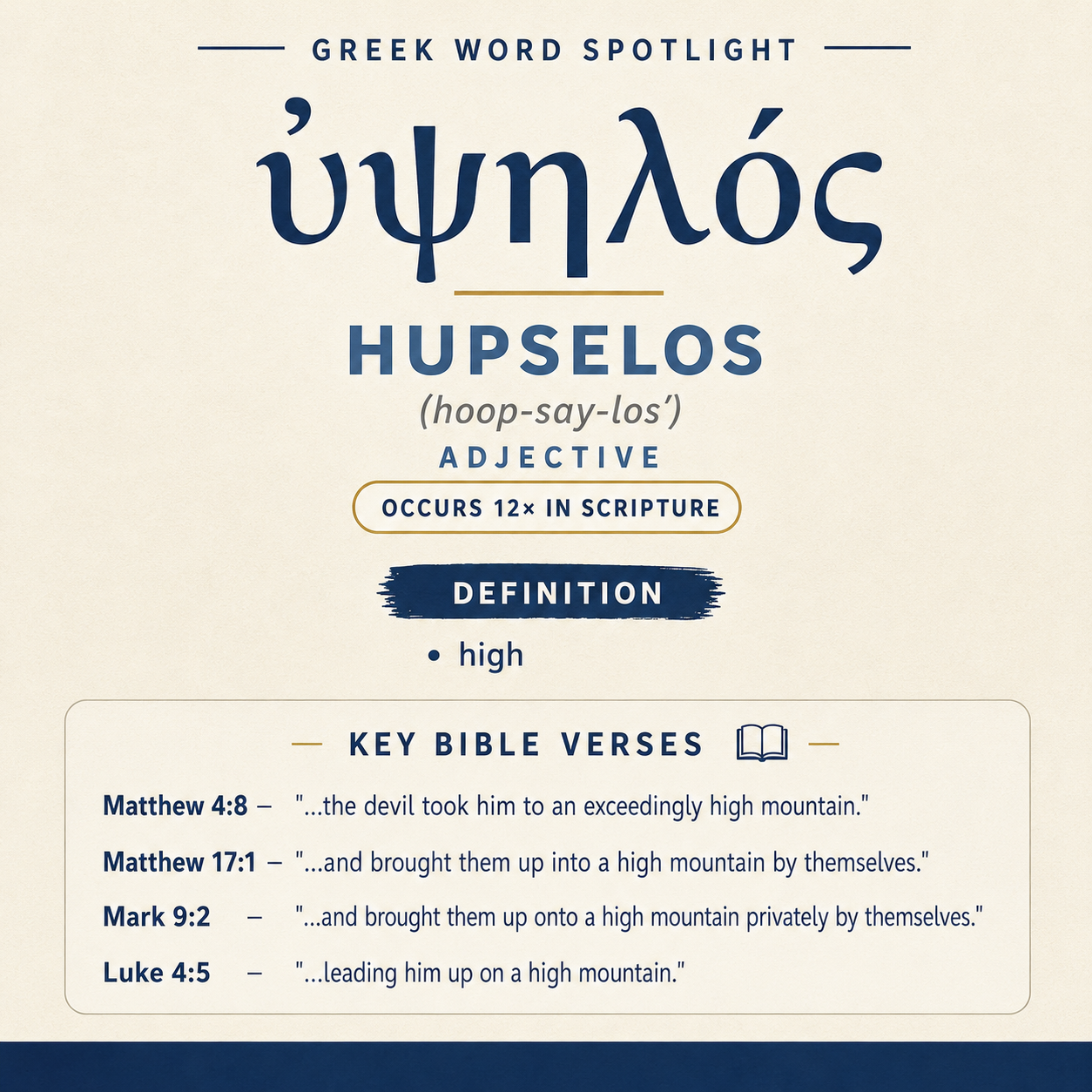
ὑψηλός (Hupselos) means “high” and occurs 12 times in Scripture, including in Matthew, Mark, Luke, Acts, and Romans.
Core Meaning
ὑψηλός is defined as “high.” It describes height in several Gospel passages.
Learn More →Gospel Settings
It appears in the temptation narratives on a “high mountain” (Matthew 4:8; Luke 4:5). It also appears in the “high mountain” accounts in Matthew 17:1 and Mark 9:2.
Learn More →Other References
ὑψηλός also occurs in Luke 16:15, Acts 13:17, Romans 11:20, and Romans 12:16. These are among its 12 total occurrences in Scripture.
Learn More →ὑψηλός describes what is “high,” a quality applied both to physical features (mountains, walls) and to what is regarded as elevated in status or sphere. In the passages where it appears, its force ranges from height that enables a sweeping view to height that marks separation, prominence, or a lofty realm.
Occurrences
“Again, the devil took him to an exceedingly high mountain, and showed him all the kingdoms of the world, and their glory.” (Matthew 4:8)
Here “high” intensifies the setting: the mountain is not merely elevated but “exceedingly” so, fitting the act of showing “all the kingdoms of the world.” The height functions as a vantage point within the scene, supporting the temptation’s grand scope—“their glory”—by placing Jesus in a position associated with sweeping visibility and perceived dominance.

“After six days, Jesus took with him Peter, James, and John his brother, and brought them up into a high mountain by themselves.” (Matthew 17:1)
The adjective marks the mountain as a place set above ordinary space. Being led “up into a high mountain” and “by themselves” links physical height with separation from the crowd: the ascent and the elevation together frame an event that is private and set apart.
“After six days Jesus took with him Peter, James, and John, and brought them up onto a high mountain privately by themselves, and he was changed into another form in front of them.” (Mark 9:2)
As in Matthew’s parallel scene, “high” characterizes the mountain as elevated, and the movement “brought them up” underscores ascent. The privacy of the location (“privately by themselves”) is reinforced by the mountain’s height, a setting suited to what happens “in front of them,” where Jesus is “changed into another form.”
“The devil, leading him up on a high mountain, showed him all the kingdoms of the world in a moment of time.” (Luke 4:5)
Luke presents the mountain’s height in close connection with being “leading him up,” again making elevation part of the narrative action. The adjective supports the scene’s sudden comprehensiveness—“all the kingdoms of the world in a moment of time”—by situating the showing from an elevated place that implies breadth and command.
“He said to them, “You are those who justify yourselves in the sight of men, but God knows your hearts. For that which is exalted among men is an abomination in the sight of God.” (Luke 16:15)
In this saying, “high” is expressed as what is “exalted among men,” shifting from physical height to social valuation. The contrast is sharp: what people raise up in their “sight” can be judged oppositely in God’s “sight.” The word’s contribution is to name the elevated status humans assign—publicly approved standing—while placing it under divine evaluation.
“The God of this people chose our fathers, and exalted the people when they stayed as aliens in the land of Egypt, and with an uplifted arm, he led them out of it.” (Acts 13:17)
“Exalted” here describes an act done by God toward “the people.” The adjective’s notion of being “high” is applied to a people’s condition rather than a location: God raises them in their situation “when they stayed as aliens in the land of Egypt.” The verse pairs that raising with deliverance—“with an uplifted arm, he led them out”—so the elevation is presented as part of God’s powerful intervention.
“True; by their unbelief they were broken off, and you stand by your faith. Don’t be conceited, but fear;” (Romans 11:20)
Although the verse uses “conceited” rather than a height-word in English, the warning targets an inner posture of self-elevation. In the logic of the sentence, standing “by your faith” is set against becoming inflated in attitude; the point is not to treat one’s position as grounds for being “high” in oneself.
“Be of the same mind one toward another. Don’t set your mind on high things, but associate with the humble. Don’t be wise in your own conceits.” (Romans 12:16)
Here “high” is explicitly mental and social: “Don’t set your mind on high things.” The instruction contrasts aiming at what is elevated with “associate with the humble,” tying the “high” orientation to relational distance and self-importance. The closing line, “Don’t be wise in your own conceits,” shows how “high” can describe an aspirational stance—what one values and pursues—rather than altitude.
“His Son is the radiance of his glory, the very image of his substance, and upholding all things by the word of his power, who, when he had by himself purified us of our sins, sat down on the right hand of the Majesty on high,” (Hebrews 1:3)
“On high” locates “the Majesty” in an elevated sphere. The phrase functions spatially and theologically within the sentence: after purifying sins, the Son “sat down on the right hand” of the one who is “on high.” The height here marks supreme placement and corresponds to the Son’s completed work and enthronement in that exalted realm.
“For such a high priest was fitting for us: holy, guiltless, undefiled, separated from sinners, and made higher than the heavens;” (Hebrews 7:26)
This occurrence uses height to articulate superiority: the priest is not only “holy, guiltless, undefiled” but also “made higher than the heavens.” The adjective’s “high” sense is extended to a superlative comparison (“higher than the heavens”), coordinating with “separated from sinners” to convey transcendence and elevation beyond ordinary human limits.
“He carried me away in the Spirit to a great and high mountain, and showed me the holy city, Jerusalem, coming down out of heaven from God,” (Revelation 21:10)
“Great and high mountain” provides a commanding viewpoint for the vision. The mountain’s height matches the grandeur of what is shown: “the holy city, Jerusalem, coming down out of heaven from God.” As in the temptation narratives, elevation supports the act of showing, but here the vantage serves revelation rather than enticement.
“having a great and high wall; having twelve gates, and at the gates twelve angels; and names written on them, which are the names of the twelve tribes of the children of Israel.” (Revelation 21:12)
“High” now qualifies the city’s wall. The height contributes to the wall’s imposing character—“a great and high wall”—which frames the ordered entry points (“twelve gates”) and guarded access (“at the gates twelve angels”). The adjective emphasizes the wall’s scale and prominence within the city’s description.

Sense and Usage
Across these passages, ὑψηλός consistently expresses height, yet the scenes show how “high” can function in more than one register. In the mountain settings (Matthew 4:8; Matthew 17:1; Mark 9:2; Luke 4:5; Revelation 21:10), height is concrete: characters are taken “up,” led “up,” or carried to an elevated place. The repeated pairing of ascent with showing (“showed him all the kingdoms…”; “showed me the holy city…”) makes height a narrative tool for perspective. A “high mountain” is the natural location for a comprehensive display—whether the devil’s presentation of “all the kingdoms of the world” or the angelic disclosure of the descending city.
In other contexts, “high” moves from terrain to valuation and position. Luke 16:15 uses the language of being “exalted among men,” locating “highness” in public reputation and social approval, then setting that “exalted” thing under God’s judgment. Acts 13:17 speaks of God who “exalted the people,” making height a metaphor for raised standing granted by divine action amid their lowly circumstances as “aliens in the land of Egypt.” Hebrews 1:3 and 7:26 employ height to speak of the divine realm (“the Majesty on high”) and of a priestly figure “made higher than the heavens,” where the adjective marks the sphere and status appropriate to the Son’s authority and to a priest characterized by holiness and separation.
Romans 11:20 and 12:16 show height applied to attitude and aspiration. The warning “Don’t be conceited” and the exhortation “Don’t set your mind on high things” treat “highness” as a stance of self-importance or socially elevated preoccupation, contrasted with “fear” and with associating “with the humble.” In these uses, “high” still retains its basic direction—upward—but its object is the mind and the social self, not a mountain or wall.
Imagery
The word’s imagery alternates between raised places and raised esteem. High mountains appear as sites where something expansive is presented—kingdoms in a moment, a transfiguring change witnessed privately, a city descending from heaven. Highness also marks what humans lift up in their own sight, what God lifts up by his power, and what belongs properly to the realm described as “on high.” Even when the focus is inward (“Don’t set your mind on high things”), the upward direction remains vivid: ὑψηλός consistently signals elevation, whether of location, status, sphere, or disposition.
Sources: Lexical data from Strong’s Exhaustive Concordance and the Translators Brief Lexicon of Extended Strongs for Greek (STEPBible, CC BY). Occurrence data from the Translators Amalgamated Greek New Testament (STEPBible, CC BY). Scripture quotations from the World English Bible (public domain).