Exploring the Meaning of Hupsoma in Greek
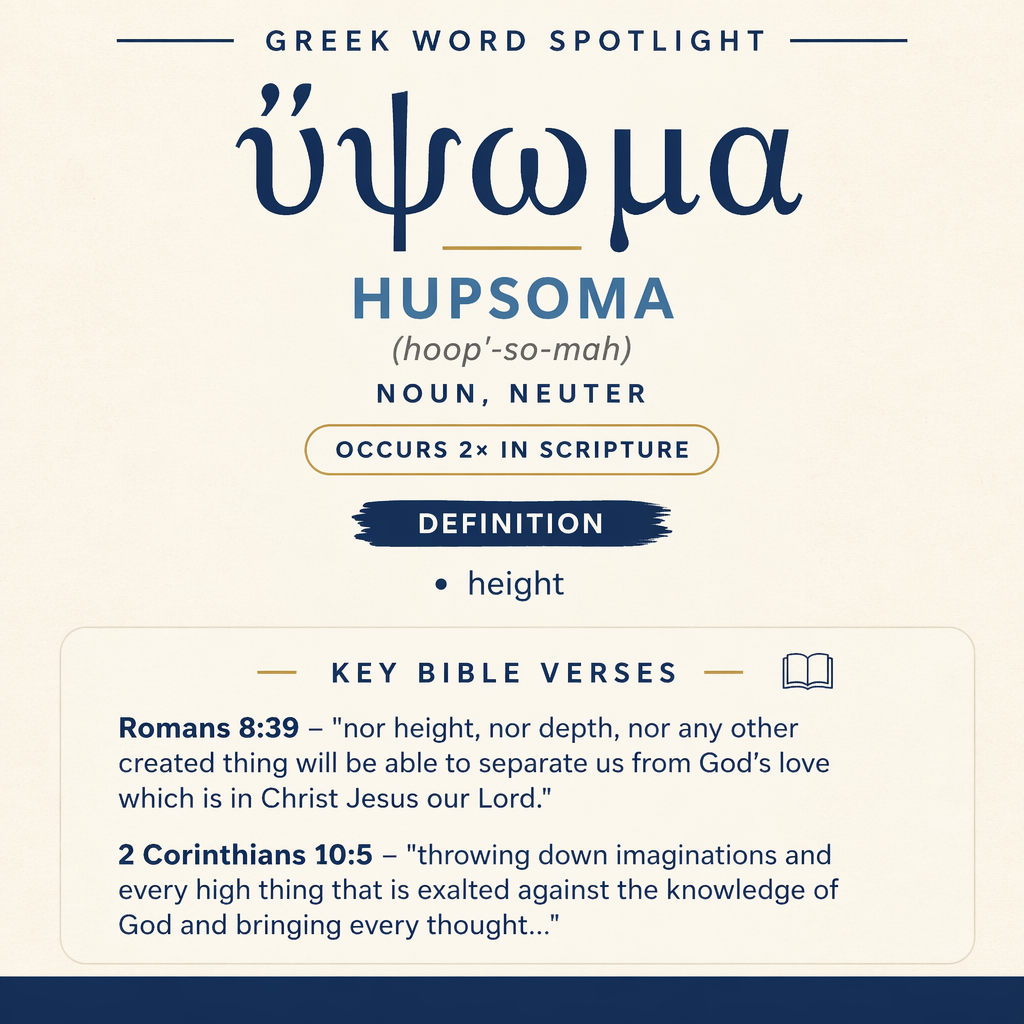
ὕψωμα (Hupsoma) means “height” and appears in Romans 8:39 and 2 Corinthians 10:5.
Verse Contexts
Romans 8:39 pairs “height” with “depth” in affirming nothing can separate from God’s love in Christ Jesus. 2 Corinthians 10:5 uses it for “every high thing” exalted against the knowledge of God.
Learn More →ὕψωμα denotes “height.” It appears twice in the New Testament, once in a list of cosmic extremes that cannot separate from God’s love, and once in a description of what must be pulled down when thoughts are brought into obedience to Christ.
Root and Related Words
ὕψωμα relates to the verb hypsoo (ὑψόω), “to lift up” (Strong’s G5312). The connection between the noun and the verb is visible in the shared idea of being raised or elevated: the verb speaks of lifting, and the noun names the resulting elevated state as “height.”

Occurrences
“nor height, nor depth, nor any other created thing will be able to separate us from God’s love which is in Christ Jesus our Lord.” (Romans 8:39)
Here ὕψωμα stands in direct contrast to “depth,” setting out a vertical pair of extremes. In the sentence, “height” is not presented as a mere measurement but as one instance within a sweeping catalogue of realities that might be imagined as barriers. The structure presses the reader to think in terms of comprehensive range: even at the topmost reach that “height” evokes—and even when set alongside its opposite—none of it has separating power. The verse then gathers the vertical pair into a broader category (“nor any other created thing”), placing “height” within the realm of what is created. In this setting, “height” functions as an image for the farthest conceivable elevation within creation, yet it is explicitly denied the ability to disrupt “God’s love which is in Christ Jesus our Lord.”
The force of the term in Romans 8:39 comes from how it participates in the sentence’s logic of impossibility. “Height” is not singled out for special explanation; it is effective precisely because it needs none. By naming an extreme, it helps the line communicate that separation is not merely unlikely but excluded across the entire span of what the mind can stretch to imagine. The term therefore contributes an expansive spatial imagination: even if one were to place oneself at some “height” as far removed as possible from ordinary experience, the verse insists that such distance does not translate into relational distance from divine love.
“throwing down imaginations and every high thing that is exalted against the knowledge of God and bringing every thought into captivity to the obedience of Christ,” (2 Corinthians 10:5)
In 2 Corinthians 10:5, ὕψωμα appears within a sequence of actions: “throwing down,” “bringing…into captivity,” and directing thoughts toward “the obedience of Christ.” The noun is embedded in the phrase “every high thing that is exalted against the knowledge of God.” Within this wording, “height” is not a neutral elevation; it is an elevated stance that positions itself “against” something—specifically, “the knowledge of God.” As a result, “height” becomes a metaphorical location of resistance: something that stands above and over, claiming a vantage point or superiority that conflicts with knowing God.
The immediate verbs and modifiers sharpen the picture. The “high thing” is described as “exalted,” strengthening the sense of raised status and reinforcing the idea that the “height” in view is not accidental but self-asserting. The response is equally spatial: it is to be “thrown down.” That downward motion answers the upward posture implied by “height,” and it parallels the later movement of “bringing every thought into captivity.” In this verse, ὕψωμα contributes to an imagery of elevation and demolition: what is raised in opposition is to be brought low, and what roams freely in thought is to be constrained under a new allegiance. The noun thus helps cast the conflict in terms of heights that must be reduced so that the mind can be redirected into obedience.
Sense and Usage
Across these two passages, “height” operates as a powerful spatial image, but it serves distinct rhetorical aims. In Romans 8:39, “height” is paired with “depth” to span an entire vertical dimension and thereby reinforce an assurance: even the most extreme positions imaginable within creation cannot “separate us from God’s love.” The term’s contribution is to broaden the horizon of what might be feared. By naming a maximal “height,” the verse anticipates the human impulse to suppose that extreme distance, extreme elevation, or extreme conditions could translate into spiritual loss. The sentence denies that inference, explicitly placing such extremes under the category of “created thing” and declaring them impotent to divide from love in Christ.
In 2 Corinthians 10:5, “height” is not used to reassure but to identify a problem. The “high thing” is characterized by opposition (“against the knowledge of God”) and by being raised (“exalted”). Here “height” evokes what is elevated as a rival claim—something that stands up in the mind’s landscape as a towering obstacle. The verse answers this elevated resistance with a corresponding action: “throwing down.” In this setting, “height” is not the farthest reach of creation but the raised posture of imagination and thought when it refuses submission to true knowledge of God and to “the obedience of Christ.”
Read together, the two uses show how “height” can carry either the sense of extreme distance (as an imagined barrier that proves powerless) or the sense of elevated pretension (as an obstacle that must be reduced). Both uses rely on the common human association between height and power: what is high seems unreachable, imposing, or authoritative. Romans 8:39 counters that association by insisting that even the highest conceivable “height” lacks power to separate from God’s love. Second Corinthians 10:5 challenges that association by depicting “height” as something that may appear imposing in the realm of thoughts and arguments but is still subject to being pulled down when measured against “the knowledge of God” and the call to Christ’s obedience.
The noun’s neuter form suits its usage in both contexts, where “height” is treated as a thing—an abstracted reality that can be named and placed in a list (Romans) or targeted and dismantled (Corinthians). In each case, ὕψωμα is effective because it compresses a larger picture into a single term. It can stand for the top of a vertical scale, or for any elevated structure within the mind that rises up in defiance. The shared imagery makes the two passages resonate: in one, heights cannot sever; in the other, heights that oppose must be overthrown.
Imagery
Both verses draw on vertical space to speak about spiritual realities. Romans 8:39 evokes the full stretch from “height” to “depth” to communicate inviolable security in “God’s love which is in Christ Jesus our Lord.” Second Corinthians 10:5 evokes the sight of a raised “high thing” being “thrown down,” a picture matched by the capture of thoughts into obedience. In this way, ὕψωμα carries an image of elevation that can either be contemplated as an extreme boundary (and then dismissed as powerless) or confronted as an arrogant rise (and then reduced), depending on the passage’s aim.
Sources: Lexical data from Strong’s Exhaustive Concordance and the Translators Brief Lexicon of Extended Strongs for Greek (STEPBible, CC BY). Occurrence data from the Translators Amalgamated Greek New Testament (STEPBible, CC BY). Scripture quotations from the World English Bible (public domain).