Exploring the Meaning of Hupsos in Greek
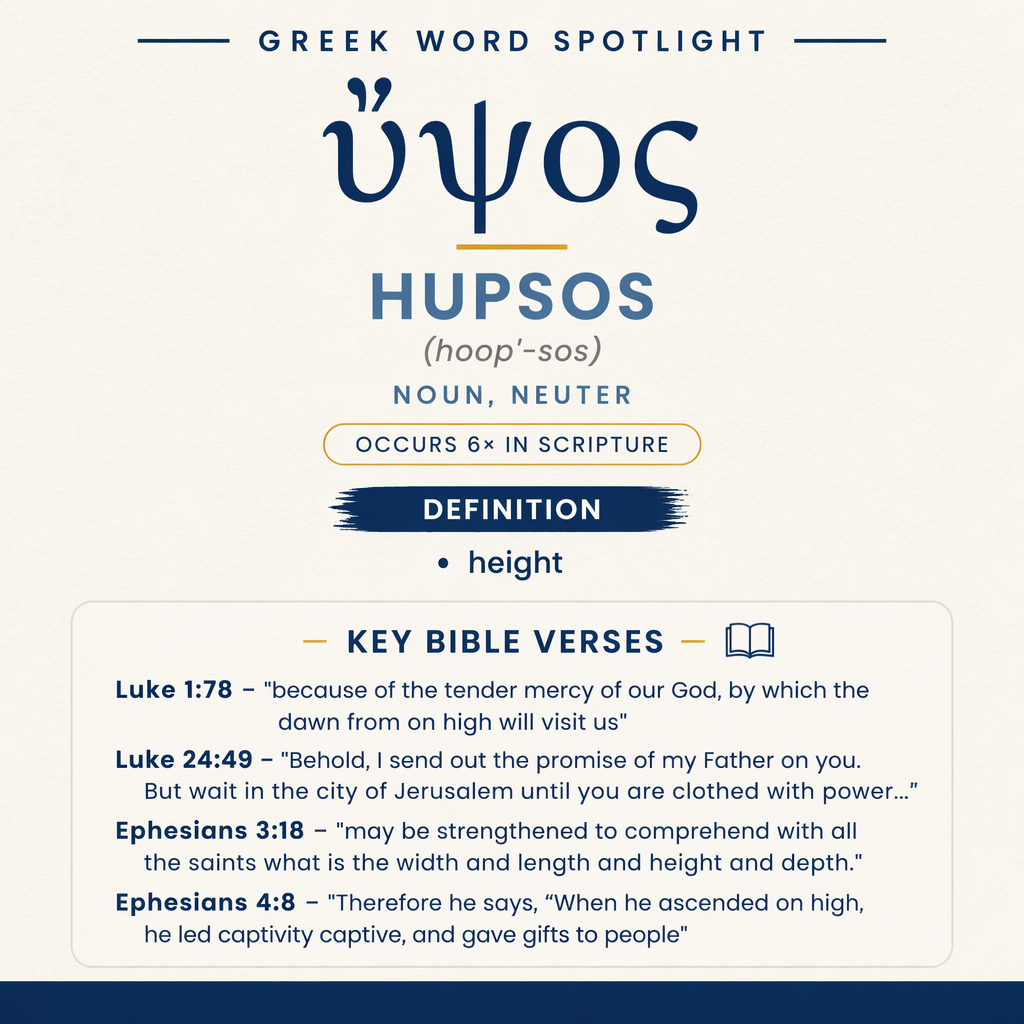
ὕψος (Hupsos) means “height” and occurs 6 times in Scripture: Luke 1:78; Luke 24:49; Ephesians 3:18; Ephesians 4:8; James 1:9; Revelation 21:16.
Core Meaning
ὕψος means “height.” It is used for what is “on high” and for measurable dimensions.
Learn More →Scripture Occurrences
It appears in Luke 1:78 and Luke 24:49, and in Ephesians 3:18 and Ephesians 4:8. It also occurs in James 1:9 and Revelation 21:16.
Learn More →Usage Highlights
Ephesians 3:18 includes it among “width and length and height and depth.” Revelation 21:16 uses it in the description of the city’s measured dimensions.
Learn More →ὕψος denotes “height,” and in the New Testament it appears in a small set of passages that range from spatial measurement to elevated location and figurative elevation. The word can name the dimension of something measured, the “on high” from which something comes, or a “high position” contrasted with humble circumstances.
Occurrences
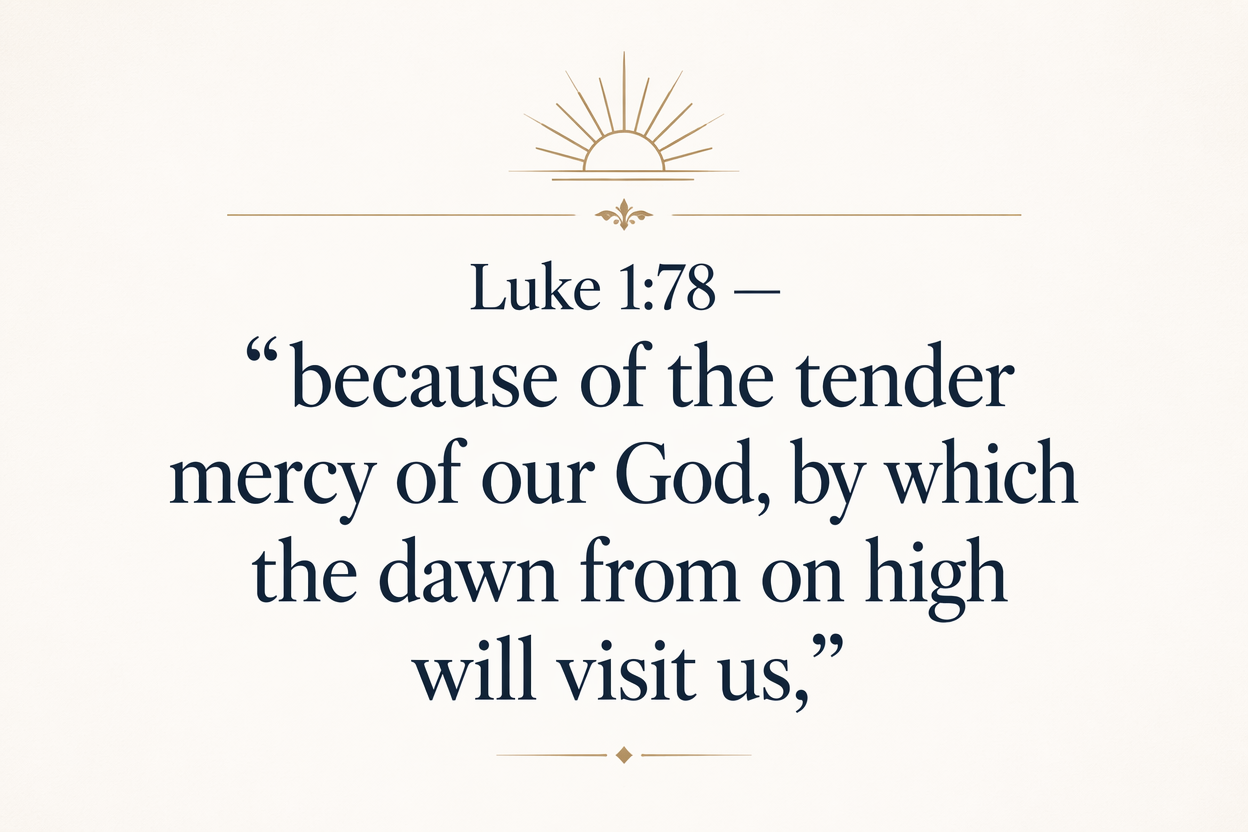
Luke 1:78 — “because of the tender mercy of our God, by which the dawn from on high will visit us,”
Here ὕψος marks the location associated with the coming “dawn”: it is “from on high.” Within the line, “from on high” functions as a directional source, emphasizing that the visitation described does not arise from the scene on earth but comes down from a lofty place. The image is vertical: mercy is linked with a visiting light that descends, and ὕψος supplies the upward reference point that makes “visit us” feel like a movement from above to below.
Luke 24:49 — “Behold, I send out the promise of my Father on you. But wait in the city of Jerusalem until you are clothed with power from on high.”
In this setting ὕψος again appears in the phrase “from on high,” now modifying “power.” The instruction to “wait” “until you are clothed” presents “power” as something bestowed, and the phrase “from on high” locates its origin in an elevated realm. The vertical sense of “height” undergirds the idiom: what is received comes down upon them (“on you”), and ὕψος helps frame the “promise of my Father” as something sent from above rather than produced by the recipients or by the city where they wait.
Ephesians 3:18 — “may be strengthened to comprehend with all the saints what is the width and length and height and depth,”
Here ὕψος is one of four dimensions—“width and length and height and depth”—named as objects of comprehension. The word contributes its straightforward spatial sense as the vertical dimension, paired with other measures to form a full, bounded set of ways to describe magnitude. In the sentence, “height” is not isolated; it stands in a coordinated list, implying that the thing to be grasped requires multidimensional understanding. ὕψος therefore functions as a technical-sounding term of measurement within a rhetorical quartet.
Ephesians 4:8 — “Therefore he says, “When he ascended on high, he led captivity captive, and gave gifts to people.””
In this quotation, ὕψος appears in “ascended on high,” describing the endpoint or sphere of an ascent. The verb “ascended” already implies upward movement; “on high” adds a destination characterized by height, reinforcing the upward trajectory. Within the quoted line, the movement “on high” is immediately followed by actions—“he led captivity captive, and gave gifts to people”—so ὕψος helps stage the scene as one in which elevation accompanies authority and bestowal. The word’s contribution is spatial and positional: the ascent culminates in a high place from which subsequent acts proceed.
James 1:9 — “But let the brother in humble circumstances glory in his high position;”
Here ὕψος is used in a contrast embedded in the verse itself: “humble circumstances” set against “his high position.” The “height” is expressed as a “position,” not a measured dimension, so the word supplies the imagery of elevation applied to status or standing. The instruction to “glory” in that “high position” depends on the tension between the brother’s outward “humble circumstances” and the elevated “position” named by ὕψος; the word furnishes the upward metaphor that makes the contrast vivid even within a single line.
Revelation 21:16 — “The city is square, and its length is as great as its width. He measured the city with the reed, twelve thousand twelve stadia. Its length, width, and height are equal.”
In Revelation 21:16 ὕψος is part of a measured description: the city’s “length, width, and height are equal.” The passage explicitly discusses measurement (“He measured the city with the reed”), and “height” is treated as a quantifiable dimension alongside length and width. ὕψος contributes to the geometric portrait of the city, completing the three-dimensional description. By stating that the “height” equals the other dimensions, the verse makes the vertical dimension as significant as the horizontal ones, and ὕψος is the term that anchors that vertical equality.

Sense and Usage
Across these passages ὕψος consistently keeps the idea of verticality in view, but it does so through several grammatical and contextual roles. In Luke 1:78 and Luke 24:49, “from on high” uses height as a point of origin. The direction is not merely “up”; it is “from” a height, marking a source that stands above the recipients. This use makes the word function almost like a coordinate in a vertical axis, situating the “dawn” and the “power” as descending realities. In both verses the gift-like character of what comes (“will visit us”; “you are clothed with power”) coheres with ὕψος as the location from which such visitation or clothing arrives.
Ephesians 3:18 and Revelation 21:16 show ὕψος in a more concrete, dimensional sense. Ephesians places it inside a four-term set that sounds like a surveyor’s or architect’s vocabulary: “width… length… height… depth.” The effect is comprehensive measurement language, and ὕψος contributes specifically the upward dimension necessary for fullness. Revelation uses a similar measuring frame but with an explicit measuring act and an explicit equality among the dimensions. There ὕψος is not simply one item in a poetic list; it is part of a numeric and geometric claim about the city’s proportions. The shared feature of these two passages is that “height” is treated as something that belongs to the shape or magnitude of what is being described—something that can be conceived, compared, and in Revelation, measured.
Ephesians 4:8 and James 1:9 move from dimension to position. In Ephesians 4:8, “on high” functions as the terminus of ascent. The word belongs to a vertical movement narrative: ascent toward a high place. It is still spatial, but it does not describe a measurement; it describes where the ascent ends. James 1:9 takes the height imagery and applies it to “position” within a contrastive statement. The verse itself sets “humble circumstances” against “high position,” so height becomes a way of naming an elevated standing without turning it into a geometric quantity. Yet even there, the metaphor depends on the ordinary sense of height: what is “high” is above what is “humble.”
Seen together, these uses show how ὕψος can operate (1) as a source “from on high,” (2) as a destination “on high” reached by ascent, (3) as a dimension within measurement language, and (4) as a “high position” set over against lowliness. The word’s flexibility lies not in changing away from “height,” but in applying height to different kinds of discourse: movement (upward/downward), measurement (dimension), and evaluation (high/low position). The consistent thread is vertical reference—either literally in spatial description or figuratively in the sense of an elevated place or standing.
Imagery
In Luke, ὕψος places key actions “from on high,” pairing height with visitation and empowerment: a “dawn” that comes down and “power” that clothes those who wait. In Ephesians, height belongs both to the mental act of “comprehend[ing]” dimensions and to an ascent “on high” linked with giving. In James, height becomes the surprising counterpart to “humble circumstances,” giving the verse its upward-and-downward tension. In Revelation, height is part of an ordered, measured city whose three dimensions stand in deliberate balance, so that what rises vertically is as definite and as describable as what extends outward.
Sources: Lexical data from Strong’s Exhaustive Concordance and the Translators Brief Lexicon of Extended Strongs for Greek (STEPBible, CC BY). Occurrence data from the Translators Amalgamated Greek New Testament (STEPBible, CC BY). Scripture quotations from the World English Bible (public domain).