
Exploring the Meaning of Hupselophroneo in Greek
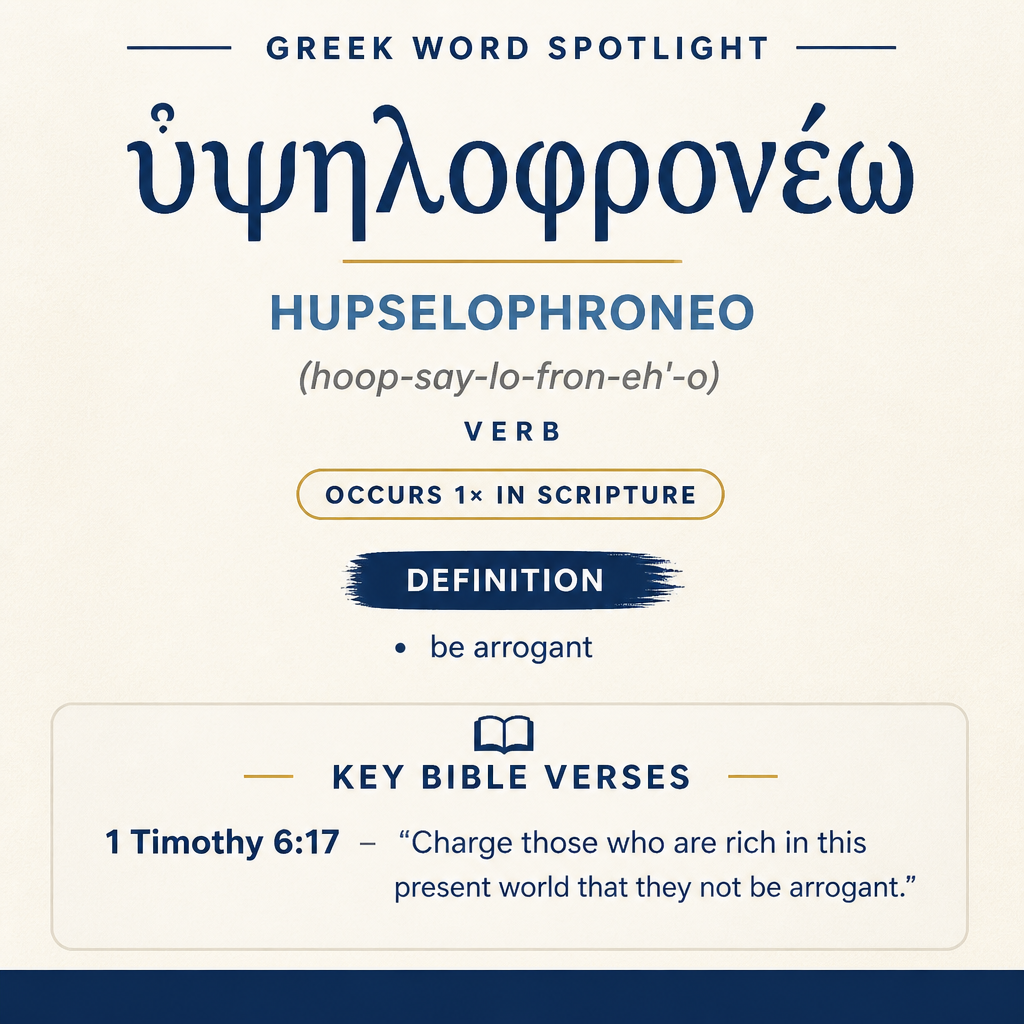
ὑψηλοφρονέω means “be arrogant” and appears once in Scripture, in 1 Timothy 6:17.
ὑψηλοφρονέω means “be arrogant,” and it appears in a single New Testament admonition directed to wealthy believers. In that setting it names a particular inner posture that must be resisted alongside other misplaced attitudes toward riches.
Root and Related Words
ὑψηλοφρονέω is connected with the adjective hypselos (ὑψηλός), “high,” and with phren (φρήν), “thinking.” These components frame the term’s imagery in terms of “highness” joined to the realm of thought or mindset.

Occurrences
“Charge those who are rich in this present world that they not be arrogant, nor have their hope set on the uncertainty of riches, but on the living God, who richly provides us with everything to enjoy;” (1 Timothy 6:17)
In 1 Timothy 6:17, ὑψηλοφρονέω is embedded in a string of directives that regulate how “those who are rich in this present world” are to carry themselves. The charge begins with a negative command—“that they not be arrogant”—and immediately adds a second caution: “nor have their hope set on the uncertainty of riches.” The placement of “be arrogant” at the head of the admonition highlights arrogance as a first and direct temptation associated with wealth, not merely as a byproduct of wrong actions but as a stance of the person.
The verse also supplies an explicit contrast that clarifies the practical direction of the command. Instead of the twin pitfalls of arrogance and hope fixed on “the uncertainty of riches,” the rich are to set their hope “on the living God.” Within that structure, ὑψηλοφρονέω names a mindset that is incompatible with hoping in God as God is presented here. The text’s contrast does not simply redirect behavior; it redirects the orientation of confidence. Arrogance, in this context, is treated as an internal elevation that needs to be checked because it competes with humble dependence on “the living God.”
The description of God in the final clause further tightens the logic: he is the one “who richly provides us with everything to enjoy.” The adverbial “richly” (used of God’s provision) stands alongside the mention of human “rich” people, creating a deliberate juxtaposition. In that juxtaposition, arrogance is exposed as an attitude that forgets the true source of abundance. The verse does not depict the wealthy as necessarily sinful for possessing riches; rather, it addresses the moral and spiritual hazards that accompany their social and economic condition. ὑψηλοφρονέω identifies one such hazard: a high-minded self-evaluation that can arise when wealth becomes the measure of security, status, or personal worth.
Because the instruction is framed as a “charge,” ὑψηλοφρονέω is treated as something that can be guarded against through teaching and accountability. The command is not abstract; it belongs to the concrete management of community life, where wealth can distort relationships and priorities. In this single occurrence, the term functions as a diagnostic label for a heart posture that must be refused if the rich are to live rightly within the community and before God.
Sense and Usage
The definition “be arrogant” plays out in 1 Timothy 6:17 as an attitude linked to elevated self-thinking. The admonition does not present arrogance as an isolated flaw; it appears alongside a second, closely related misdirection—hoping in riches. Together they present a coherent picture: arrogance is a posture of internal “height” that easily grows when material resources appear to secure the future. The verse’s wording, “the uncertainty of riches,” undercuts the plausibility of that posture. If riches are uncertain, then building the self upward on them is unstable, and the instruction presses the rich to refuse the psychological and social temptation to act as though wealth places them above others or beyond need.
At the same time, the verse indicates that arrogance is not corrected merely by reducing possessions, since it addresses “those who are rich” as a continuing category. Instead, arrogance is countered by a different object of hope: “the living God.” The term ὑψηλοφρονέω therefore marks an internal movement away from God-centered trust and toward self-elevation. The command “that they not be arrogant” is paired with the positive alternative of hope in God, showing that the remedy is not simply to avoid a vice but to adopt a different stance of reliance.
The concluding portrayal of God “who richly provides us with everything to enjoy” also shapes how arrogance is understood here. God is not depicted as stingy or distant, but as abundant in provision. Arrogance, then, is especially unfitting because it forgets dependence on a giver and subtly credits the self as if wealth were self-originating or self-securing. The verse’s logic gives arrogance a relational dimension: it is not only an inflated view of self in general but an attitude that sits poorly alongside recognition of God’s ongoing generosity.
Because this is the only occurrence, the semantic profile is concentrated in a single pastoral command. Yet even within one verse, the term is positioned within a network of ideas—wealth, uncertainty, hope, and divine provision—so that “be arrogant” is not left vague. It is the high-mindedness that wealth can foster, the kind that competes with God-directed hope and that must be explicitly charged against in the life of the church.
Imagery
The term’s conceptual imagery aligns with “high” thinking: a lifted stance of mind that rises above proper dependence. In 1 Timothy 6:17, that “height” is brought down to earth by the reminder that riches are uncertain and that true, reliable abundance belongs to “the living God, who richly provides us with everything to enjoy.”
Sources: Lexical data from Strong’s Exhaustive Concordance and the Translators Brief Lexicon of Extended Strongs for Greek (STEPBible, CC BY). Occurrence data from the Translators Amalgamated Greek New Testament (STEPBible, CC BY). Scripture quotations from the World English Bible (public domain).




