
Exploring the Meaning of Hoplizo in Greek
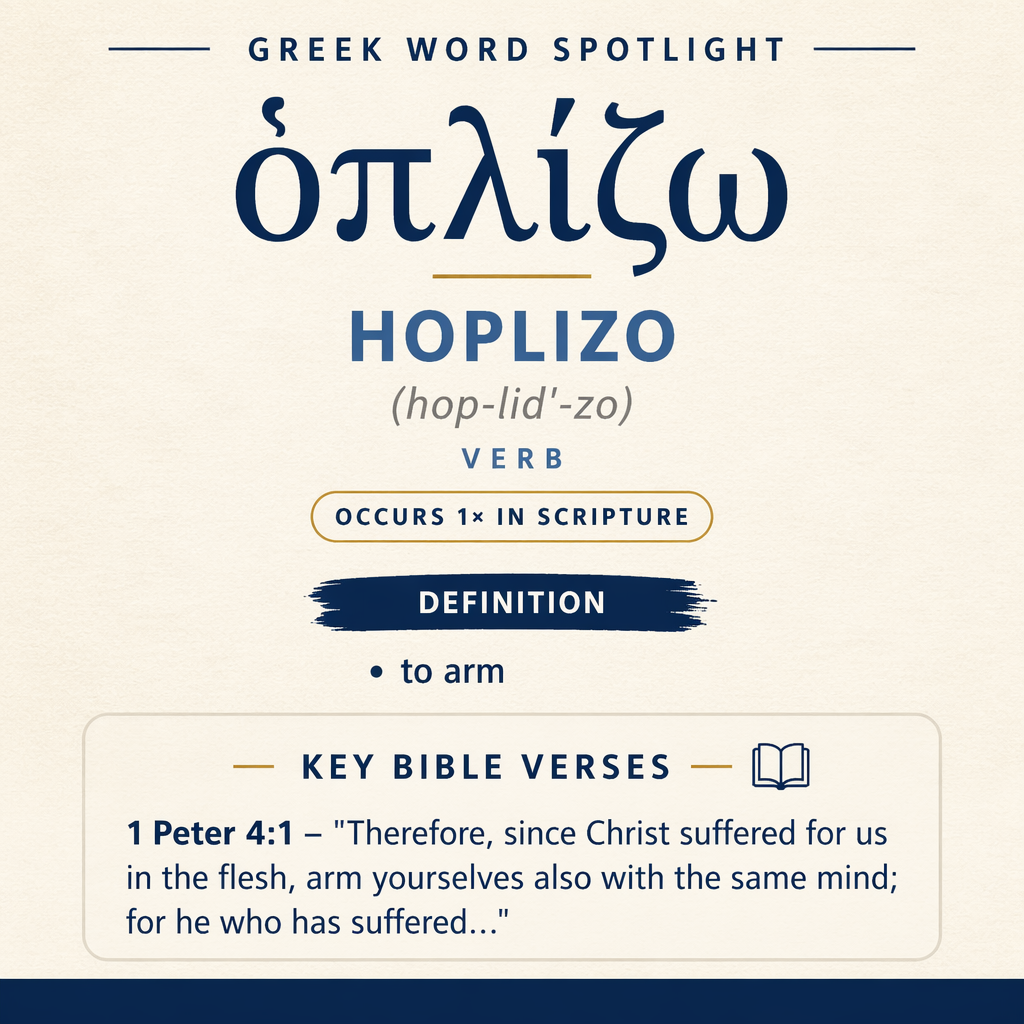
ὁπλίζω (Hoplizo) means “to arm” and appears once in Scripture, in 1 Peter 4:1.
Scripture Occurrence
This verb occurs 1 time in Scripture. Its single occurrence is in 1 Peter 4:1.
Learn More →Context in 1 Peter
In 1 Peter 4:1, believers are told to “arm yourselves also with the same mind.” The instruction is given in light of Christ suffering in the flesh.
Learn More →ὁπλίζω means “to arm,” and it appears once in the New Testament, in 1 Peter 4:1. There it is framed by Christ’s suffering “in the flesh” and a summons to take up “the same mind.”
Root and Related Words
ὁπλίζω derives from hoplon (ὅπλον), “weapon” (Strong’s G3696). The relationship between verb and noun places the action of “arming” in direct contact with the concrete imagery of weaponry, even when the immediate context speaks in terms of “mind.”

Occurrences
“Therefore, since Christ suffered for us in the flesh, arm yourselves also with the same mind; for he who has suffered in the flesh has ceased from sin,” (1 Peter 4:1)
In 1 Peter 4:1, ὁπλίζω stands as a commanded response to the opening statement: “since Christ suffered for us in the flesh.” The verb supplies the practical hinge between what is announced about Christ’s suffering and what is required of the readers. The content of this “arming” is specified immediately: “with the same mind.” Within the sentence, the command is not open-ended; the object of preparation is not equipment in hand but a determined disposition that corresponds to Christ’s suffering “in the flesh.”
The military metaphor implied by “arm yourselves” gives the line a sense of intentional readiness. The readers are summoned to adopt a posture that treats what follows as a real conflict in which one does not remain unprepared. The stated rationale reinforces the seriousness of that preparation: “for he who has suffered in the flesh has ceased from sin.” The verb therefore functions to connect Christ’s suffering (as the precedent) with a particular mental readiness (as the required response), and then to connect that readiness with an outcome described as a break with sin. Even though the verse does not describe literal weapons or physical combat, ὁπλίζω imports the idea of taking up what is needed before engagement, and it presses the readers toward deliberate, resolved action rather than passive reflection.
Sense and Usage
The single attestation of ὁπλίζω shows how “to arm” can be applied to the interior life while retaining the force of a call to preparedness. The verse places the act of arming in the realm of “mind,” yet keeps it anchored to embodied reality by repeating “in the flesh” and grounding the exhortation in Christ’s concrete suffering: “Christ suffered for us in the flesh.” In this way, the command does not float free as mere attitude adjustment; it is shaped by a costly pattern and oriented toward a real moral consequence: “has ceased from sin.”
Because ὁπλίζω appears here with a reflexive expression (“arm yourselves”), the action is portrayed as something the readers must actively undertake. The verse’s structure presents arming as a purposeful self-preparation that matches the seriousness of suffering. The phrase “with the same mind” defines the specific “armament” to be taken up; it is not a general call to be strong, but a directive to adopt a mindset that corresponds to Christ’s suffering in the flesh. Within the logic of the sentence, this mindset is linked to a decisive shift in relation to sin. Thus, the verb “to arm” contributes urgency and intentionality: one prepares oneself for a demanding path by taking up a particular resolve, presented as the fitting response to Christ’s suffering and as bound up with ceasing from sin.
The imagery of arming also implies forethought and commitment. To arm is not a momentary impulse; it is a conscious step taken because a confrontation is expected. In 1 Peter 4:1, that expectation is set by the mention of suffering and the moral stakes connected with sin. The word therefore functions as a strong imperative that frames the Christian response to suffering not as accidental or merely endured, but as met with prepared resolve—“the same mind”—in light of Christ’s suffering “for us.”
Imagery
In this passage, the language of arming draws a battlefield-colored picture without shifting the subject away from Christ’s suffering and the believer’s inner stance. The reader is asked to imagine preparation undertaken with purpose, as if equipping oneself ahead of a test. Yet the “weapon” taken up is named as “the same mind,” tying the metaphor to a settled resolve shaped by Christ’s suffering in the flesh and aimed at a life that “has ceased from sin.”
Sources: Lexical data from Strong’s Exhaustive Concordance and the Translators Brief Lexicon of Extended Strongs for Greek (STEPBible, CC BY). Occurrence data from the Translators Amalgamated Greek New Testament (STEPBible, CC BY). Scripture quotations from the World English Bible (public domain).





