Exploring the Meaning of Strateuomai in Greek
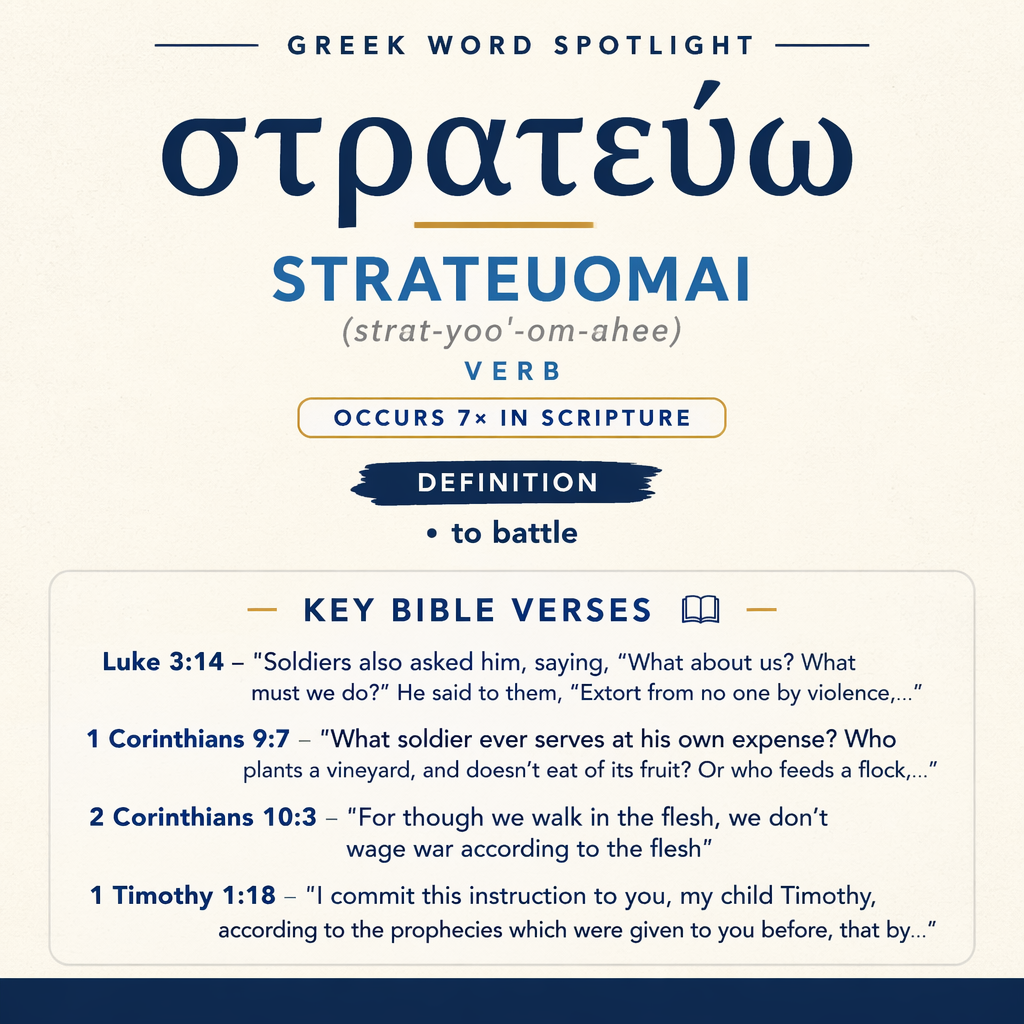
στρατεύω means “to battle” and occurs 7 times in Scripture: Luke 3:14; 1 Corinthians 9:7; 2 Corinthians 10:3; 1 Timothy 1:18; 2 Timothy 2:4; James 4:1; 1 Peter 2:11.
Core Meaning
στρατεύω is defined as “to battle.” It appears in contexts that speak of soldiers and warfare.
Learn More →Scripture Occurrences
The verb occurs 7 times in Scripture. It is found in Luke 3:14; 1 Corinthians 9:7; 2 Corinthians 10:3; 1 Timothy 1:18; 2 Timothy 2:4; James 4:1; and 1 Peter 2:11.
Learn More →Usage Snapshots
It is used of soldiers (Luke 3:14; 1 Corinthians 9:7; 2 Timothy 2:4) and of waging war (2 Corinthians 10:3). It also describes wars among people and desires that war against the soul (James 4:1; 1 Peter 2:11).
Learn More →στρατεύω expresses the act of battling, and in the New Testament it appears in settings that range from literal soldiers and military service to inner conflict and moral struggle. The passages below show how the verb can describe outward warfare, disciplined service, and hostile impulses that “war” within a person.
Occurrences
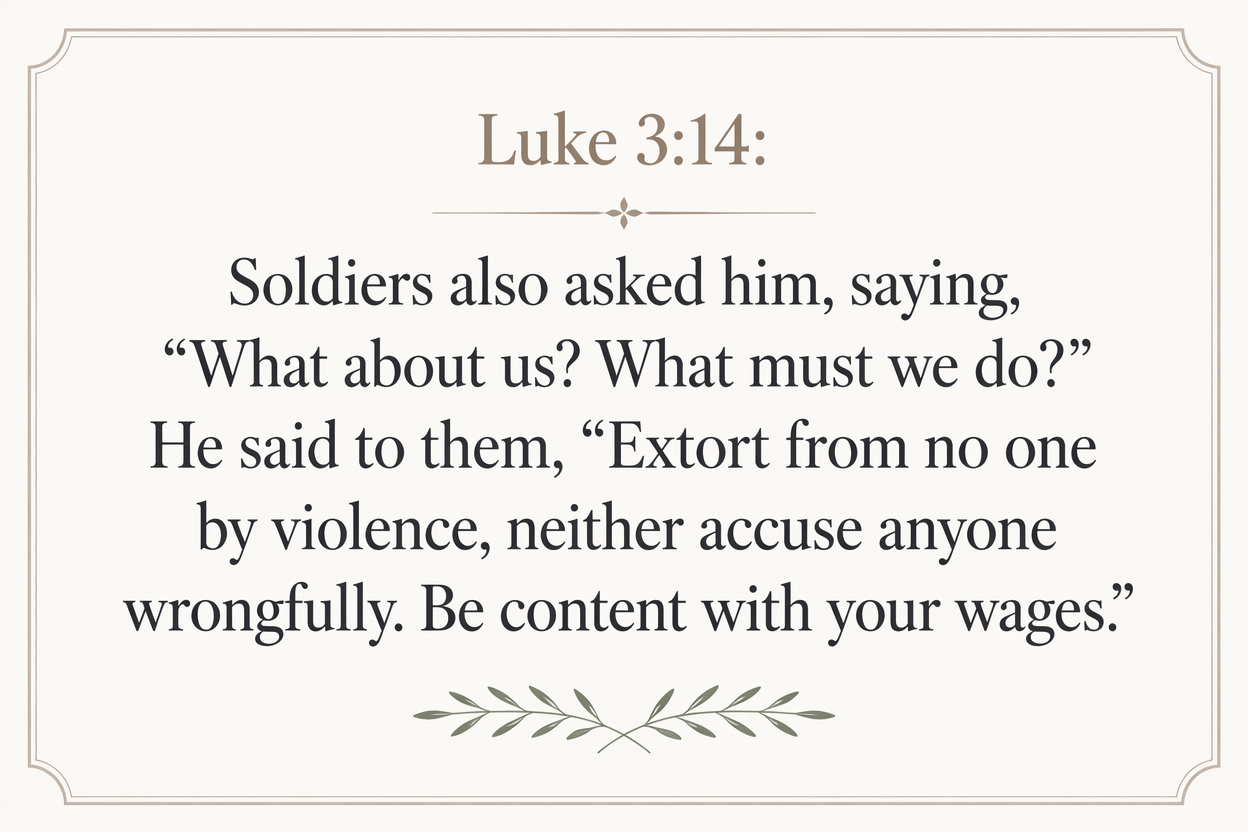
Luke 3:14: Soldiers also asked him, saying, “What about us? What must we do?” He said to them, “Extort from no one by violence, neither accuse anyone wrongfully. Be content with your wages.”
In this exchange, the presence of “Soldiers” frames the conversation around people whose work is tied to force and coercion. The instruction John gives (“Extort from no one by violence… Be content with your wages.”) addresses temptations that can accompany a soldier’s position and power. The verb’s domain of battling fits the social reality implied by soldiers asking how to live rightly while remaining in a role associated with violence.
1 Corinthians 9:7: What soldier ever serves at his own expense? Who plants a vineyard, and doesn’t eat of its fruit? Or who feeds a flock, and doesn’t drink from the flock’s milk?
Here “soldier” provides the first analogy in a trio (soldier/vineyard/flock). The rhetorical question assumes a pattern: service in a demanding role is ordinarily supported rather than self-funded. The verb’s sphere of battle supplies a concrete picture of costly service, used to argue that those who labor should not be expected to absorb all costs personally. The military image is not developed for its tactics but for its understood demands and obligations.
2 Corinthians 10:3: For though we walk in the flesh, we don’t wage war according to the flesh;
This statement contrasts ordinary human life (“walk in the flesh”) with the manner in which the conflict is carried out (“we don’t wage war according to the flesh”). The word’s contribution is to cast Paul’s activity in terms of warfare while sharply qualifying the kind of warfare involved. The sentence creates a tension: the battleground language is retained, but the standards and methods are explicitly distinguished from merely human, physical, or worldly ones.
1 Timothy 1:18: I commit this instruction to you, my child Timothy, according to the prophecies which were given to you before, that by them you may wage the good warfare,
The verb appears in an exhortation directed to Timothy, where instruction and remembered prophecies are presented as resources “that by them you may wage the good warfare.” Battling language functions as a framework for Timothy’s task: he is to engage in a struggle described as “good,” suggesting that the conflict is purposeful and morally bounded. The “instruction” is not merely information; it is equipment for sustained engagement.
2 Timothy 2:4: No soldier on duty entangles himself in the affairs of life, that he may please him who enrolled him as a soldier.
This verse uses the soldier as a model of focused commitment. The warfare concept is implied by “soldier on duty” and sharpened by the contrast between entanglement in “the affairs of life” and the aim “that he may please him who enrolled him.” The verb’s world of battling highlights the need for clear priorities: active service limits distractions, because the soldier’s attention is oriented toward the one who has enlisted him.
James 4:1: Where do wars and fightings among you come from? Don’t they come from your pleasures that war in your members?
The imagery shifts from external battlefields to interpersonal conflict and inner impulses. “Wars and fightings among you” are traced to “pleasures that war in your members,” locating the source of communal strife inside the person. The verb makes the pleasures active combatants: they do not merely exist; they “war,” generating pressure that spills outward into “wars and fightings” within the community.
1 Peter 2:11: Beloved, I beg you as foreigners and pilgrims, to abstain from fleshly lusts, which war against the soul;
Again the warfare is internalized: “fleshly lusts” are portrayed as forces that “war against the soul.” The exhortation to “abstain” gains urgency because the opposition is not neutral; it is aggressive and ongoing. By choosing battlefield language, the verse describes desire as something that attacks and seeks to overpower, and it portrays the soul as the target of that assault.

Sense and Usage
Across these contexts, στρατεύω consistently imports the dynamics of battle into whatever sphere the writer is describing. In some passages, the military world stands in the foreground through explicit references to “Soldiers” and “soldier on duty” (Luke 3:14; 2 Timothy 2:4). In others, the conflict is expressed without naming soldiers at all, as when Paul speaks of not “wage[ing] war according to the flesh” (2 Corinthians 10:3) or when James and Peter depict desires as active opponents within a person (James 4:1; 1 Peter 2:11). The verb is therefore flexible in application while remaining stable in its core idea: it describes engagement in a struggle that has an adversarial shape.
In passages that use a soldier as an illustration (1 Corinthians 9:7; 2 Timothy 2:4), the warfare idea supplies social expectations. A soldier’s service is understood to involve cost, obligation, and discipline. Paul’s question, “What soldier ever serves at his own expense?” presumes that battle-service normally entails provision and support; the point depends on the perceived fairness built into military life. Similarly, “No soldier on duty entangles himself in the affairs of life” relies on the common-sense notion that active military commitment constrains everyday freedom; the soldier’s goal is “to please him who enrolled him.” In both cases, the military frame is not ornamental: it carries assumptions about what battling life requires and what it permits.
When the verb is applied to Christian ministry and moral perseverance (1 Timothy 1:18; 2 Corinthians 10:3), it gives a vivid structure to tasks that might otherwise sound abstract. “Wage the good warfare” treats Timothy’s calling as a campaign requiring endurance and direction, and it links the ability to do so with “instruction” and prior “prophecies.” The effect is to present teaching and remembered divine guidance as instruments that enable ongoing engagement. In 2 Corinthians 10:3, the same battle concept is affirmed but bounded: warfare language is adopted while “according to the flesh” is denied. That phrasing keeps the sense of real conflict while rejecting a merely human mode of fighting, sharpening the distinction between the sphere of ordinary life (“walk in the flesh”) and the manner of the struggle.
James 4:1 and 1 Peter 2:11 show how naturally the verb can be extended to inner life without losing its force. In James, the inner “pleasures” are described as warring “in your members,” and the outward result is “wars and fightings among you.” The direction runs from inward conflict to communal breakdown. Peter, addressing “foreigners and pilgrims,” frames abstinence from “fleshly lusts” as resistance in a conflict where lusts “war against the soul.” In both, warfare language captures persistence and hostility: these impulses do not simply tempt; they attack. The choice of battlefield imagery portrays moral life as contested ground where opposing forces press for control.
Imagery
Taken together, these verses form a coherent picture of battle as a metaphor for demanding service and for the pressure of hostile impulses. The soldier scenes evoke duty, wages, and pleasing an enlisting authority (Luke 3:14; 1 Corinthians 9:7; 2 Timothy 2:4), while the inward scenes depict pleasures and lusts as aggressors that initiate conflict within the person (James 4:1; 1 Peter 2:11). Paul’s language holds both aspects in tension: a real warfare is acknowledged, yet it is explicitly distinguished from warfare conducted “according to the flesh” (2 Corinthians 10:3), and Timothy is urged to engage in a warfare characterized as “good” and sustained by instruction (1 Timothy 1:18).
Sources: Lexical data from Strong’s Exhaustive Concordance and the Translators Brief Lexicon of Extended Strongs for Greek (STEPBible, CC BY). Occurrence data from the Translators Amalgamated Greek New Testament (STEPBible, CC BY). Scripture quotations from the World English Bible (public domain).