Exploring the Meaning of Epichoregia in Greek
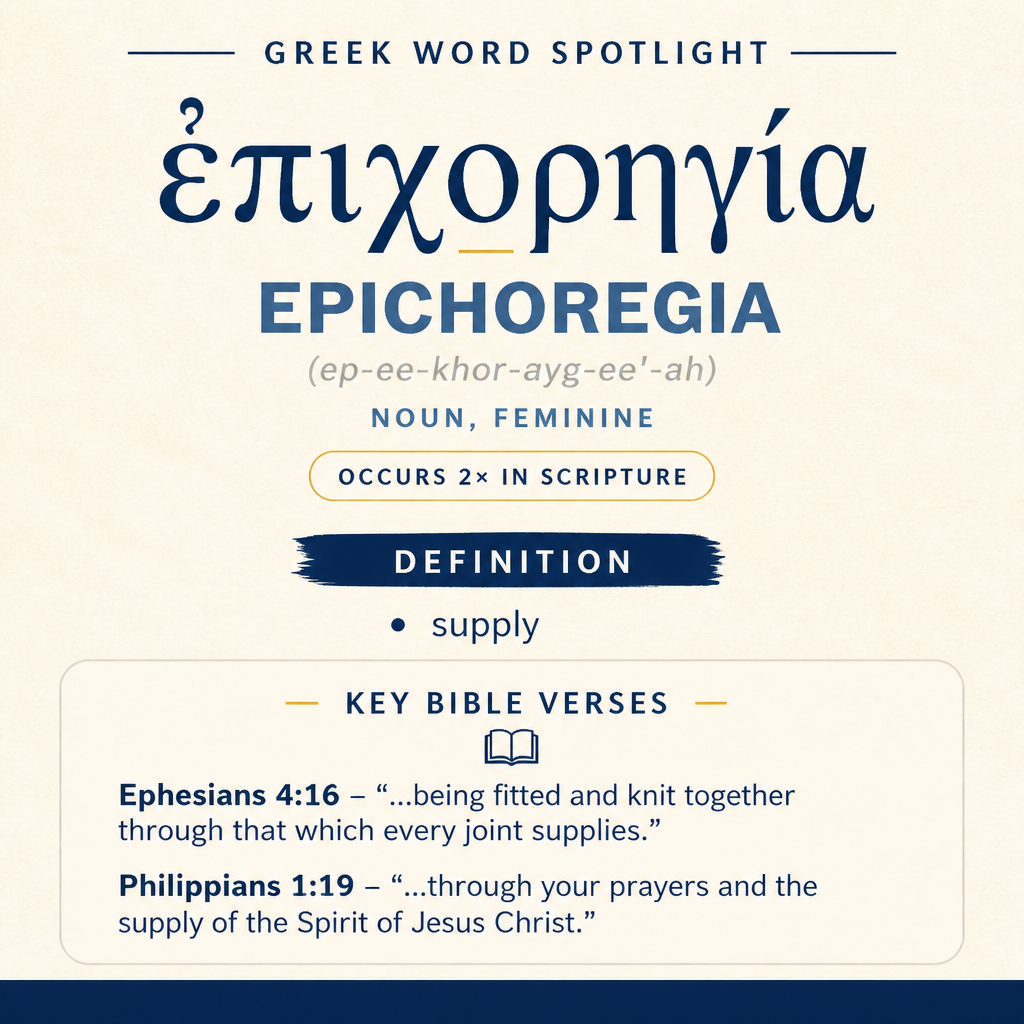
ἐπιχορηγία means “supply” and appears in Ephesians 4:16 and Philippians 1:19.
Scripture Occurrences
It occurs 2 times in Scripture: Ephesians 4:16 and Philippians 1:19.
Learn More →Context in Verses
In Ephesians 4:16 it describes what every joint supplies to the body. In Philippians 1:19 it refers to the supply of the Spirit of Jesus Christ.
Learn More →ἐπιχορηγία means “supply” and appears in two New Testament passages: one describing how the body grows through what each joint supplies, and one describing salvation advancing through prayer and the Spirit’s supply.
Root and Related Words
ἐπιχορηγία is related to the verb Epichoregeo (ἐπιχορηγέω), meaning “to supply” (Strong’s G2023).
Occurrences
Ephesians 4:16 — “from whom all the body, being fitted and knit together through that which every joint supplies, according to the working in measure of each individual part, makes the body increase to the building up of itself in love.”
In this sentence the word “supply” sits inside an extended description of the body’s unity and growth. The body is pictured as “fitted and knit together,” and the practical means by which this cohesion holds is “that which every joint supplies.” Here ἐπιχορηγία names the concrete contribution associated with a “joint”—something that passes through the body’s connections so that the whole can function as one. The statement is not merely that the body exists or is arranged well; it “makes the body increase,” and that increase occurs “according to the working in measure of each individual part.” The “supply” therefore belongs to the sphere of measured, effective operation: each part works, each part has a measure, and through the joints there is a supply that serves the body’s increase. The result is not abstract growth but growth “to the building up of itself in love,” so the supply is portrayed as a means by which the body actively builds itself up, rather than being built up only from the outside.
The phrasing also highlights direction and dependence: the whole process is “from whom,” and only then does the description unfold into joints, parts, working, and increase. In this context, ἐπιχορηγία helps describe how what comes “from” the source becomes operative within the body’s internal structure. The supply is not treated as a vague resource; it is located at the joints, where the fitted parts meet, and it is linked to the body’s being “knit together.” That placement makes the word carry the idea of provision that enables connection and coordinated action, expressed through the body metaphor’s anatomy.
Philippians 1:19 — “For I know that this will turn out to my salvation, through your prayers and the supply of the Spirit of Jesus Christ,”
Here ἐπιχορηγία appears in a tightly focused statement of confidence: “I know that this will turn out to my salvation.” The sentence then names the means “through” which that outcome will come: “your prayers” and “the supply of the Spirit of Jesus Christ.” The word “supply” therefore functions as one of two channels through which the stated result is expected. It is coordinated with “your prayers,” setting the supply alongside a communal human activity and presenting both together as instrumental to the anticipated deliverance.
The supply is specifically “of the Spirit of Jesus Christ,” so ἐπιχορηγία in this setting is not an impersonal provision but one tied to the Spirit. It is also framed as something available for an ongoing situation: the speaker anticipates a future outcome (“will turn out”), and the supply belongs to the process leading to that outcome (“through”). In this way, the word supports a view of salvation not as a bare assertion but as something reached by means that are presently in operation—prayers being offered and the Spirit’s supply being given.
Sense and Usage
Across these two passages, “supply” is presented as a meaningful provision that enables a desired end. In Ephesians 4:16 the supply is distributed within an organic whole: joints supply, parts work “in measure,” and the body increases toward self-edification “in love.” The emphasis falls on coordinated provision within interdependence. The word is not attached to a solitary individual acting alone; it is attached to the body’s connections, where provision serves cohesion and growth. Supply, in that portrayal, is a functional contribution that participates in the body’s internal unity and outward increase.
In Philippians 1:19 the supply is not described in anatomical terms but in relational and spiritual terms: it is “of the Spirit of Jesus Christ” and works alongside “your prayers” as a means to an expected saving outcome. The shared idea is that supply is an effective provision that is not merely possessed but operative—something that participates in bringing about growth in one passage and salvation in the other. Both uses place ἐπιχορηγία in instrumental phrases (“through that which every joint supplies”; “through your prayers and the supply…”), highlighting supply as a conduit by which something happens.
The contexts also show that the word readily fits both corporate and personal horizons. In Ephesians, supply is expressed through the body’s interlocking life, and the endpoint is communal building up. In Philippians, supply is tied to the Spirit and to a specific person’s anticipated salvation, while still involving the community through their prayers. The word’s sense remains consistent: a supply is something furnished that materially affects the stated outcome, whether the outcome is the body’s increase or an individual’s salvation as events “turn out.”
Imagery in Context
Ephesians 4:16 gives ἐπιχορηγία tangible imagery by placing it at “every joint,” where provision passes through the body’s points of connection so that the whole increases and builds itself up in love. Philippians 1:19 gives the word a different kind of vividness: supply is paired with prayer and linked to “the Spirit of Jesus Christ,” forming part of the means by which a hoped-for deliverance is expected to unfold.
Sources: Lexical data from Strong’s Exhaustive Concordance and the Translators Brief Lexicon of Extended Strongs for Greek (STEPBible, CC BY). Occurrence data from the Translators Amalgamated Greek New Testament (STEPBible, CC BY). Scripture quotations from the World English Bible (public domain).