Exploring the Meaning of Etoi in Greek
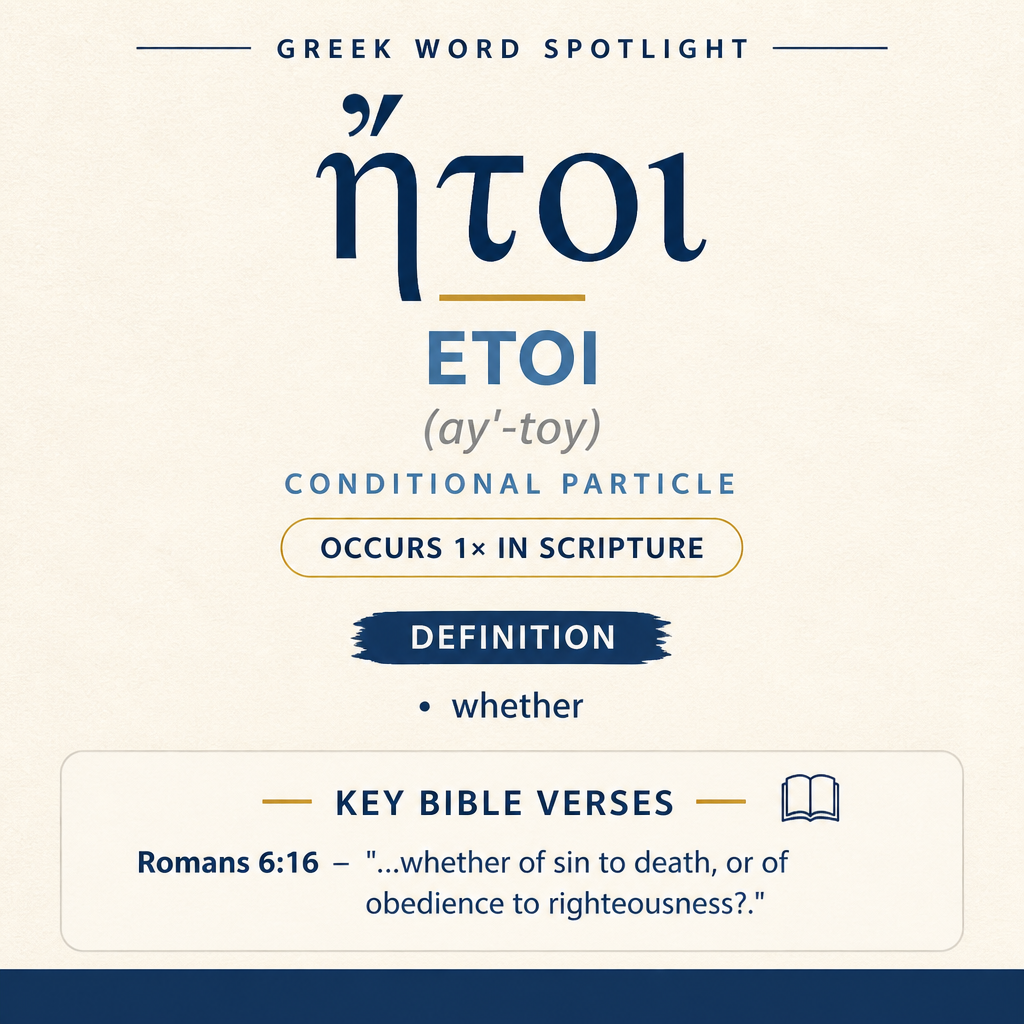
ἤτοι means “whether” and appears once in Scripture, in Romans 6:16.
Biblical Occurrence
This word occurs 1 time in Scripture. Its recorded occurrence is in Romans 6:16.
Learn More →Verse Context
In Romans 6:16, it appears within a statement about presenting yourselves as servants and obeying someone.
Learn More →ἤτοι expresses an alternative framed as “whether,” and it is attested in the New Testament in Romans 6:16. In that verse it introduces a two-way division that helps the reader hear the sentence as a pair of contrasted outcomes.
Root and Related Words
ἤτοι is connected with the particle e (ἤ), “or,” and with toi (τοί), “certainly.”

Occurrences
“Don’t you know that when you present yourselves as servants and obey someone, you are the servants of whomever you obey; whether of sin to death, or of obedience to righteousness?” (Romans 6:16)
In Romans 6:16, ἤτοι stands at the hinge where the statement turns from a general principle to two concrete alternatives. The verse begins with a broad claim about presentation and obedience: “when you present yourselves as servants and obey someone, you are the servants of whomever you obey.” After that, the sentence specifies the possible masters and their corresponding ends. By introducing the first option—“whether of sin to death”—ἤτοι signals that what follows is one member of a set. The reader is prepared to expect a second member, which the verse supplies: “or of obedience to righteousness.”
Because the alternatives are laid out after a semicolon, ἤτοι functions as an organizer of the clause that follows. It helps keep the logic from collapsing into a vague statement about service and obedience; instead, it forces the principle into a sharply delimited choice. The two members are parallel in form (“of sin…” / “of obedience…”), and ἤτοι marks that the first member is not a standalone comment but part of a structured either–or construction. In context, this makes the line read as a categorical division: presenting oneself and obeying leads to belonging to the one obeyed, and that belonging is then described under two headings.
The word also contributes to the rhetorical force of the question “Don’t you know…?” The question assumes the audience recognizes the basic social logic: servants belong to the one they obey. ἤτοι then pushes that recognition into a moral contrast within the same frame of belonging and outcome. The result is that “sin” and “obedience” are not merely listed as topics; they are set as alternatives that map onto distinct endpoints (“death” versus “righteousness”) within one coherent sentence.
Sense and Usage
The sense “whether” in Romans 6:16 is used to present one option that is immediately balanced by a second. It does not add a new subject or a new line of reasoning; it establishes the form of the reasoning as an alternative. In this verse, the alternatives are not offered as a speculative question about what might be the case; they are presented as the two ways the general principle can be instantiated. The structure “whether … or …” constrains the reader to think in terms of a bifurcation: one path described as “of sin to death,” the other as “of obedience to righteousness.”
In ordinary discourse, “whether” can introduce uncertainty or inquiry, but here it operates inside a statement that is meant to be obvious to the audience (“Don’t you know…?”). The “whether” clause therefore reads as a clarifying partition rather than a request for information. It frames the alternatives as real and mutually exclusive within the logic of the sentence: to obey is to be a servant of the one obeyed, and this servitude is describable under one of two headings. ἤτοι helps the reader track that the sentence is not contrasting two abstract nouns in isolation but correlating them with outcomes: the “sin” alternative is characterized by movement “to death,” and the “obedience” alternative is characterized by movement “to righteousness.”
The placement of ἤτοι is also significant for how the verse lands. It occurs after the main assertion has been stated in full, so its “whether” does not govern the whole sentence but the specification that follows. This makes the verse read like a logical progression: principle first, then categorized application. The conjunction “or” that follows later completes what ἤτοι initiates, turning the final portion of the verse into a balanced pair. The effect is a concise alternative structure that supports the verse’s emphasis on the determinative character of obedience: one is servant “of whomever you obey,” and the alternatives supplied show how that servitude is understood in terms of destination.
Imagery in Context
Romans 6:16 uses the everyday picture of presenting oneself as a servant and obeying a master, and ἤτοι helps that picture split into two roads with different destinations. The language of “servants,” “obey,” and “to death” or “to righteousness” gives the alternatives a directional feel, as though service carries one forward toward a defined end; “whether” marks the first of those ends as part of a paired outcome.
Sources: Lexical data from Strong’s Exhaustive Concordance and the Translators Brief Lexicon of Extended Strongs for Greek (STEPBible, CC BY). Occurrence data from the Translators Amalgamated Greek New Testament (STEPBible, CC BY). Scripture quotations from the World English Bible (public domain).