Exploring the Meaning of Enteuthen in Greek
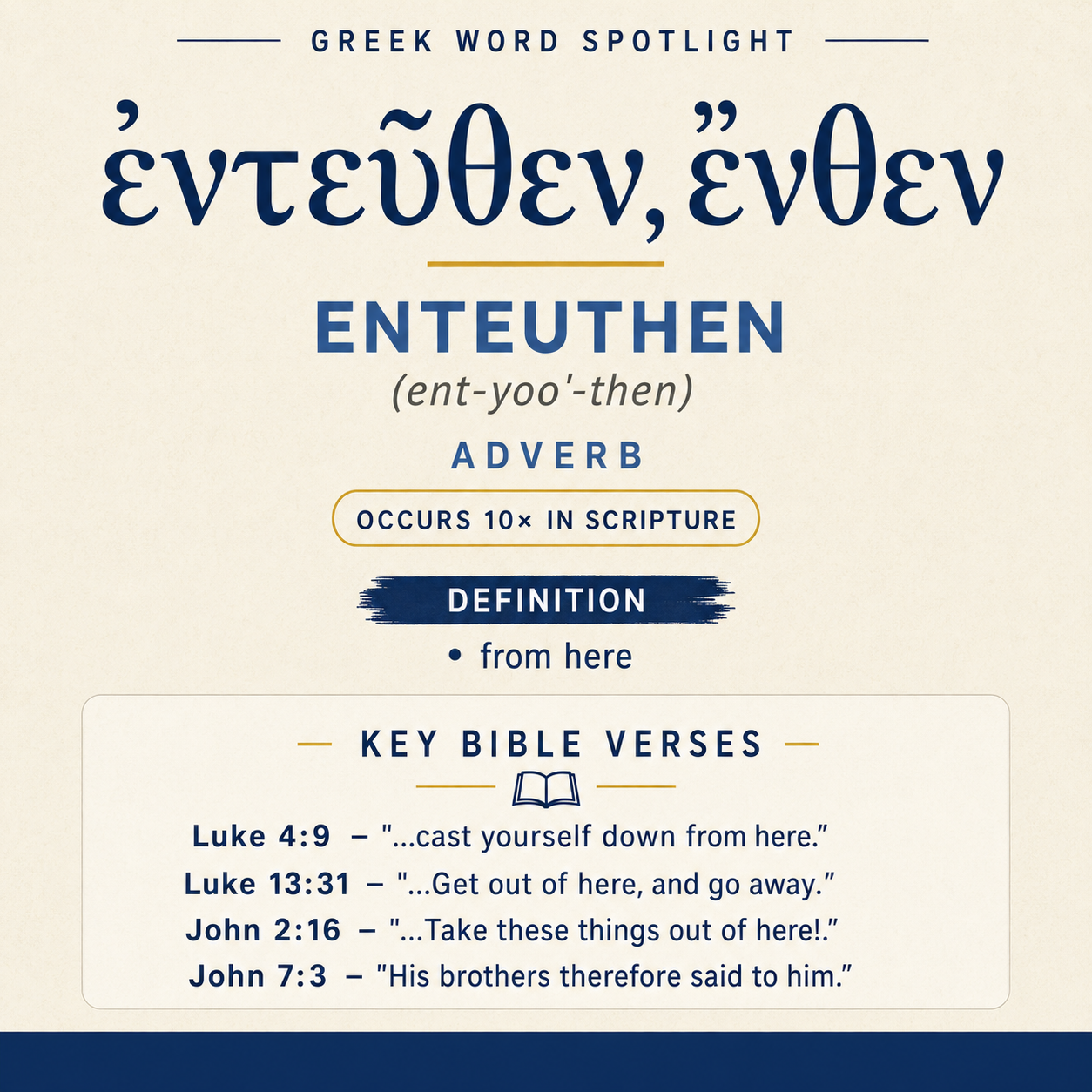
ἐντεῦθεν (ἔνθεν) means “from here” and occurs 10 times in Scripture, including Luke, John, and James.
Scripture Occurrences
It occurs 10 times in Scripture, including places in Luke, John, and James.
Learn More →Sample Contexts
It is used in direct speech such as “Get out of here” (Luke 13:31) and “Take these things out of here” (John 2:16).
Learn More →ἐντεῦθεν / ἔνθεν expresses movement or origin “from here,” marking departure from a location or denial of a source. In the passages where it appears, it repeatedly sharpens the scene by pointing to the immediate place being left, rejected, or contrasted with some other realm.
Occurrences
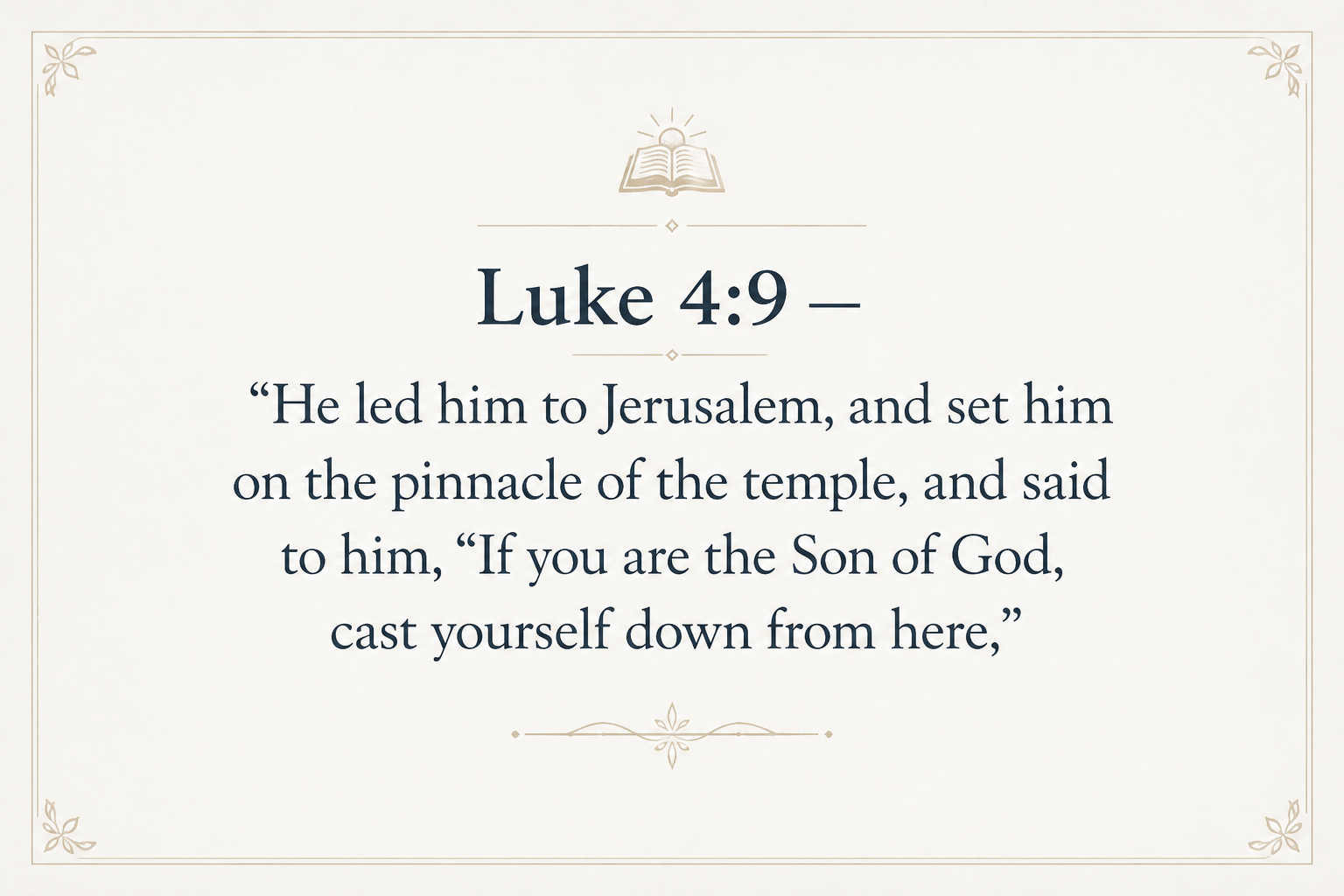
Luke 4:9 — “He led him to Jerusalem, and set him on the pinnacle of the temple, and said to him, “If you are the Son of God, cast yourself down from here,”
“From here” fixes the temptation’s challenge to the precise spot where Jesus stands: the temple’s pinnacle. The adverb anchors the command to the immediate physical location, so that the proposed action is not merely “cast yourself down” in general but specifically a drop initiated at that elevated point in Jerusalem.
Luke 13:31 — “On that same day, some Pharisees came, saying to him, “Get out of here, and go away, for Herod wants to kill you.””
Here the phrase “out of here” functions as an urgent directive to leave the present setting. The adverb gives the warning a concrete spatial edge: danger is tied to where Jesus is now, and safety—at least in the speakers’ framing—is imagined as distance created by departure from that immediate place.
John 2:16 — “To those who sold the doves, he said, “Take these things out of here! Don’t make my Father’s house a marketplace!””
“Out of here” is the sharp, practical thrust of the command: removal from the location in view, identified in the next line as “my Father’s house.” The adverb presses the action toward clearing the space itself; what is objectionable is not merely the existence of “these things” but their presence in that place, so they must be taken away from there.
John 7:3 — “His brothers therefore said to him, “Depart from here and go into Judea, that your disciples also may see your works which you do.”
In this counsel from Jesus’ brothers, “from here” sets up a planned relocation: leave the current region and “go into Judea.” The adverb marks the starting point for the proposed move and frames the suggestion as a change of venue connected to visibility—so that disciples “may see” what he does in a different setting.
John 14:31 — “But that the world may know that I love the Father, and as the Father commanded me, even so I do. Arise, let’s go from here.”
“Let’s go from here” closes the statement with an immediate transition from words to movement. The adverb makes the departure feel concrete and present: the location of speaking becomes the location being left, and the shift is portrayed as purposeful action consistent with what has just been said about obedience to the Father’s command.
John 18:36 — “Jesus answered, “My Kingdom is not of this world. If my Kingdom were of this world, then my servants would fight, that I wouldn’t be delivered to the Jews. But now my Kingdom is not from here.””
“Not from here” carries the force of a denial of origin or source, set against “this world.” The adverb marks a contrast between the present sphere in which Jesus is being opposed and delivered, and the Kingdom he speaks of. By stating it is “not from here,” Jesus distinguishes the Kingdom’s source from the immediate realm in which the conflict and potential fighting would otherwise be expected.
John 19:18 — “where they crucified him, and with him two others, on either side one, and Jesus in the middle.”
This verse narrates the location of the crucifixion (“where they crucified him”), placing Jesus “in the middle.” In context, “from here” contributes a deictic precision in surrounding scenes by emphasizing specific places and departures; in a narrative that foregrounds where events occur, such place-pointing language serves to keep the reader oriented to the concrete setting as the action unfolds.
James 4:1 — “Where do wars and fightings among you come from? Don’t they come from your pleasures that war in your members?”
The repeated “come from” presses the question of origin: the source of “wars and fightings among you.” While not a command to depart, the adverbial idea “from here” naturally resonates with the passage’s focus on where something arises. The emphasis is on tracing conflict back to an originating point, described as “your pleasures that war in your members,” bringing the issue close—rooted within the community’s own internal drives rather than in a distant cause.
Revelation 22:2 — “in the middle of its street. On this side of the river and on that was the tree of life, bearing twelve kinds of fruits, yielding its fruit every month. The leaves of the tree were for the healing of the nations.”
The verse is rich in spatial markers: “in the middle,” “On this side… and on that,” locating the tree of life relative to “its street” and “the river.” Within such carefully mapped imagery, “from here” functions elsewhere as a pointer to starting point or source; this kind of adverbial anchoring suits a scene where location and orientation are central to what is being described.

Sense and Usage
Across these passages, “from here” consistently does one primary job: it binds an action or claim to an immediate point of reference. In narrative settings, it makes departures feel real and situated. When Jesus’ brothers say, “Depart from here and go into Judea” (John 7:3), the expression identifies the present place as the starting line for a deliberate move to a different region. When Jesus says, “Arise, let’s go from here” (John 14:31), the same expression compresses decision and movement into the moment; the location of speaking is treated as the location being left, giving the line the feel of an actual step forward rather than a mere conclusion.
In commands directed at others, “from here” can carry a purging or clearing sense simply by specifying the place from which objects must be removed. “Take these things out of here!” (John 2:16) is not abstract protest but an instruction tied to a specific locale—immediately clarified as “my Father’s house.” The adverb pins the problem to presence-in-place: the issue is that “these things” occupy that space, so the demanded remedy is removal from that location.
In confrontational or threatening contexts, “from here” highlights perceived proximity to danger. “Get out of here, and go away, for Herod wants to kill you” (Luke 13:31) makes the current place sound like the danger zone. The adverb does not describe the threat itself; it describes the direction of the advised response—distance from the present setting. Likewise, in the temptation at the temple, “cast yourself down from here” (Luke 4:9) uses “from here” to locate the proposed act at a dramatic point: the temple’s pinnacle. The adverb fixes the suggestion to that spot, intensifying the immediacy of the challenge by making the reader look from the present location down.
The most theologically charged use remains straightforwardly spatial in form: “my Kingdom is not from here” (John 18:36). The adverb still denotes origin (“from”), but the contrast is between “this world” and “here.” The line uses “from here” to draw a boundary between the realm in which Jesus is being handled—delivered, threatened, and subject to violence—and the Kingdom’s source. The statement gains rhetorical force precisely because “here” is the world the audience stands in; “not from here” marks the Kingdom as not arising out of the immediate sphere where power struggles and physical defense would normally decide outcomes.
Even in passages that focus less on movement and more on causation, the same basic “from” idea helps frame the thought. James asks, “Where do wars and fightings among you come from?” (James 4:1). The question presses for a point of origin, then answers by tracing the source to “your pleasures.” The logic is origin-focused: conflicts have a “from,” and the text directs attention to a near and internal “from,” not a remote one.
Imagery
Because “from here” is deictic—spoken from within a scene—it frequently invites the reader to stand inside the narrated space and look outward. At the temple pinnacle (Luke 4:9), it points from a height toward the drop below. In the temple courts (John 2:16), it points from within “my Father’s house” toward the exits as items are ordered removed. In farewells and transitions (John 14:31), it points away from the place of speaking into the next, unpictured movement. And in the Kingdom saying (John 18:36), it points from the present world as “here” toward an origin that is deliberately placed elsewhere by the denial “not from here.”
Sources: Lexical data from Strong’s Exhaustive Concordance and the Translators Brief Lexicon of Extended Strongs for Greek (STEPBible, CC BY). Occurrence data from the Translators Amalgamated Greek New Testament (STEPBible, CC BY). Scripture quotations from the World English Bible (public domain).