Exploring the Meaning of Peteinon in Greek
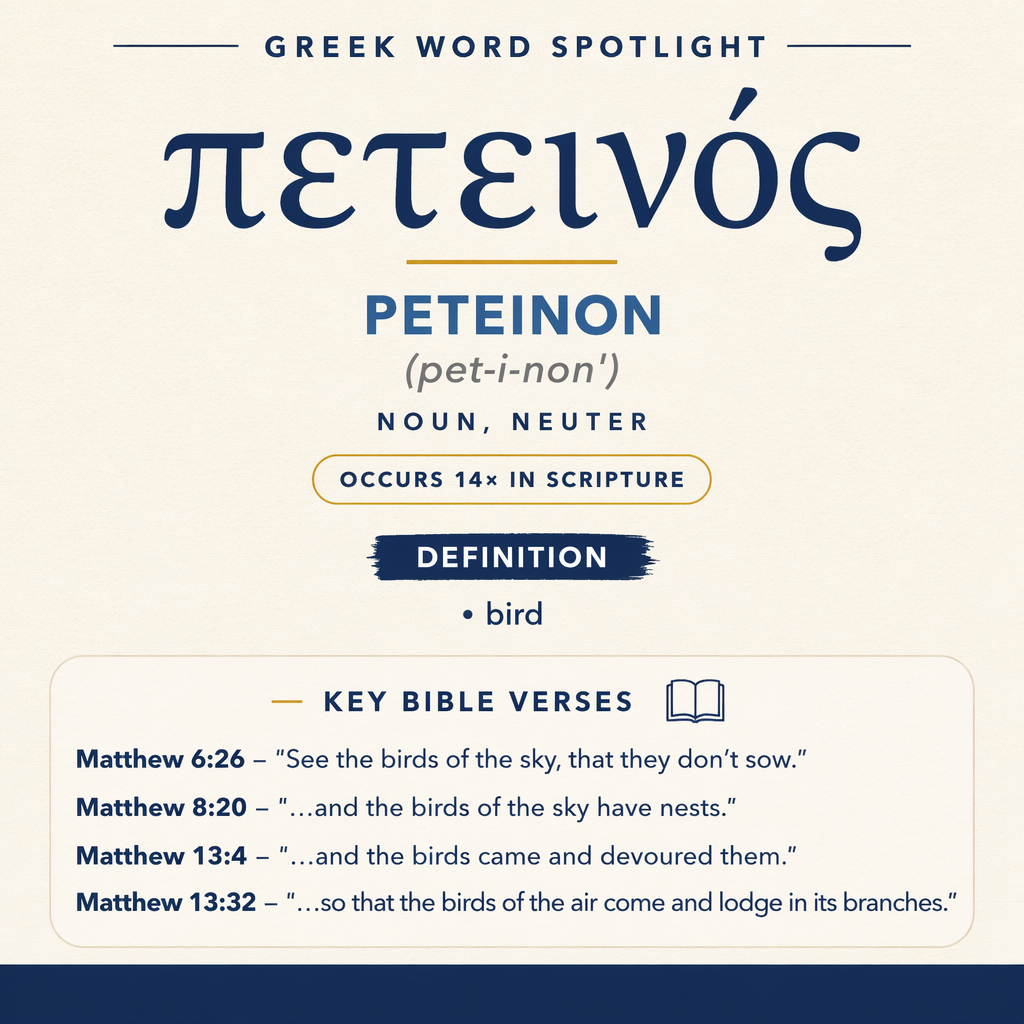
πετεινός means “bird” and appears 14 times in Scripture, including Matthew, Mark, and Luke.
Gospel Occurrences
It occurs in Matthew 6:26; 8:20; 13:4; 13:32, Mark 4:4; 4:32, and Luke 8:5; 9:58.
Learn More →Context Snapshots
It is used for “birds of the sky” with nests (Matthew 8:20; Luke 9:58). It also describes birds devouring seed by the roadside (Matthew 13:4; Mark 4:4; Luke 8:5).
Learn More →πετεινός refers to a bird. In the passages where it appears, it serves as a familiar, observable creature in teaching illustrations, sayings about shelter and provision, and a vision scene that lists living kinds.
Occurrences
Matthew 6:26 — “See the birds of the sky, that they don’t sow, neither do they reap, nor gather into barns. Your heavenly Father feeds them. Aren’t you of much more value than they?”
Here πετεινός evokes birds in their ordinary life: they do not perform the agricultural actions named (“sow… reap… gather into barns”), yet they are fed. The word anchors the argument in something visible and commonplace—creatures that live without the human practices of storing grain—so that the contrast (“Aren’t you of much more value than they?”) can be heard against a concrete picture.
Matthew 8:20 — “Jesus said to him, “The foxes have holes, and the birds of the sky have nests, but the Son of Man has nowhere to lay his head.””
πετεινός is paired with foxes to describe animal shelter. “Birds of the sky have nests” uses birds as an example of creatures that possess a place of rest, sharpening the force of the final clause about having “nowhere to lay his head.” The word contributes the image of nesting—an expected, stable refuge—without specifying any particular species.
Matthew 13:4 — “As he sowed, some seeds fell by the roadside, and the birds came and devoured them.”
In this sowing scene, πετεινός depicts birds as opportunistic eaters. Their arrival explains the fate of seed “by the roadside”: it does not remain to grow because it is “devoured.” The word supplies the agent that removes the seed, making the roadside outcome immediate and visible.
Matthew 13:32 — “which indeed is smaller than all seeds. But when it is grown, it is greater than the herbs, and becomes a tree, so that the birds of the air come and lodge in its branches.”
πετεινός appears in a growth comparison: a small beginning becomes “a tree,” and birds respond by settling into it. “Come and lodge in its branches” uses birds to measure the tree’s maturity and size; the word helps the reader picture branching space sufficient for perching and temporary dwelling.
Mark 4:4 — “and as he sowed, some seed fell by the road, and the birds came and devoured it.”
This occurrence parallels the roadside image: birds arrive and consume exposed seed. πετεινός again provides the natural explanation for loss—seed on the road is accessible, and birds function as the immediate cause of its disappearance.
Mark 4:32 — “yet when it is sown, grows up, and becomes greater than all the herbs, and puts out great branches, so that the birds of the sky can lodge under its shadow.”
Here birds mark the result of vigorous growth: “puts out great branches” leads to sheltering shade. πετεινός contributes to the scene by introducing living creatures that make use of that shade, and the phrase “can lodge under its shadow” highlights the plant’s expansive canopy as a place where birds may rest.
Luke 8:5 — ““The farmer went out to sow his seed. As he sowed, some fell along the road, and it was trampled under foot, and the birds of the sky devoured it.”
In Luke’s form of the sowing scene, birds are one of two forces acting on seed “along the road”: it is “trampled under foot,” and birds then “devoured it.” πετεινός thus joins a sequence of causes explaining why that seed yields nothing; birds complete the picture of roadside vulnerability.
Luke 9:58 — “Jesus said to him, “The foxes have holes, and the birds of the sky have nests, but the Son of Man has no place to lay his head.””
As in Matthew 8:20, πετεινός appears in a comparison about having a place of rest. The mention of birds and their nests makes “no place to lay his head” more striking by contrasting human homelessness with the ordinary nesting habit of birds.
Luke 12:24 — “Consider the ravens: they don’t sow, they don’t reap, they have no warehouse or barn, and God feeds them. How much more valuable are you than birds!”
Although ravens are singled out for consideration, πετεινός appears in the closing comparison (“more valuable… than birds”). The word expands the point from one example to birds generally, keeping the focus on creatures that lack “warehouse or barn” and yet are fed. The rhetorical move depends on birds as a recognized class of living things whose lives can be observed apart from human storage and planning.
Luke 13:19 — “It is like a grain of mustard seed which a man took and put in his own garden. It grew and became a large tree, and the birds of the sky live in its branches.”
πετεινός here contributes an image of a “large tree” that becomes habitat. The wording “live in its branches” is stronger than a brief stopover; birds are pictured as inhabiting the tree’s branching structure. The word thus helps portray the tree as a sustained living space, not merely a tall plant.
Acts 10:12 — “in which were all kinds of four-footed animals of the earth, wild animals, reptiles, and birds of the sky.”
In this vision list, πετεινός names one category among multiple land-and-sky creatures. The word’s role is classificatory: along with “four-footed animals… wild animals… reptiles,” it rounds out the scene with “birds of the sky,” implying variety (“all kinds”) within the pictured collection.
Acts 11:6 — “When I had looked intently at it, I considered, and saw the four-footed animals of the earth, wild animals, creeping things, and birds of the sky.”
This retelling repeats the creature categories with slight variation (“creeping things”); πετεινός again supplies the avian category. The verbs “looked intently… considered… saw” frame the list as careful observation, and the presence of birds alongside other kinds underscores the breadth of what is being shown.

Sense and Usage
Across these passages, πετεινός functions as a general term for birds rather than a narrow designation of a single kind. It is often modified by a phrase describing their domain (“of the sky,” “of the air”), which keeps attention on birds as freely moving creatures above human fields and dwellings and as a natural part of the environment in which sowing, growth, and daily life take place.
In the teaching scenes from Matthew, Mark, and Luke, birds serve two recurring purposes. First, they embody unplanned dependence in the sayings about provision: birds do not participate in the human cycle of sowing, reaping, and storing, yet they are fed (Matthew 6:26; Luke 12:24). The word therefore helps set up a comparison between human anxieties and the observable life of animals. Second, birds act as agents within agricultural imagery: in the sowing scenes, they remove exposed seed by eating it (Matthew 13:4; Mark 4:4; Luke 8:5). In that setting, the word evokes quick, natural loss—seed on the road is open to trampling and to birds.
In the mustard-seed growth sayings, πετεινός highlights the outcome of growth through the response of birds to the plant’s size. Whether the birds “come and lodge in its branches” (Matthew 13:32), “can lodge under its shadow” (Mark 4:32), or “live in its branches” (Luke 13:19), the term supplies the living occupants that make the tree’s largeness tangible. The point is not botanical detail but the created space: branches and shade become meaningful when birds can settle, lodge, or live there.
In the sayings about shelter (Matthew 8:20; Luke 9:58), πετεινός evokes the simple fact that birds have nests. The word thus participates in a contrast between the settled places of animals and the lack of a resting place described in the final clause. In Acts 10:12 and 11:6, the term moves from illustration to inventory: birds are one group within a vision’s comprehensive array of creatures, placing avian life alongside land animals and reptiles/creeping things as part of a wide, varied scene.
Imagery
The imagery carried by πετεινός in these texts is consistently concrete: birds feeding without barns (Matthew 6:26), nesting (Matthew 8:20), sweeping down on seed (Matthew 13:4), and occupying branches and shade as growth makes room for them (Mark 4:32; Luke 13:19). In Acts, the word contributes to a vivid tableau of “all kinds” of creatures seen together (Acts 10:12), reinforcing the sense of breadth and variety within the living world.
Sources: Lexical data from Strong’s Exhaustive Concordance and the Translators Brief Lexicon of Extended Strongs for Greek (STEPBible, CC BY). Occurrence data from the Translators Amalgamated Greek New Testament (STEPBible, CC BY). Scripture quotations from the World English Bible (public domain).