
Exploring the Meaning of Arrhabon in Greek
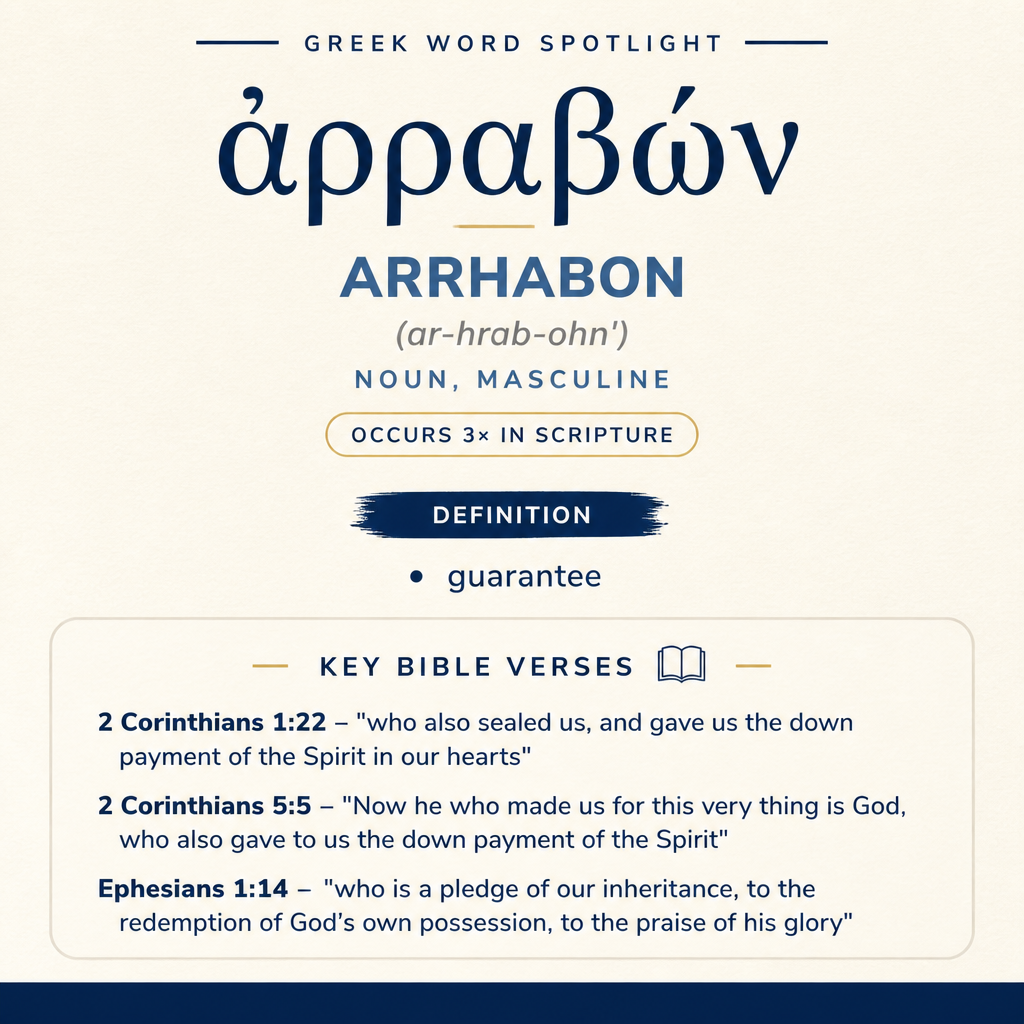
ἀρραβών means “guarantee” and appears three times in Scripture: 2 Corinthians 1:22; 2 Corinthians 5:5; Ephesians 1:14.
Pauline Occurrences
It occurs three times in Scripture: 2 Corinthians 1:22; 2 Corinthians 5:5; Ephesians 1:14.
Learn More →Spirit as Pledge
In 2 Corinthians 1:22 and 5:5, it is “the down payment of the Spirit” in believers. In Ephesians 1:14, it is “a pledge of our inheritance.”
Learn More →ἀρραβών means “guarantee” and appears in three Pauline contexts that connect the Spirit with what God will complete. In these passages the word serves as a concrete way of speaking about assurance grounded in God’s action.
Occurrences
“who also sealed us, and gave us the down payment of the Spirit in our hearts.” (2 Corinthians 1:22)
Here ἀρραβών is expressed with the phrase “the down payment of the Spirit,” placed alongside God’s “sealed” action. The word functions in a tightly packed cluster of divine acts: God seals, and God gives. Within this sentence, the guarantee is not an abstract idea floating free of experience; it is “in our hearts,” locating God’s assuring action in the inner life of the people addressed. The pairing of “sealed” and “down payment” also makes the guarantee feel formal and intentional: it is something God has put in place, not something inferred from circumstances.
“Now he who made us for this very thing is God, who also gave to us the down payment of the Spirit.” (2 Corinthians 5:5)
In this second occurrence, ἀρραβών again appears as “the down payment of the Spirit,” but it is framed by God’s purpose: “he who made us for this very thing is God.” The guarantee thus sits inside a statement about divine design and divine giving. The sentence presents a progression of thought: God has made (fashioned) people for a specific end, and God has already given something that corresponds to that end. The word’s contribution is to mark the Spirit as a present gift that points beyond itself—something given now that supports confidence about the “very thing” for which God made them.
“who is a pledge of our inheritance, to the redemption of God’s own possession, to the praise of his glory.” (Ephesians 1:14)
In Ephesians, ἀρραβών is rendered “a pledge of our inheritance,” and the surrounding phrases expand the horizon: “inheritance,” “redemption,” and “God’s own possession.” The guarantee language here is tied not only to inward assurance but also to a future-oriented movement “to the redemption” that culminates “to the praise of his glory.” The term functions as a bridge between present identity and future completion: it is a pledge that belongs with “inheritance,” and it directs attention toward a defined goal—redemption—described as concerning what already belongs to God (“God’s own possession”).

Sense and Usage
Across these three passages, ἀρραβών (“guarantee”) is consistently linked with God’s giving of the Spirit. The word’s sense is not used for human promises or interpersonal assurances; it is reserved for describing what God provides as a stabilizing certainty. In both Corinthians texts, the phrasing “the down payment of the Spirit” places the guarantee in the category of something granted now, and the grammatical emphasis falls on God as the giver (“gave us,” “gave to us”). This keeps the guarantee anchored in God’s initiative and generosity rather than in the recipients’ efforts or perceptions.
The immediate settings also show how the guarantee operates in different angles of Christian experience. In 2 Corinthians 1:22, the guarantee is set beside being “sealed,” and it is located “in our hearts.” The effect is personal and inward: God’s guarantee is not merely a future promise but a present reality experienced internally. In 2 Corinthians 5:5, the guarantee is connected to divine purpose (“made us for this very thing”), so the word serves the logic of destiny and preparation: what God intends, God also underwrites in advance by giving the Spirit as guarantee. In Ephesians 1:14, the guarantee is framed in corporate and eschatological terms—“our inheritance,” “God’s own possession,” and “redemption”—so the word serves to connect present belonging to God with the future completion that will bring praise to his glory.
Even where English varies (“down payment” in 2 Corinthians; “pledge” in Ephesians), the conceptual work remains consistent: ἀρραβών expresses God-provided assurance that what is spoken of—whether the “very thing” for which God made his people or the “inheritance” leading to “redemption”—is not uncertain. The guarantee is not portrayed as an external token detached from life; it is specifically “of the Spirit,” and in one place explicitly “in our hearts.” This keeps the term from being merely legal or transactional in tone; it is experiential and relational in its placement, while still carrying the weight of firm assurance suggested by a guarantee.
The word also interacts with time in a structured way. Each occurrence places something in the present (“sealed us,” “gave us,” “gave to us,” “is a pledge”) that corresponds to something with forward direction (“for this very thing,” “our inheritance,” “to the redemption”). In that forward direction, ἀρραβών helps the reader understand the Spirit as more than comfort for the present moment: the Spirit is described as God’s own given guarantee that aligns the present with the future God has in view.
Imagery and Emphasis
The imagery attached to ἀρραβών in these verses is concrete: a “down payment” and a “pledge” are terms that speak of assurance put into place, not merely feelings of confidence. Paul’s phrasing binds this concreteness to the Spirit, so the guarantee is not presented as a separate object but as God’s own gift. In 2 Corinthians 1:22 the guarantee is “in our hearts,” giving the picture an inward locus; in Ephesians 1:14 it is tied to “inheritance” and “redemption,” widening the picture to God’s people as his possession moving toward a divinely intended completion “to the praise of his glory.”
Sources: Lexical data from Strong’s Exhaustive Concordance and the Translators Brief Lexicon of Extended Strongs for Greek (STEPBible, CC BY). Occurrence data from the Translators Amalgamated Greek New Testament (STEPBible, CC BY). Scripture quotations from the World English Bible (public domain).




