
Exploring the Meaning of Enneuo in Greek
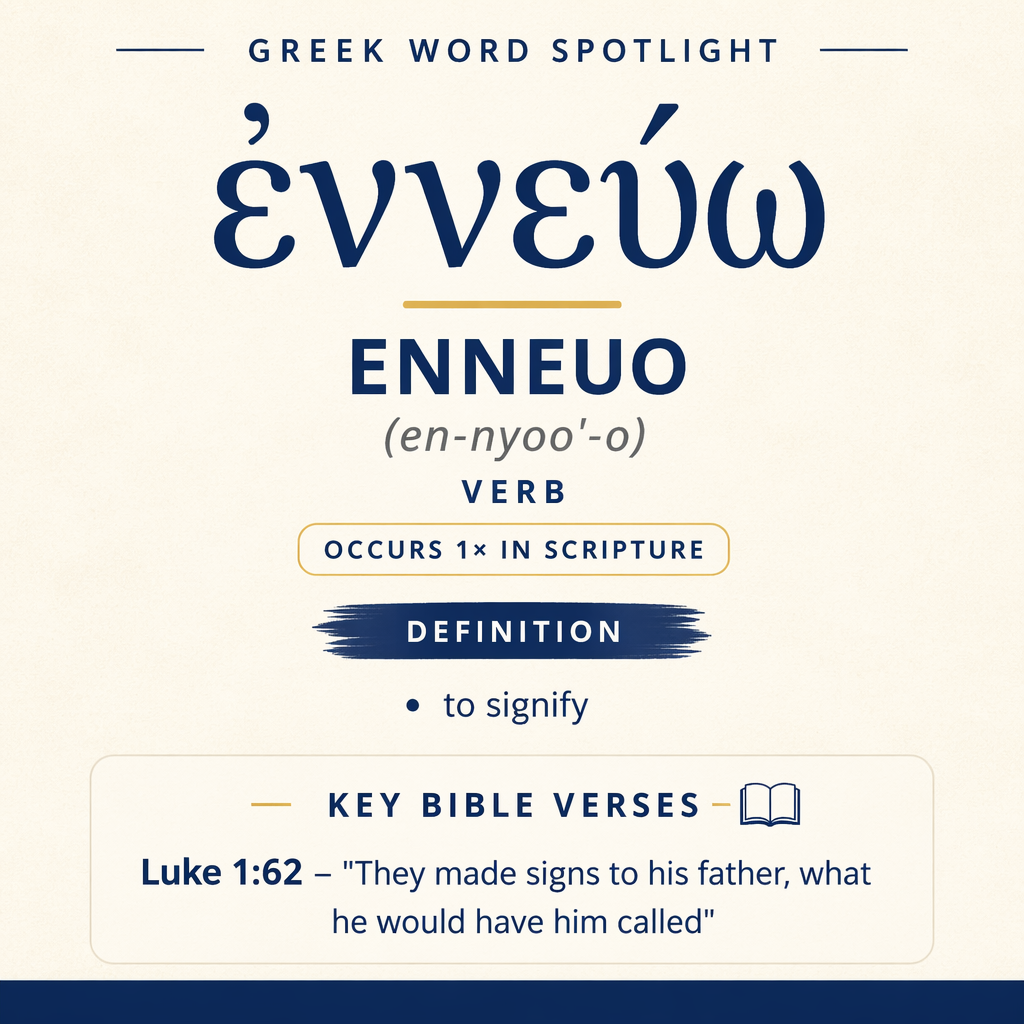
ἐννεύω means “to signify” and appears once in Scripture, in Luke 1:62.
Scripture Occurrence
This verb occurs 1 time in Scripture. The occurrence is in Luke 1:62.
Learn More →Context in Luke
In Luke 1:62, people made signs to his father about what he would have him called.
Learn More →ἐννεύω expresses the act of signifying—communicating by a sign rather than by spoken words. It appears in the account of John the Baptist’s naming, where the onlookers resort to nonverbal communication with his father.
Root and Related Words
ἐννεύω is connected with the preposition en (ἐν), “in/on/among” (Strong’s G1722), and with the verb neuō (νεύω), “to motion” (Strong’s G3506). Together these relations situate the verb within the realm of communication by bodily motion—signs made in and through gesture.

Occurrences
“They made signs to his father, what he would have him called.” (Luke 1:62)
Here the verb functions in a setting where a community attempts to learn a father’s intention about a child’s name. The quoted line foregrounds the means: instead of asking in ordinary speech, “They made signs to his father.” The verb marks a deliberate turn to signifying through gesture, as a practical way of conveying a question and inviting a response. The action is not merely incidental movement; it is motion employed for the purpose of conveying meaning—signs directed to a particular person (“his father”) with a definite communicative aim (“what he would have him called”).
The scene assumes a shared social knowledge that sign-based communication can carry a real question. The group’s signifying is purposeful and addressed: they are not generally gesturing among themselves, but signaling to a specific individual. The content of what is signified is also concrete: it concerns naming, and naming in this context is an act of decision and acknowledgment. The verb therefore anchors a moment where meaning must be transmitted without relying on ordinary spoken exchange, and where physical gesture becomes the channel for a significant family and communal determination.
Sense and Usage
The force of ἐννεύω in its lone New Testament use is tightly focused: it depicts signifying as an intentional communicative act. The verse does not portray vague gesturing or expressive body language for its own sake; it portrays signs as a substitute for speech in order to obtain a clear piece of information. The verb therefore sits at the intersection of movement and meaning: the motion itself is not the goal, but the means by which meaning is indicated to another person.
Within Luke 1:62, this signifying is interactive. The onlookers are not simply announcing something by signs; they are signifying a question to elicit the father’s will about the child’s name. That gives the verb a dialog-like profile: it is the opening move in an exchange, with signs initiating communication and inviting an answering indication. The clause “what he would have him called” clarifies that the signifying is capable of carrying specific semantic content—not only emotion or emphasis, but a request for a decision.
The use of signifying here also highlights the embodied character of communication. The verse presents meaning as something that can be conveyed through visible actions. In this sense, ἐννεύω underscores that signifying is not an abstract mental act hidden inside the speaker; it is an outward, perceivable action directed toward another, aiming at comprehension. The verb naturally belongs in a narrative moment where the social group must rely on visible cues, using motion to indicate what they are asking.
Because the narrative frames the act as communal (“They made signs”), ἐννεύω can also carry a collective dimension: multiple people may participate in signifying, whether by repeated gestures, coordinated signals, or a shared attempt to get the question across. The verb itself does not specify technique; it simply marks the communicative intent as signifying. The reader is left to picture a scene of animated, purposeful signaling in which gestures are treated as meaningful speech.
Imagery
The imagery attached to ἐννεύω in Luke 1:62 is plain and concrete: hands and bodies used as instruments of meaning. In the naming scene, signifying becomes the visible bridge between a community’s question and a father’s intent, capturing a moment where meaning is carried through motion and received through sight.
Sources: Lexical data from Strong’s Exhaustive Concordance and the Translators Brief Lexicon of Extended Strongs for Greek (STEPBible, CC BY). Occurrence data from the Translators Amalgamated Greek New Testament (STEPBible, CC BY). Scripture quotations from the World English Bible (public domain).




