Exploring the Meaning of Ekplerosis in Greek
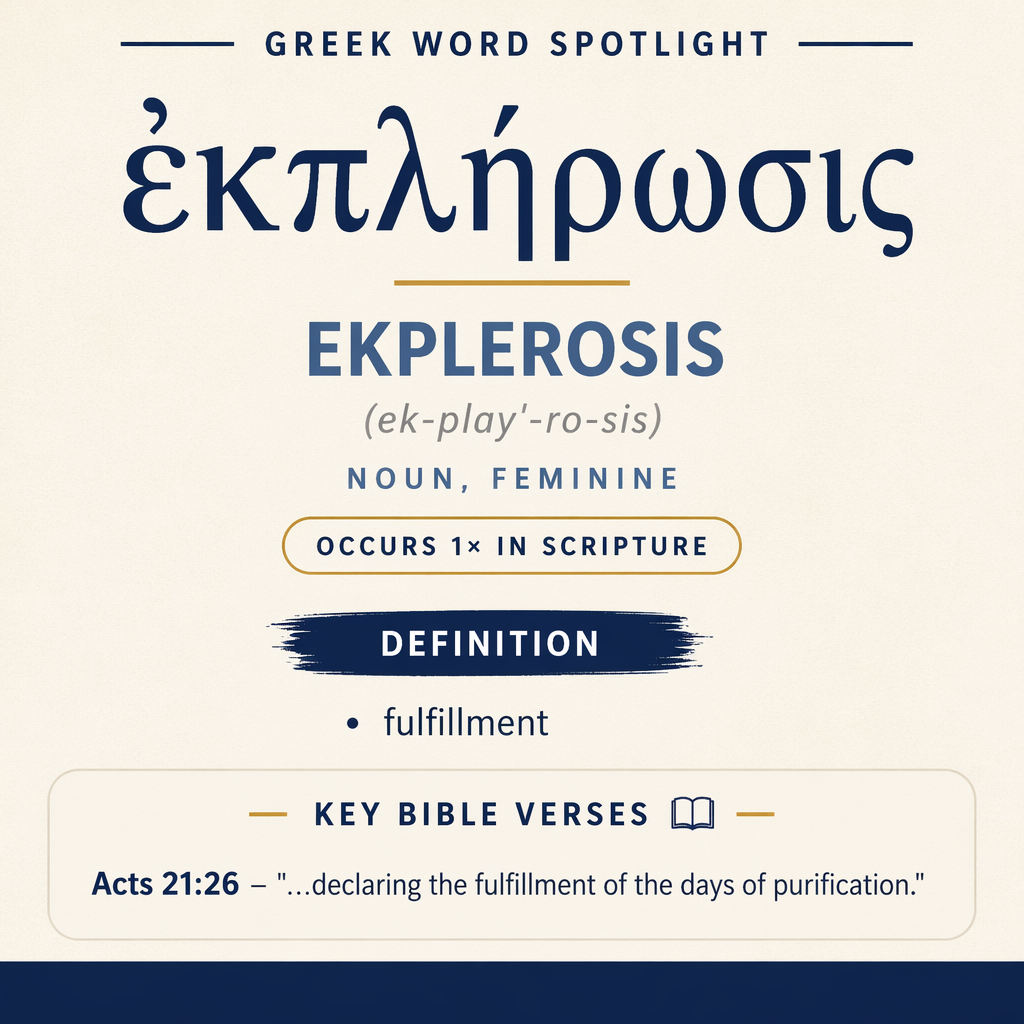
ἐκπλήρωσις means “fulfillment” and appears once in Scripture, in Acts 21:26.
Biblical Usage
This noun occurs one time in Scripture. Its single occurrence is in Acts 21:26.
Learn More →ἐκπλήρωσις denotes “fulfillment” and is attested once in the New Testament, in Acts 21:26. In that narrative setting it names the point at which a defined period reaches its intended completion.
Root and Related Words
Ekplerosis is related to the verb ekpleroo (ἐκπληρόω), “to fulfill” (Strong’s G1603). The noun-form foregrounds the completed state or declared completion that corresponds to the verbal action of fulfilling.

Occurrences
“Then Paul took the men, and the next day purified himself and went with them into the temple, declaring the fulfillment of the days of purification, until the offering was offered for every one of them.” (Acts 21:26)
Here ekplerosis is bound tightly to a concrete schedule and a public setting. Paul “took the men” and, “the next day,” entered a sequence of acts: he “purified himself,” “went with them into the temple,” and then made a declaration. The declaration concerns “the fulfillment of the days of purification,” which frames the purification not as an indefinite religious posture but as an observance measured in “days.” Ekplerosis names the completion-point of those days—the moment when the counted time arrives at its full term.
The verse also sets that fulfillment within a visible process that continues “until the offering was offered for every one of them.” The noun therefore functions as a temporal and procedural marker: it designates the finishing horizon of a period whose endpoint is coordinated with the required offering. In the sentence, “declaring the fulfillment” is not merely private awareness; it is a formal notification in the temple context that the days are being carried through to their completion. Ekplerosis contributes the idea that the purification has a definable endpoint that can be announced and recognized in connection with an offering made “for every one of them.”
The placement of the word after “declaring” also highlights how fulfillment can be treated as an accountable fact within communal worship. The fulfillment is not described as an inner feeling or a general hope; it is something stated in the course of temple participation. The phrase “the days of purification” is plural and specific, and ekplerosis anchors those days to their completed whole: the span is not left hanging but is spoken of as reaching the end that the observance calls for.
Sense and Usage
In Acts 21:26, “fulfillment” is the completion of a defined period (“the days of purification”) carried through in step with required actions (“until the offering was offered”). The sense is therefore temporal and procedural: a set of days is expected to run its course, and that course has an end that can be declared in the temple. Ekplerosis names that end as a completion that matters to the ritual sequence.
This usage also shows how “fulfillment” can be used to speak of an observance reaching its full measure rather than simply beginning well. The narrative has momentum: “the next day” initiates the process, and “until” marks the continuing span toward a terminus. Ekplerosis sits between those markers as the concept that gathers the whole duration into a single completed reality. It treats the days as something that can be summed up: the “days of purification” are not only experienced day by day, but can also be spoken of as fulfilled once their full count and purpose are met.
Because the fulfillment is declared “into the temple,” the word also carries a note of public recognition. Fulfillment in this scene is not abstract; it is tied to a communal environment where offerings are presented and where actions are observed and reported. The clause “for every one of them” further connects the fulfillment to shared participation: the completion of the days is coordinated with an offering corresponding to each person in the group. Ekplerosis thus functions as a term that can encompass both the time completed and the completion’s practical implications in worship—namely, that the period is reckoned complete up to the point the offering is made.
Imagery
The verse evokes fulfillment as the end of a counted stretch of time marked by purification and culminating in an offering. The imagery is not of a sudden event but of days advancing to an appointed finish, with the temple as the setting where that finish is acknowledged aloud.
Sources: Lexical data from Strong’s Exhaustive Concordance and the Translators Brief Lexicon of Extended Strongs for Greek (STEPBible, CC BY). Occurrence data from the Translators Amalgamated Greek New Testament (STEPBible, CC BY). Scripture quotations from the World English Bible (public domain).