
Exploring the Meaning of Ekpleo in Greek
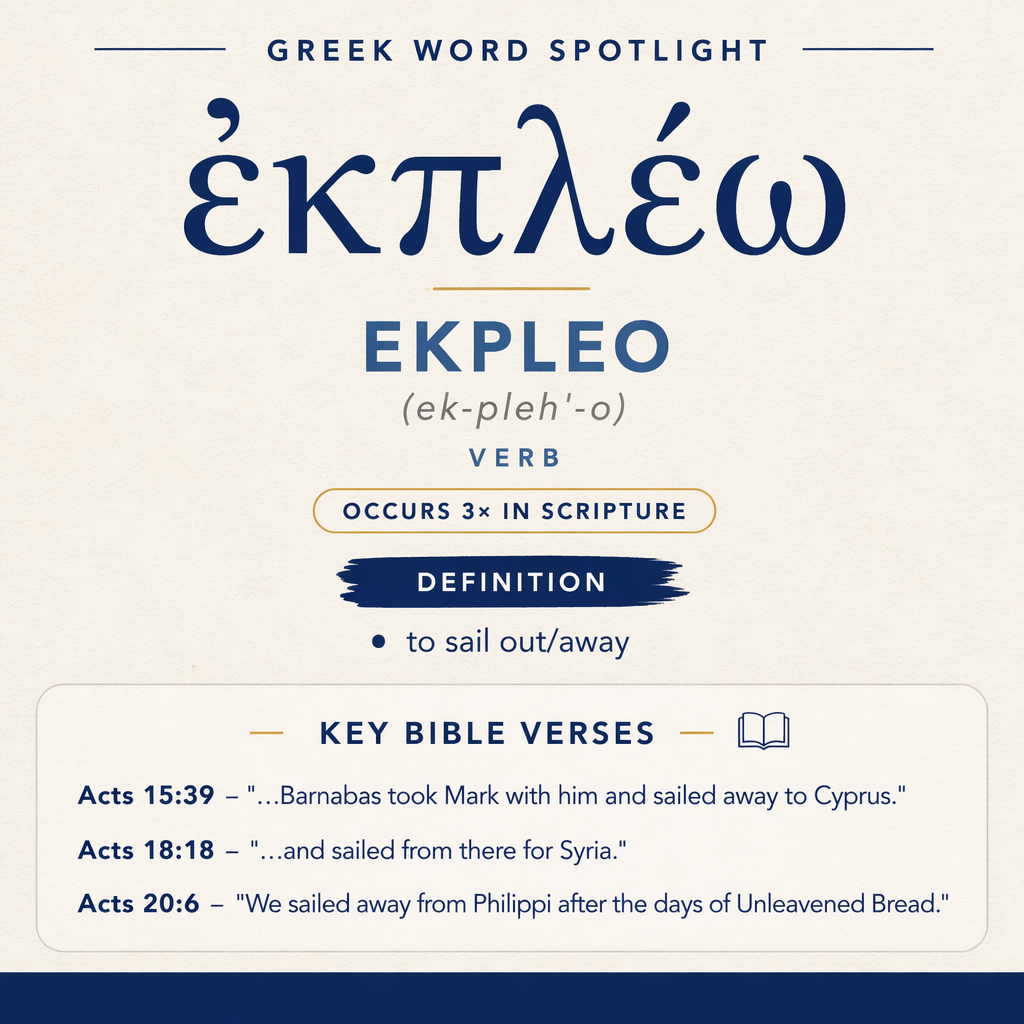
ἐκπλέω means “to sail out/away” and appears three times in Scripture: Acts 15:39; 18:18; 20:6.
Travel Context
In each occurrence, it describes departing by sea: Barnabas with Mark, Paul sailing for Syria, and the group leaving Philippi for Troas.
Learn More →ἐκπλέω means “to sail out/away” and appears in three travel scenes in Acts, each marking a decisive departure by ship. In these verses it gives the movement a clear direction away from one place toward another, fitting moments of separation, leave-taking, and onward travel.
Root and Related Words
ἐκπλέω is formed from ἐκ (ek), “out from” (Strong’s G1537), and πλέω (pleo), “to sail” (Strong’s G4126). The combined shape of the word naturally conveys sailing as an outward movement, highlighting departure as the defining feature of the action.

Occurrences
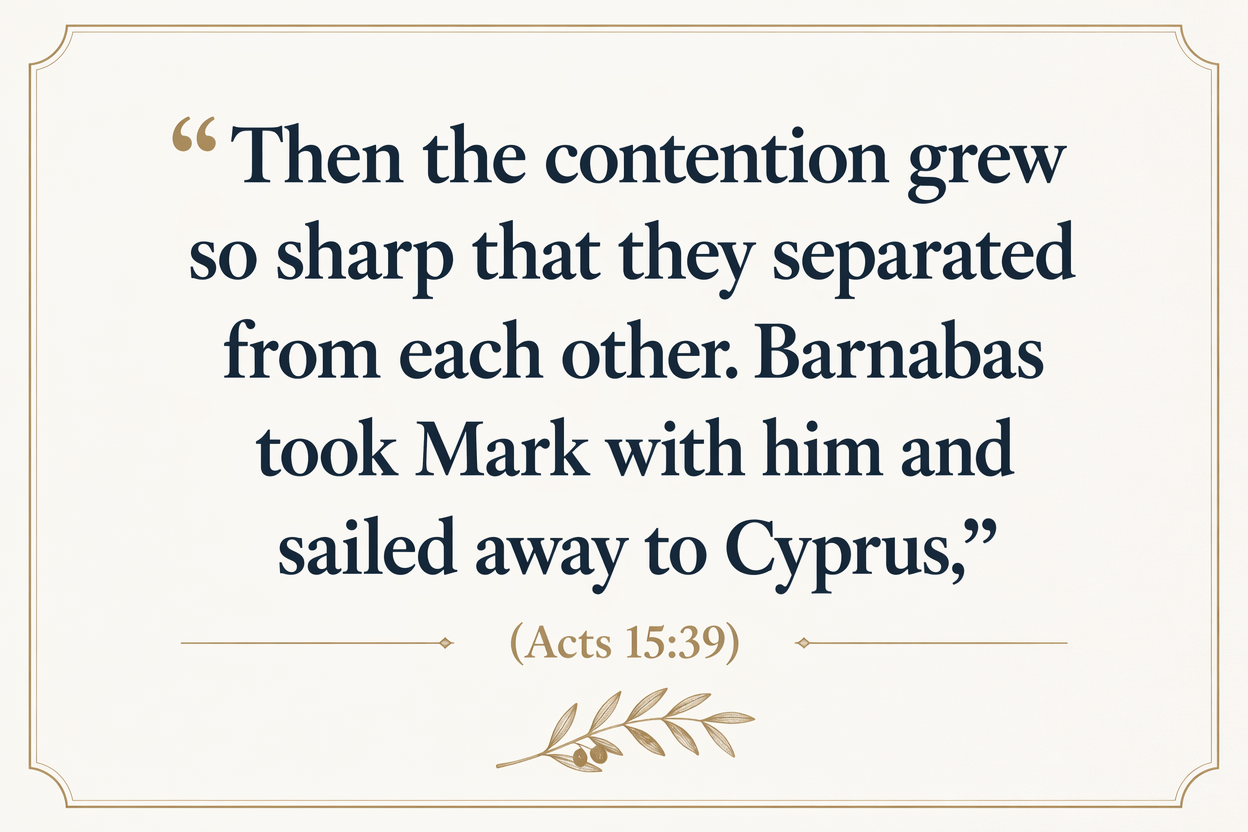
“Then the contention grew so sharp that they separated from each other. Barnabas took Mark with him and sailed away to Cyprus,” (Acts 15:39)
Here ἐκπλέω sits inside a sentence dominated by relational rupture and physical separation: “the contention grew so sharp that they separated from each other.” The sailing is not merely a detail about transportation; it is the concrete form the separation takes for Barnabas and Mark. “Barnabas took Mark with him” sets up a new companionship, and “sailed away to Cyprus” gives that new pairing a clear trajectory away from the place of conflict and toward a named destination. The verb makes the departure feel clean and final: the disagreement results in two parties no longer traveling together, and Barnabas’s party is portrayed as already gone—carried away by ship to Cyprus.
“Paul, having stayed after this many more days, took his leave of the brothers, and sailed from there for Syria, together with Priscilla and Aquila. He shaved his head in Cenchreae, for he had a vow.” (Acts 18:18)
In Acts 18:18 the same sailing verb marks a planned transition after a period of settled time: Paul “having stayed after this many more days” now “took his leave of the brothers.” ἐκπλέω gives the leave-taking a visible follow-through. Paul’s farewell is not abstract; it culminates in departure “from there for Syria,” a phrasing that frames the journey as moving out from the current location toward a wider region. The companions named—“together with Priscilla and Aquila”—show that this sailing away is also a communal movement, not a solitary exit. The verse then adds, “He shaved his head in Cenchreae, for he had a vow,” anchoring the sailing in a particular itinerary and underscoring that the departure belongs to a larger sequence of purposeful actions. Within this scene, ἐκπλέω signals the moment when staying ends and travel begins, when relationships and commitments are carried forward into the next leg of the journey.
“We sailed away from Philippi after the days of Unleavened Bread, and came to them at Troas in five days, where we stayed seven days.” (Acts 20:6)
Acts 20:6 places ἐκπλέω within a carefully timed travel note. The departure occurs “after the days of Unleavened Bread,” linking the sailing to a calendar marker and making it feel scheduled rather than sudden. The verb introduces a movement with both a starting point and an endpoint: “We sailed away from Philippi” and “came to them at Troas in five days.” The outward motion implied by ἐκπλέω is complemented by the measured arrival: the distance is traversed in “five days,” and travel gives way to stability again—“where we stayed seven days.” In this verse, ἐκπλέω functions as the hinge between two periods: a marked time “after” a set of days, and a new period of remaining in a place for “seven days.” It makes the narrative feel like a series of deliberate stages—departing, arriving, staying—rather than a vague sense of wandering.
Sense and Usage
Across these passages, “to sail out/away” consistently points to departure as the main idea, not the mechanics of seafaring. Each context supplies a clear “from” and/or “to”: in Acts 15:39, the destination is “Cyprus”; in Acts 18:18, the direction is “for Syria,” with the departure following the concrete social act of taking leave; in Acts 20:6, the starting point is “Philippi” and the arrival is “Troas,” with the travel time stated. The verb’s force is especially visible where it is paired with words of separation or transition. In Acts 15:39, the narrative explicitly frames the sailing as the outward consequence of a sharp contention—travel becomes the enacted form of parting ways. In Acts 18:18 and 20:6, by contrast, the sailing is embedded in orderly movement: staying for “many more days,” then leaving; observing a set of days, then departing. In all three, ἐκπλέω serves as a narrative marker that closes one scene and opens another, moving the story from relational moments (“separated,” “took his leave,” “together with”) into geographical change.
The word also consistently binds people to routes. It never appears as an impersonal description of ships at sea; it is always someone sailing away: “Barnabas,” “Paul,” and “We.” That personal subject keeps the focus on the travelers and their decisions—who goes, with whom, and when. Even when the verse gives additional details (companions in Acts 18:18; timing and duration in Acts 20:6), ἐκπλέω remains the verb that turns those details into motion away from a former location. The result is a compact expression for outward travel that naturally suits Acts’ interest in departures, arrivals, and the spread of the message through real journeys.
Imagery
In these scenes, ἐκπλέω carries the image of a coastline receding behind the travelers as one stage of life or mission gives way to another. Acts 15:39 places that image against a backdrop of sharp disagreement, making the sailing away feel like a decisive break. Acts 18:18 pairs it with leave-taking and companionship, so the outward sailing reads as a continuation of relationships into new territory. Acts 20:6 frames it by festival days, travel time, and a week-long stay, so the act of sailing away becomes one measured step in a rhythm of departure and rest.
Sources: Lexical data from Strong’s Exhaustive Concordance and the Translators Brief Lexicon of Extended Strongs for Greek (STEPBible, CC BY). Occurrence data from the Translators Amalgamated Greek New Testament (STEPBible, CC BY). Scripture quotations from the World English Bible (public domain).





