Exploring the Meaning of Ekpleroo in Greek
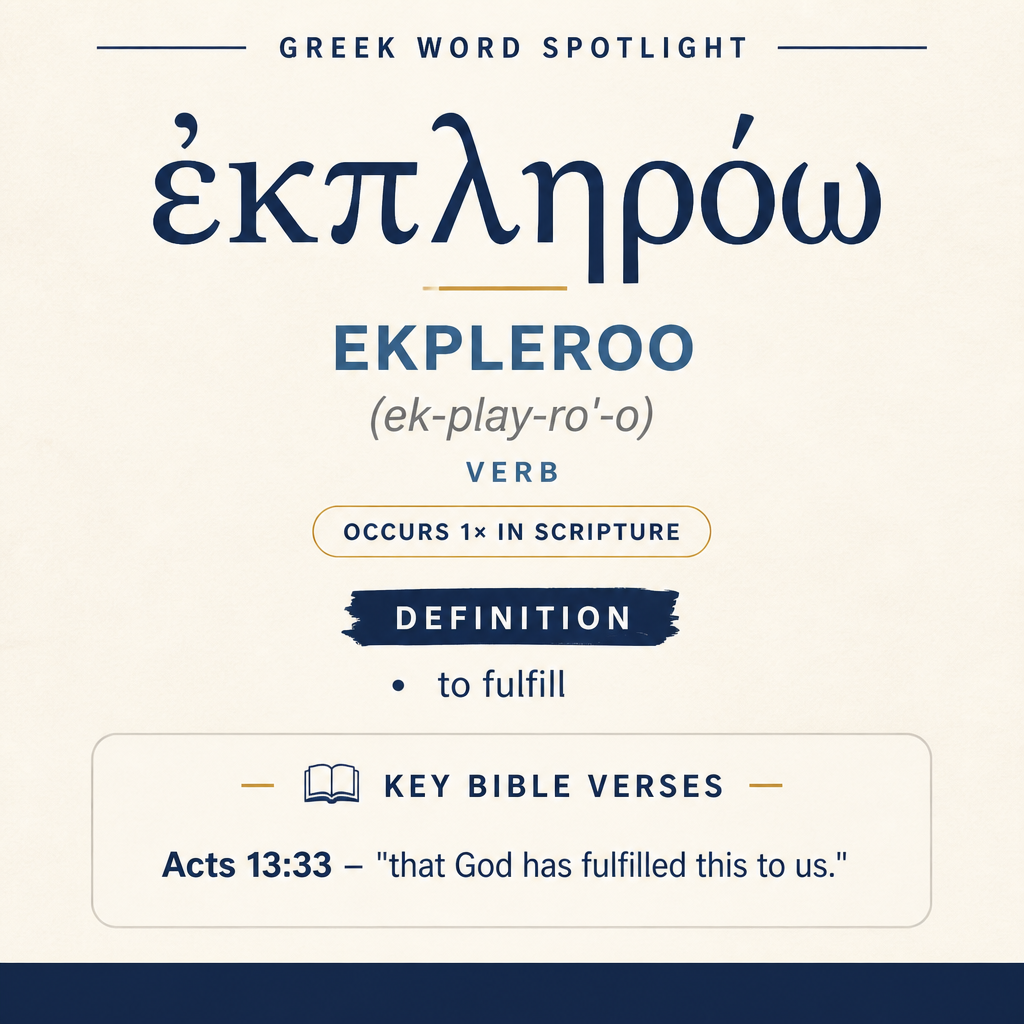
ἐκπληρόω (Ekpleroo) means “to fulfill” and appears once in Scripture, in Acts 13:33.
Scripture Occurrence
It occurs one time in Scripture. The single reference is Acts 13:33.
Learn More →Acts 13 Context
In Acts 13:33, it describes God fulfilling this to their children by raising up Jesus. The verse connects this statement to what is written in the second psalm.
Learn More →ἐκπληρόω means “to fulfill,” and it appears once in the New Testament, in Paul’s synagogue proclamation at Pisidian Antioch (Acts 13:33). In that setting it describes God’s action toward “us, their children,” tied directly to the raising up of Jesus and to a written testimony Paul cites.
Root and Related Words
ἐκπληρόω is connected with ek (ἐκ), “out from,” and pleroo (πληρόω), “to fulfill.”

Occurrences
“that God has fulfilled this to us, their children, in that he raised up Jesus. As it is also written in the second psalm, ‘You are my Son. Today I have become your father.’” (Acts 13:33)
In Acts 13:33, ἐκπληρόω anchors Paul’s claim about what God has done “to us, their children.” The verb frames the raising up of Jesus as the divine completion of something previously spoken or promised: “God has fulfilled this… in that he raised up Jesus.” The construction ties the act (“he raised up Jesus”) to the result (“fulfilled this”), so that the raising is presented not merely as an event but as the decisive act by which fulfillment occurs.
The verse also sets fulfillment within a pattern of correspondence between God’s action and a written witness: “As it is also written in the second psalm.” Paul’s quotation—“You are my Son. Today I have become your father.”—is introduced as written testimony that bears on the meaning of the raising up of Jesus. Within the flow of the sentence, ἐκπληρόω therefore does two things at once: it attributes the initiative to God (“God has fulfilled”), and it positions the raising up of Jesus as the concrete act that brings what is written into effect for a defined audience (“to us, their children”).
The pronouns and appositions are part of the force of the statement. Paul does not speak in the abstract; he locates the fulfillment “to us” and describes that “us” as “their children,” linking his hearers to the earlier generations he has been discussing. ἐκπληρόω, in this line, serves as a bridge between generations: something pertaining to “their” story reaches “their children” through what God has done in raising up Jesus.
Sense and Usage
The sense “to fulfill” in this passage is relational and event-focused: fulfillment is something God does “to” a people, and it happens “in that” a specific act occurs. The verb does not function here as a vague claim that predictions generally came true; it is attached to an identifiable divine deed and to an identifiable beneficiary. The emphasis lies on the completed realization of “this” for the present community addressed by Paul, rather than on a merely private or internal experience.
Because Paul immediately adds, “As it is also written,” fulfillment is also portrayed as the meeting point of deed and written witness. The citation, “You are my Son. Today I have become your father,” is not offered as an ornament; it is introduced to interpret the raising up of Jesus as an act that stands in a meaningful relationship to what is written. In this way, ἐκπληρόω carries a declarative weight: it announces that God’s action is not isolated, but corresponds to a recognized scriptural testimony now brought to its intended completion for the hearers.
The wording “fulfilled this to us” also implies that fulfillment is not only about an objective completion in history but about the delivery of that completion to a particular group. In the sentence as it stands, fulfillment has an outward-facing direction: from God toward “us,” and from the raising up of Jesus toward the community’s reception of what God has done. The verb thus supports Paul’s rhetorical aim in Acts 13:33: to present the raising up of Jesus as God’s own act of bringing what was written to its realized outcome for the people now addressed.
Imagery
Acts 13:33 gives ἐκπληρόω the imagery of completion through decisive action: what is “written” is not left hanging, but is brought to its realized end “in that he raised up Jesus.” The picture is of a divine act that makes a written testimony stand forth as accomplished for “their children,” so that fulfillment is heard not as an abstraction but as a completed turning point announced to a gathered audience.
Sources: Lexical data from Strong’s Exhaustive Concordance and the Translators Brief Lexicon of Extended Strongs for Greek (STEPBible, CC BY). Occurrence data from the Translators Amalgamated Greek New Testament (STEPBible, CC BY). Scripture quotations from the World English Bible (public domain).