Exploring the Meaning of ‘egroph in Hebrew
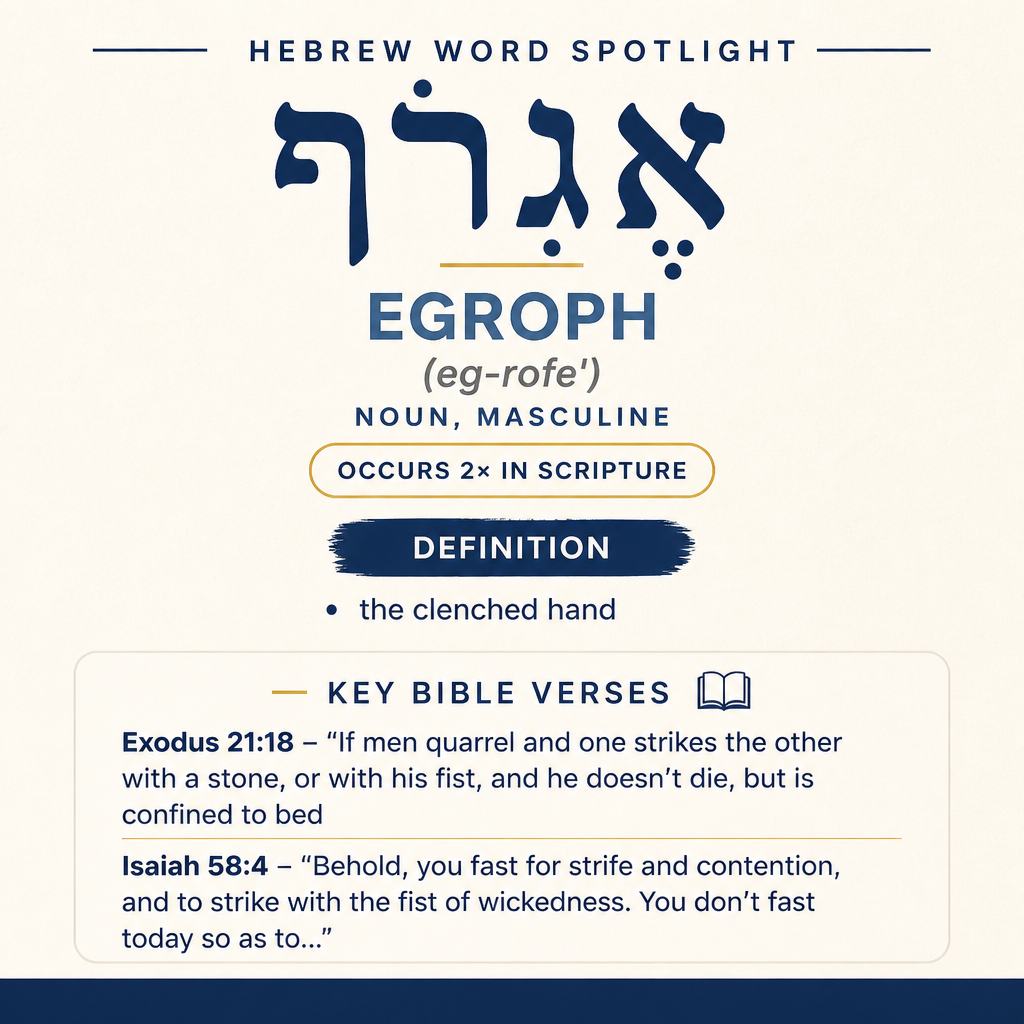
אֶגְרֹף means “the clenched hand” and appears twice in Scripture: Exodus 21:18 and Isaiah 58:4.
Biblical Usage
In Exodus 21:18 it describes striking another person “with his fist” in a quarrel.
Learn More →Prophetic Context
In Isaiah 58:4 it appears in the phrase “to strike with the fist of wickedness.”
Learn More →אֶגְרֹף (egroph) means “the clenched hand” and appears in two passages that speak about striking another person: a case law setting in Exodus and a prophetic rebuke in Isaiah.
Occurrences
“If men quarrel and one strikes the other with a stone, or with his fist, and he doesn’t die, but is confined to bed;” (Exodus 21:18)
Here אֶגְרֹף names the bodily instrument of a blow within a legal scenario: two men quarrel, and one “strikes the other” either “with a stone” or “with his fist.” The verse places the “fist” alongside a “stone,” presenting two concrete ways injury may be inflicted in a fight—one using an object held and thrown or wielded, the other using the attacker’s own clenched hand. In this line, the word functions with practical specificity: it is not generic violence, but the immediate, physical means of striking in close range. The surrounding details—“he doesn’t die, but is confined to bed”—frame the injury as serious but not fatal, and the mention of the “fist” contributes to the picture of interpersonal conflict that escalates into bodily harm.
Because the scene is formulated as case law (“If men quarrel…”), אֶגְרֹף is used in a controlled, descriptive way. The word helps distinguish the type of assault being contemplated, without moralizing about motives in the wording of the clause itself. It is the sort of detail that allows the reader to visualize what happened: not merely that someone was struck, but that a hand was tightened into a striking form and used as a weapon. In this setting, “fist” signals direct contact and personal force—violence executed without a tool beyond the body.
Behold, you fast for strife and contention, and to strike with the fist of wickedness. You don’t fast today so as to make your voice to be heard on high. (Isaiah 58:4)
In Isaiah, אֶגְרֹף appears in a critique of religious behavior that is outwardly pious but socially destructive. The verse juxtaposes “fast” with “strife and contention,” then adds the concrete outcome: “to strike with the fist of wickedness.” The phrase is vivid because it binds a bodily action (“strike with the fist”) to an ethical characterization (“of wickedness”). The clenched hand is not a neutral physical detail here; it is the embodied expression of wrongdoing that accompanies or even drives the community’s “strife and contention.”
Within the sentence, the “fist” also anchors the accusation in visible behavior. The rebuke is not limited to inner attitude; it points to a kind of harm that can be observed—people are being struck. And because the verse is addressing a day of fasting (“You don’t fast today…”), the mention of the clenched hand intensifies the contradiction: the same day marked by religious abstention is also marked by aggression. אֶגְרֹף thus functions rhetorically as a sharp, physical image of oppression and hostility, reinforcing the prophet’s point that the fast described here does not align with a voice “to be heard on high.”

Sense and Usage
The core sense of אֶגְרֹף, “the clenched hand,” is inherently concrete: it is a hand tightened into a compact form. In both occurrences, that physical configuration is linked to striking. The word is not used for the open hand, nor for the arm, nor for a generic “blow.” It points to a particular posture of the hand—closed, tightened, and ready for impact—and, by doing so, it conveys a certain kind of force. A clenched hand suggests compression and directed power; it is the body re-formed into an instrument.
Across the two contexts, the same physical referent supports two different kinds of discourse. In Exodus the “fist” belongs to judicially framed description. The verse is concerned with a quarrel that leads to injury severe enough for someone to be “confined to bed,” and the “fist” stands as one of the enumerated means by which the injury may occur. The wording keeps the focus on the act and its consequence. In Isaiah the “fist” belongs to moral and spiritual confrontation. There, the clenched hand is placed into a chain of behaviors—“strife and contention” leading “to strike”—and it is explicitly colored by the phrase “of wickedness.” The same bodily instrument becomes a sign of a deeper disorder in communal life.
These uses show how a concrete anatomical term can carry weight beyond anatomy without leaving its literal footing. The word remains anchored in the hand itself, but because the hand is clenched, it naturally lends itself to the action of assault. A clenched hand is not merely a hand; it is a hand prepared for conflict. That preparation is what makes the imagery forceful: the text does not merely say “to harm,” but points to the familiar gesture that precedes and accompanies a punch.
In both verses, אֶגְרֹף appears in close connection with verbs of striking (“strikes,” “to strike”). The word therefore operates as the immediate agent of a blow—what makes contact, what delivers the impact. In Exodus it stands in contrast with a “stone,” a non-bodily implement. That contrast helps clarify the sense of the clenched hand as an instrument that requires no external object; the body itself is shaped into the striking tool. In Isaiah it stands in contrast with “fast,” a religious practice, and thus gains a different kind of contrast: not tool versus tool, but ritual versus violence. The clenched hand, in that line, is the visible form of hostility that undermines the claim of devotion.
The two attestations also show how the “clenched hand” can depict both a momentary act and a settled pattern. Exodus describes a specific quarrel scenario—one incident imagined within legal conditions. Isaiah speaks with a broader accusatory scope, addressing a community’s conduct on a day when they are “fast[ing] for strife and contention.” The “fist of wickedness” suggests more than accidental collision; it frames the clenched hand as the chosen expression of moral failure. Yet in both, the word’s strength lies in how tactile it is: it points to the simplest and most immediate means by which one person can strike another at close range.
Imagery
אֶגְרֹף carries the imagery of violence compressed into a single body part. In Exodus 21:18 the clenched hand is pictured in the midst of a quarrel, alongside a stone, as a straightforward means of injury that can put someone in bed. In Isaiah 58:4 the same clenched hand becomes an emblem of wrongdoing that accompanies religious fasting, making the contradiction between outward practice and harmful behavior feel concrete: the hand that should be restrained is instead tightened and used to strike.
Sources: Lexical data from Strong’s Exhaustive Concordance and the Open Scriptures Hebrew Lexicon. Occurrence data from the Westminster Leningrad Codex with STEPBible reference data (CC BY). Scripture quotations from the World English Bible (public domain).