
Exploring the Meaning of ‘egel in Hebrew
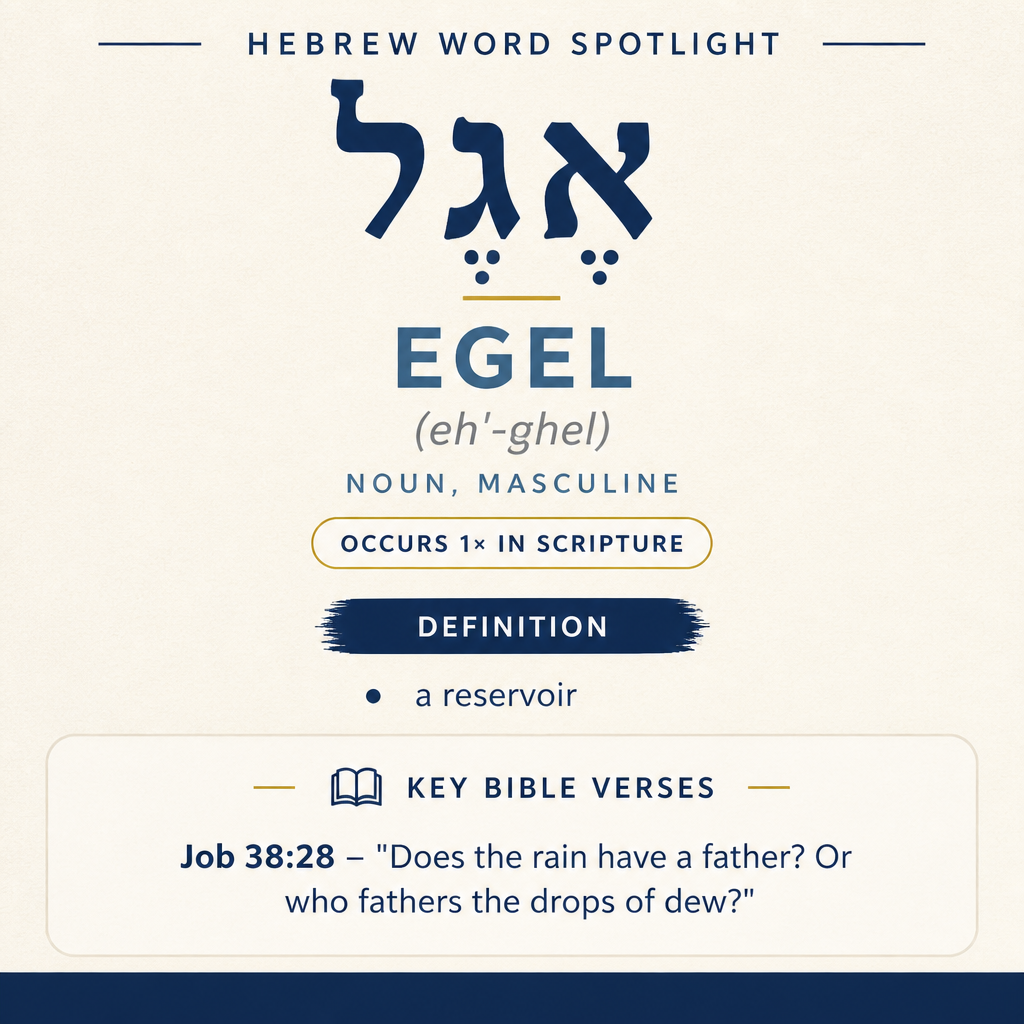
אֶגֶל means “a reservoir” and appears once in Scripture, in Job 38:28.
Verse Context
Its occurrence is in Job 38:28: “Does the rain have a father? Or who fathers the drops of dew?”
Learn More →אֶגֶל (egel) denotes “a reservoir” and is attested in Job’s extended meditation on the origins and governance of weather. In its single appearance, the word stands within a chain of questions that press beyond human knowing toward the source of rain and dew.
Occurrences
“Does the rain have a father? Or who fathers the drops of dew?” (Job 38:28)
Job 38:28 presents the natural world as a field of probing questions: rain and dew are treated as realities with a source, yet the speaker asks after that source in personal terms (“father,” “fathers”). Within this line of questioning, אֶגֶל contributes the concrete imagery of a “reservoir”—a place where water is held, gathered, or kept. Even though the verse’s focus is on rain and dew, the mention of a reservoir belongs to the same conceptual world of water’s origins and containment: rain falls and dew forms, but a reservoir evokes the idea that water can also be stored and maintained, not only dispersed. The question format itself heightens the force of the image: the speaker is not inviting a technical explanation of weather but confronting the listener with the limits of human ability to account for water’s coming and going, from gathered supply to falling drops.
The verse is also carefully scaled: it moves from “rain” as a broad phenomenon to “the drops of dew,” a finer, almost countable detail. A “reservoir” sits naturally between these scales. It is larger than a drop, yet it is a definite, bounded locale rather than the open sky. In the rhetorical setting of Job 38, this helps situate the water imagery not only in what is seen (rain falling, dew appearing) but in what might be conceived behind it: some held store, some controlled source, some place where water may be kept before it emerges as rain or dew.

Sense and Usage
As “a reservoir,” אֶגֶל names a bounded body or holding-place of water. The word’s force lies in its concreteness: it evokes water not as a fleeting surface phenomenon but as something that can be contained. In Job 38:28, the surrounding questions frame natural processes in terms of origin (“father,” “fathers”), and a reservoir sharpens that inquiry by suggesting more than mere appearance. Rain and dew are not depicted as self-originating; they are traced back toward a source that is stable enough to be imagined as a holding place.
Because Job 38:28 asks about fatherhood—about who brings rain and dew into being—the reservoir image functions as an implied counterpoint to human experience. Humans can recognize reservoirs and may even know them as places where water is collected; yet the verse’s questions confront the listener with the fact that the true “parentage” of rain and dew is beyond human claiming. The reservoir thus participates in the passage’s pattern: it uses an everyday, physical referent to point to a domain of ordering and provision that the human hearer cannot own or explain simply by observation.
The verse also holds together two different expressions of water: rain, which arrives with force and volume, and dew, which appears quietly as “drops.” A reservoir suits this pairing because it represents continuity of water’s presence across different manifestations. Whether water is imagined as amassed in a holding place or dispersed into countless droplets, the same element is at work. Within the question, אֶגֶל helps keep water from being reduced to a momentary event; it suggests depth and persistence, a background supply that stands behind what is briefly visible on the ground or in the air.
In this way, the word supports the passage’s larger rhetorical aim: the questions do not deny that rain and dew exist, nor do they treat them as random; instead, they direct attention to their dependence—on a source, a governance, an ordering that can be pictured through the tangible notion of a reservoir. The reservoir image provides a spatial anchor for thinking about water’s provision: somewhere water may be held before it becomes what is experienced as weather.
Imagery
Job 38:28 places rain and dew under scrutiny through familial language, turning familiar weather into an occasion for awe and interrogation. In that setting, אֶגֶל adds the picture of water gathered and contained, a quiet counterpart to water falling and forming. The reservoir image gives weight to the passage’s insistence that what seems ordinary—rain above, dew below—rests on a source that cannot be reduced to human fatherhood or human control.
Sources: Lexical data from Strong’s Exhaustive Concordance and the Open Scriptures Hebrew Lexicon. Occurrence data from the Westminster Leningrad Codex with STEPBible reference data (CC BY). Scripture quotations from the World English Bible (public domain).





