
Exploring the Meaning of ‘Eglayim in Hebrew
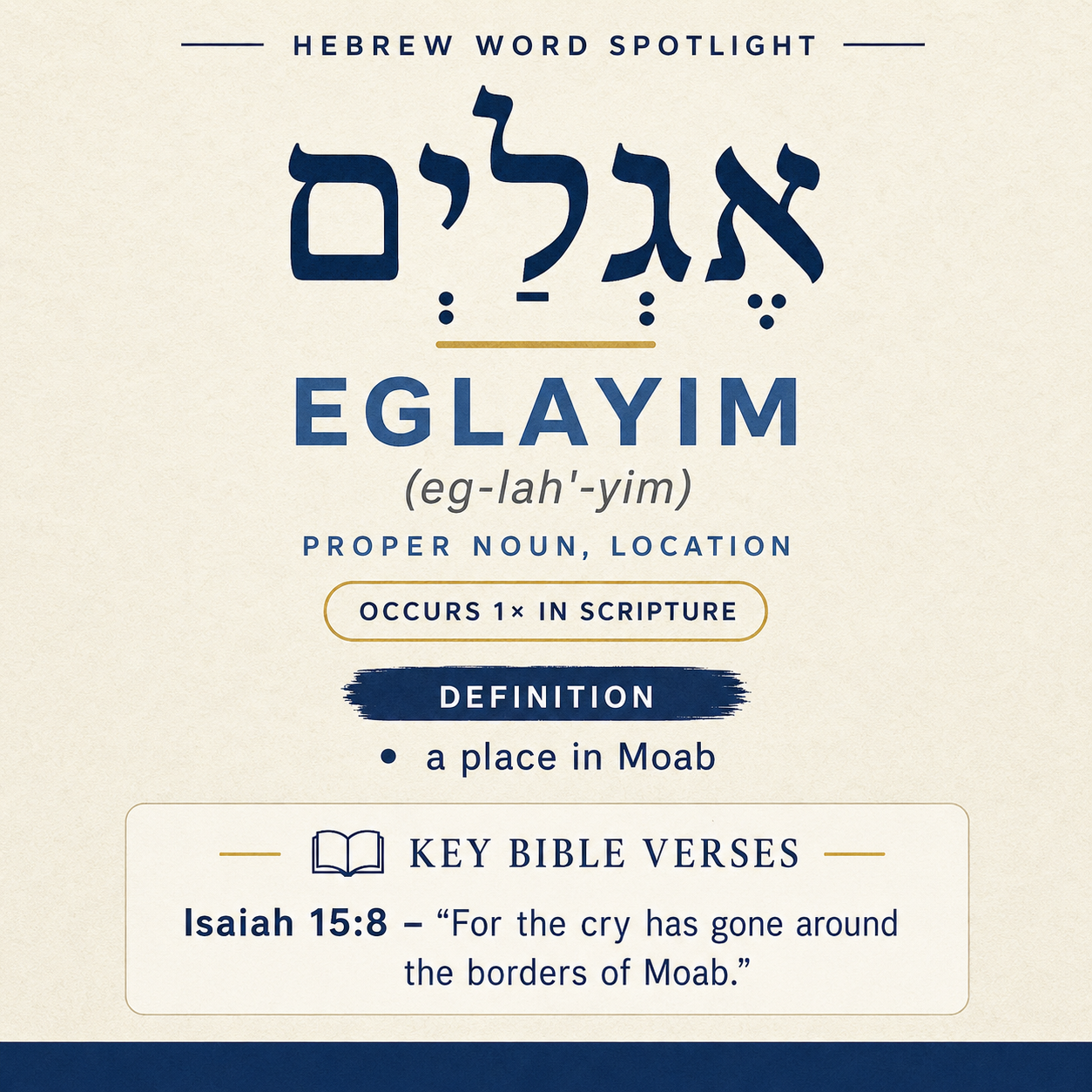
אֶגְלַיִם (Eglayim) means a place in Moab and appears once in Scripture in Isaiah 15:8.
Verse Context
In Isaiah 15:8, Moab’s wailing is described as reaching to Eglaim and to Beer Elim.
Learn More →Eglayim is a place in Moab. It appears in a single prophetic line that traces the spread of Moab’s mourning across its borders.
Occurrences
“For the cry has gone around the borders of Moab, its wailing to Eglaim, and its wailing to Beer Elim.” (Isaiah 15:8)
Here Eglayim functions as a named destination of sound: Moab’s “cry” and “wailing” travel outward until they reach it. The sentence frames the lament as moving “around the borders of Moab,” and Eglayim marks one point on that circuit—an identifiable place included within the sweep of the distress. The parallel phrasing (“its wailing to Eglaim, and its wailing to Beer Elim”) places Eglayim beside another Moabite location so that the grief is heard not only generally but in specific locales. In the verse’s geography of sorrow, Eglayim is a station where the public noise of calamity arrives and is registered.

Sense and Usage
Because Eglayim is a place in Moab, its role in Isaiah 15:8 is to anchor an otherwise broad statement (“the cry has gone around the borders of Moab”) in a concrete map. The verse does not describe Eglayim’s features or situation; it uses the name to show reach. The grief is not confined to a single site or a private corner—its “wailing” is depicted as extending to multiple points, and Eglayim serves as one of those points named aloud.
The structure of the line highlights how a place-name can carry narrative weight without additional description. “Borders” suggests perimeter and extent; “wailing to Eglaim” suggests penetration into recognized places along that perimeter or within it. By pairing Eglayim with Beer Elim in matching syntax, the verse treats Eglayim as part of a set of Moabite locations that together communicate totality: the mourning is widespread and audible across the land. The place-name therefore contributes specificity—this is not an abstract lament floating over Moab, but one that can be traced from place to place.
In this usage, Eglayim is not the subject of the lament but a marker of how far the lament goes. The verse presents the “cry” as already in motion (“has gone around”), and Eglayim stands as evidence of that motion’s breadth. The name helps the reader hear the lament as a soundscape spanning a territory, with Eglayim included among the places reached.
Imagery
Isaiah 15:8 paints Moab’s distress as something that can be followed by ear: a “cry” circling borders, “wailing” arriving at named destinations. Within that picture, Eglayim evokes the image of a settled place under the pressure of public grief—one point on the landscape where the sound of mourning is heard and answered by more mourning, as the verse repeats the refrain of “its wailing.”
Sources: Lexical data from Strong’s Exhaustive Concordance and the Open Scriptures Hebrew Lexicon. Occurrence data from the Westminster Leningrad Codex with STEPBible reference data (CC BY). Scripture quotations from the World English Bible (public domain).





