
Exploring the Meaning of ‘egowz in Hebrew
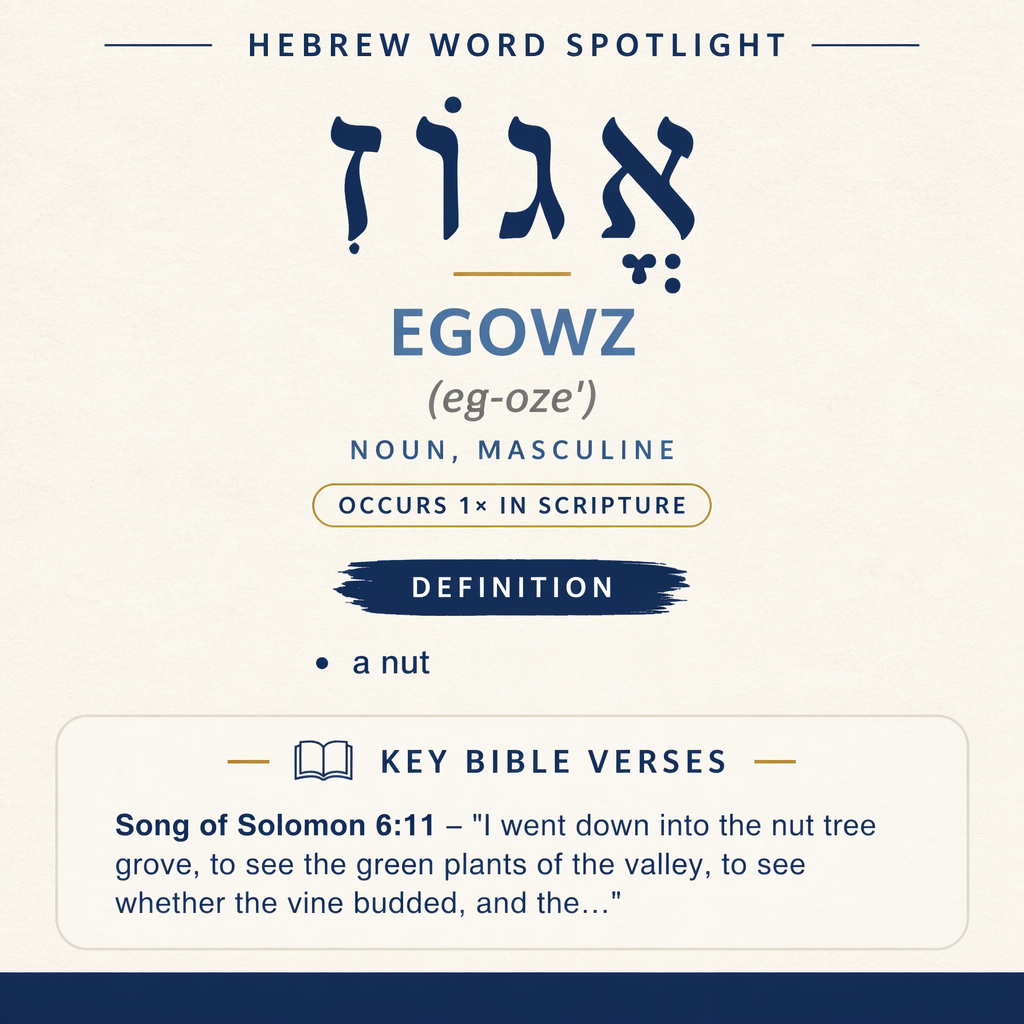
אֱגוֹז means “a nut” and appears once in Scripture, in Song of Solomon 6:11.
אֱגוֹז (egowz) means “a nut” and appears in a single poetic scene in Song of Solomon. There it helps locate the speaker’s movement and attention within a cultivated landscape of growth and fruitfulness.
Occurrences
“I went down into the nut tree grove, to see the green plants of the valley, to see whether the vine budded, and the pomegranates were in flower.” (Song of Solomon 6:11)
Here “nut” belongs to a string of concrete garden details that together frame the speaker’s descent “into the … grove” and the purpose of that movement: “to see the green plants of the valley.” The “nut tree grove” functions as a specific destination within the wider agricultural setting. It is not presented as an isolated botanical curiosity, but as part of an ordered place—“grove,” “valley,” “vine,” and “pomegranates”—where plant life can be observed in stages of development.
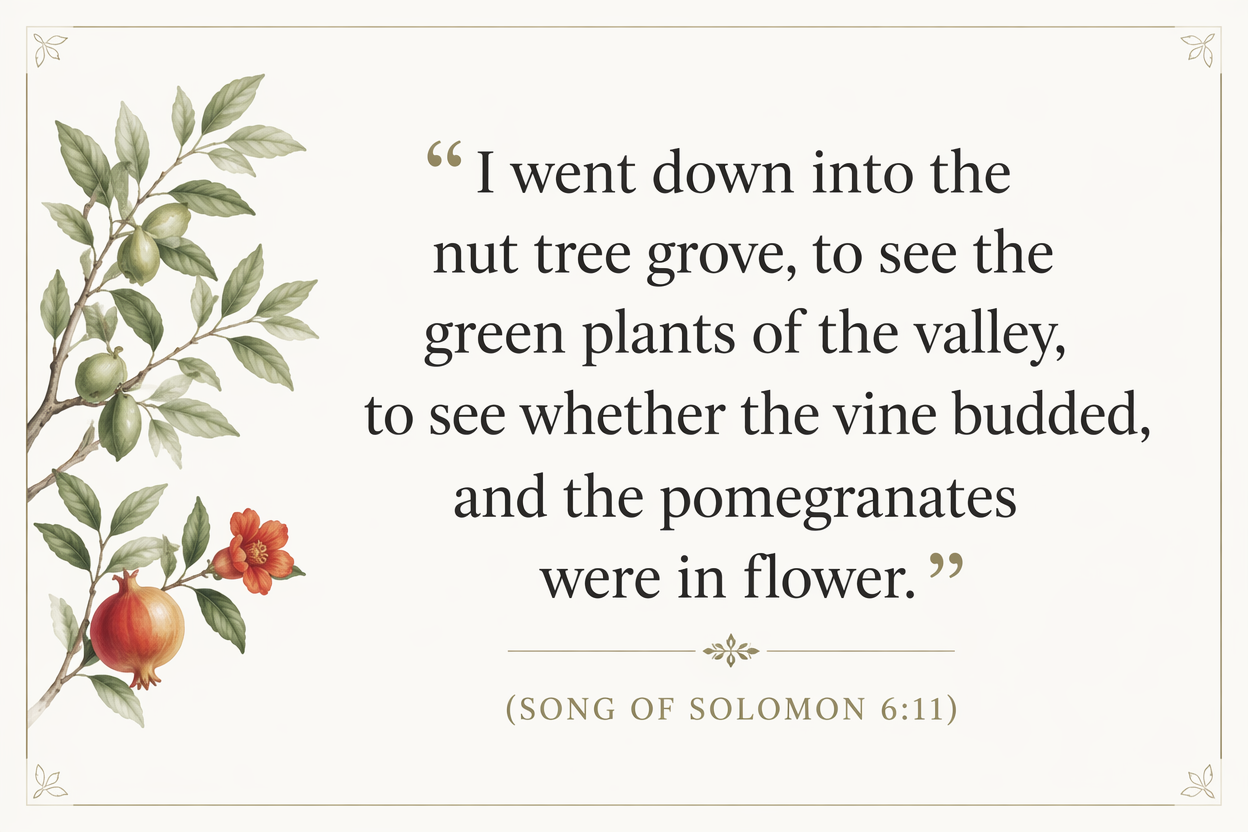
The verse also places the nut trees alongside other signs used to assess the season’s progress: whether “the vine budded” and whether “the pomegranates were in flower.” Within this cluster, the nut trees contribute to the sense of a tended orchard or garden complex. The word anchors the line’s opening motion (“went down”) in a named area, then yields to the speaker’s repeated “to see,” emphasizing careful inspection rather than harvesting. The scene’s energy is observational: the nut tree grove is the first landmark named as the speaker moves into the valley to check on living growth.

Sense and Usage
Because אֱגוֹז denotes a “nut,” its sense in Song of Solomon 6:11 is bound to the natural world and to the cultivated spaces where such plants are found. In this verse, the nut is not treated as food in hand or as a commodity; instead it appears as part of the environment—“the nut tree grove.” That phrasing turns the noun toward place-description: it marks a grove characterized by nut trees and thus helps sketch the setting with precision and texture.
The immediate context also shows how the term can participate in a layered description of fertility without needing to be pressed into metaphor. The speaker’s interest is directed toward visible indicators of growth: “green plants,” a “vine” that may have “budded,” and “pomegranates” that may be “in flower.” The nut trees stand at the entrance of this list. Their presence broadens the picture from one plant type to a whole orchard-like area and supports the verse’s focus on abundance and development across multiple kinds of vegetation.
Within the verse, the noun’s contribution is primarily locative and descriptive. “Grove” suggests a gathered stand of trees, and the nut trees specify what kind. This specificity carries the reader into a concrete agricultural scene: descending into a valley that contains planted areas and fruit-bearing species. The repetition of “to see” indicates that the nut tree grove is part of a purposeful visit to examine growth, and so the term aligns with the verse’s orientation to seasonality, cultivation, and the observation of budding and flowering.
Imagery
The nut tree grove in Song of Solomon 6:11 serves as the threshold of a verdant valley scene. It evokes an enclosed or clustered area of trees that one can “go down into,” after which the eye ranges over “green plants,” checks a “vine” for budding, and looks for “pomegranates” “in flower.” The word’s imagery is therefore earthy and spatial: a named grove within a valley, forming part of a landscape where growth can be seen and assessed.
Sources: Lexical data from Strong’s Exhaustive Concordance and the Open Scriptures Hebrew Lexicon. Occurrence data from the Westminster Leningrad Codex with STEPBible reference data (CC BY). Scripture quotations from the World English Bible (public domain).





