Understanding the Significance of Diktuon in Greek
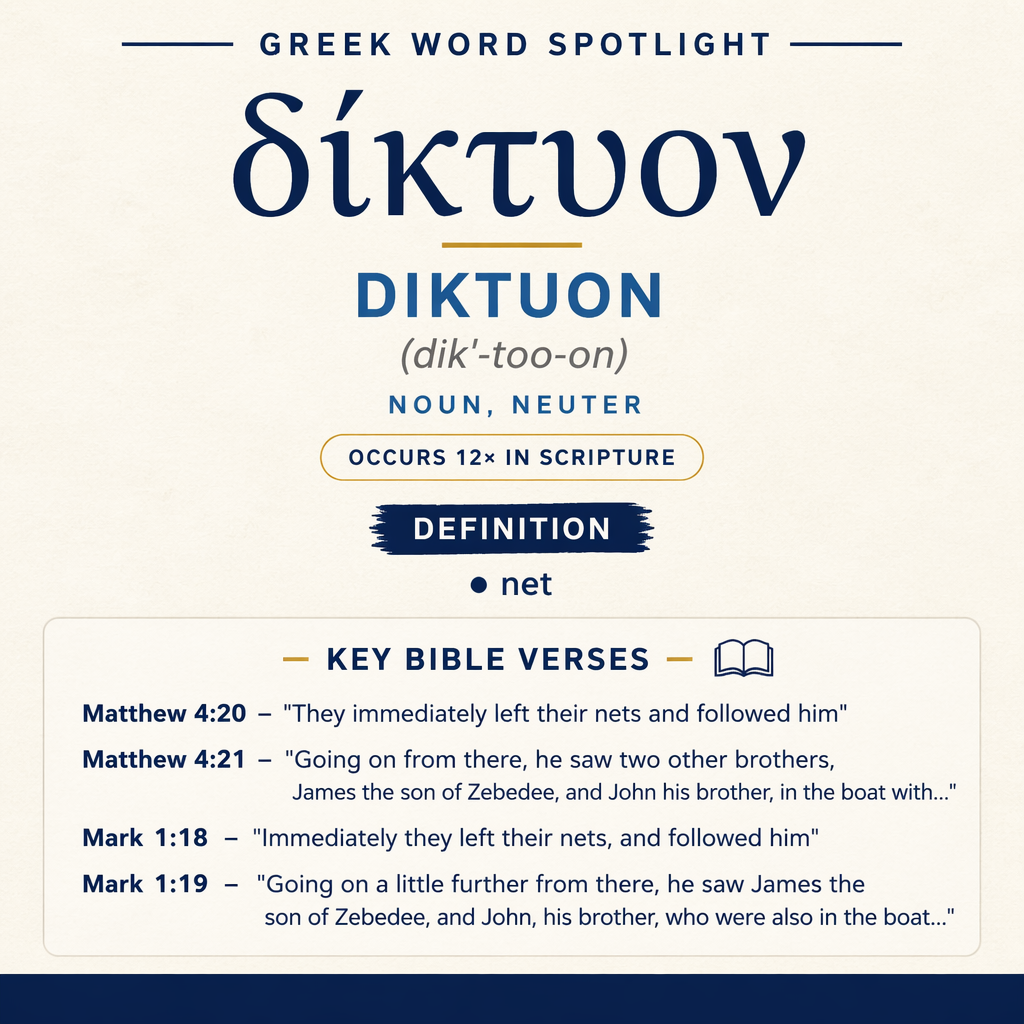
δίκτυον (Diktuon) means “net” and appears 12 times in Scripture, including Matthew 4, Mark 1, and Luke 5.
Gospel Scenes
In Matthew 4:20 and Mark 1:18, disciples immediately leave their nets to follow him. In Luke 5:2, fishermen wash their nets by the lake.
Learn More →Fishing Actions
In Luke 5:4–6, Simon is told to let down the nets for a catch, and a great multitude of fish is caught. Their net is breaking in Luke 5:6.
Learn More →δίκτυον refers to a “net,” a concrete tool of fishing. In the Gospels it appears in scenes of calling, routine work at the boat, and extraordinary catches that test the net’s strength.
Occurrences
“They immediately left their nets and followed him.” (Matthew 4:20)
Here δίκτυον stands for the working equipment the fishermen abandon at once. The word marks what is left behind as they shift from their trade to following Jesus; the action is abrupt and practical—nets are not theoretical possessions but the means of making a living.

“Going on from there, he saw two other brothers, James the son of Zebedee, and John his brother, in the boat with Zebedee their father, mending their nets. He called them.” (Matthew 4:21)
In this boat-side scene, δίκτυον is something that can be “mending,” emphasizing maintenance and readiness for work. The brothers are pictured in the middle of ordinary labor, and the word anchors the scene in the tangible tasks of fishing: repairing what gets worn so it can be used again.
“Immediately they left their nets, and followed him.” (Mark 1:18)
As in Matthew’s call narrative, δίκτυον highlights a decisive break with the tools of the job. The focus is not on the process of fishing but on the immediacy of leaving behind the gear that normally defines their day-to-day work.
“Going on a little further from there, he saw James the son of Zebedee, and John, his brother, who were also in the boat mending the nets.” (Mark 1:19)
Mark repeats the detail of “mending,” keeping δίκτυον tied to careful hands-on labor. The nets are treated as equipment that requires attention; their presence in the boat points to fishing as skilled work involving preparation, not merely casting and hauling.
“He saw two boats standing by the lake, but the fishermen had gone out of them, and were washing their nets.” (Luke 5:2)
δίκτυον appears here in the quiet after-work routine: the fishermen are “washing” their nets. The word contributes the sense of a cycle—use, then cleaning—suggesting the net’s material reality: it gets dirty, must be cleaned, and is handled regularly outside the boat as well as within it.
“When he had finished speaking, he said to Simon, “Put out into the deep, and let down your nets for a catch.”” (Luke 5:4)
In Jesus’ instruction, δίκτυον belongs to the deliberate act of fishing: “let down your nets.” The word here is tied to purpose (“for a catch”) and location (“into the deep”), so the nets function as the intended means by which the catch will be taken, not an incidental detail.
“Simon answered him, “Master, we worked all night, and took nothing; but at your word I will let down the net.”” (Luke 5:5)
δίκτυον, now singular (“the net”), becomes the focal point of Simon’s response. The contrast between “worked all night” and “took nothing” frames the net as an instrument that can be used with great effort yet produce no result; nevertheless, Simon commits to the action of lowering it again on the basis of Jesus’ word.
“When they had done this, they caught a great multitude of fish, and their net was breaking.” (Luke 5:6)
Here δίκτυον is stressed as a physical object under strain: “their net was breaking.” The word contributes an image of capacity and limitation; the catch is so large that the net’s integrity is threatened. The narrative weight falls on the net’s vulnerability when pressed beyond normal loads.
“He said to them, “Cast the net on the right side of the boat, and you will find some.” They cast it therefore, and now they weren’t able to draw it in for the multitude of fish.” (John 21:6)
In this post-resurrection lakeside scene, δίκτυον is again the key tool of the fishermen, now directed with precision: “on the right side of the boat.” The net’s role is immediate and decisive—once cast as instructed, the catch is so abundant that hauling becomes difficult: “they weren’t able to draw it in.”
“But the other disciples came in the little boat (for they were not far from the land, but about two hundred cubits away), dragging the net full of fish.” (John 21:8)
δίκτυον is pictured not in the act of catching but in transport: “dragging the net full of fish.” The word helps the reader visualize the weight and fullness of what has been taken; the net becomes a container being pulled through the water toward land, tying the catch to the practical work of bringing it in.
“Simon Peter went up, and drew the net to land, full of one hundred fifty-three great fish. Even though there were so many, the net wasn’t torn.” (John 21:11)
In this final depiction, δίκτυον is hauled ashore and described as “full,” with the fish counted. The closing remark, “the net wasn’t torn,” places emphasis on the net’s intactness under heavy load, contrasting with the earlier scene where “their net was breaking” (Luke 5:6). The word thus frames the catch not only as abundance but as something borne without failure.

Sense and Usage
Across these passages δίκτυον consistently names a net used in fishing, but the narratives treat that net in several distinct actions: leaving it, mending it, washing it, letting it down, casting it, dragging it, drawing it to land, and observing its condition under strain. The word therefore functions as more than a prop; it is a working object that must be cared for and handled, and it behaves in ways that matter to the story.
In the call accounts (Matthew 4:20; Mark 1:18), “nets” represent the concrete apparatus of a former way of life—something that can be dropped immediately. In the paired descriptions of “mending” (Matthew 4:21; Mark 1:19) and “washing” (Luke 5:2), δίκτυον signals the rhythms of a fisherman’s labor: repair and cleaning are essential to readiness. Luke’s sequence then ties the net directly to obedience and outcome: the same kind of tool that had accompanied fruitless night work (“took nothing,” Luke 5:5) becomes, when lowered again, the means of a catch so great the net begins to fail (“was breaking,” Luke 5:6). John 21 returns to the same world of boats and nets but focuses on placement and retrieval: cast to a specific side, the net becomes so full it is hard to draw in (John 21:6), then it is dragged and drawn to land (John 21:8, 21:11). The culminating detail that the net “wasn’t torn” (John 21:11) draws attention to the net’s durability at the moment of maximum fullness.
Imagery
δίκτυον carries a consistent lakeshore and boat-side imagery: hands working at repair, cleaning after use, and coordinated effort at lowering and hauling. The word also serves as a measure of abundance by the stress placed on it—either threatening to break (Luke 5:6) or remaining intact despite a counted multitude (John 21:11). Within these scenes, the net is the tangible boundary between empty labor and overflowing catch, between ordinary maintenance and extraordinary strain.
Sources: Lexical data from Strong’s Exhaustive Concordance and the Translators Brief Lexicon of Extended Strongs for Greek (STEPBible, CC BY). Occurrence data from the Translators Amalgamated Greek New Testament (STEPBible, CC BY). Scripture quotations from the World English Bible (public domain).