Exploring the Meaning of Dakruo in Greek
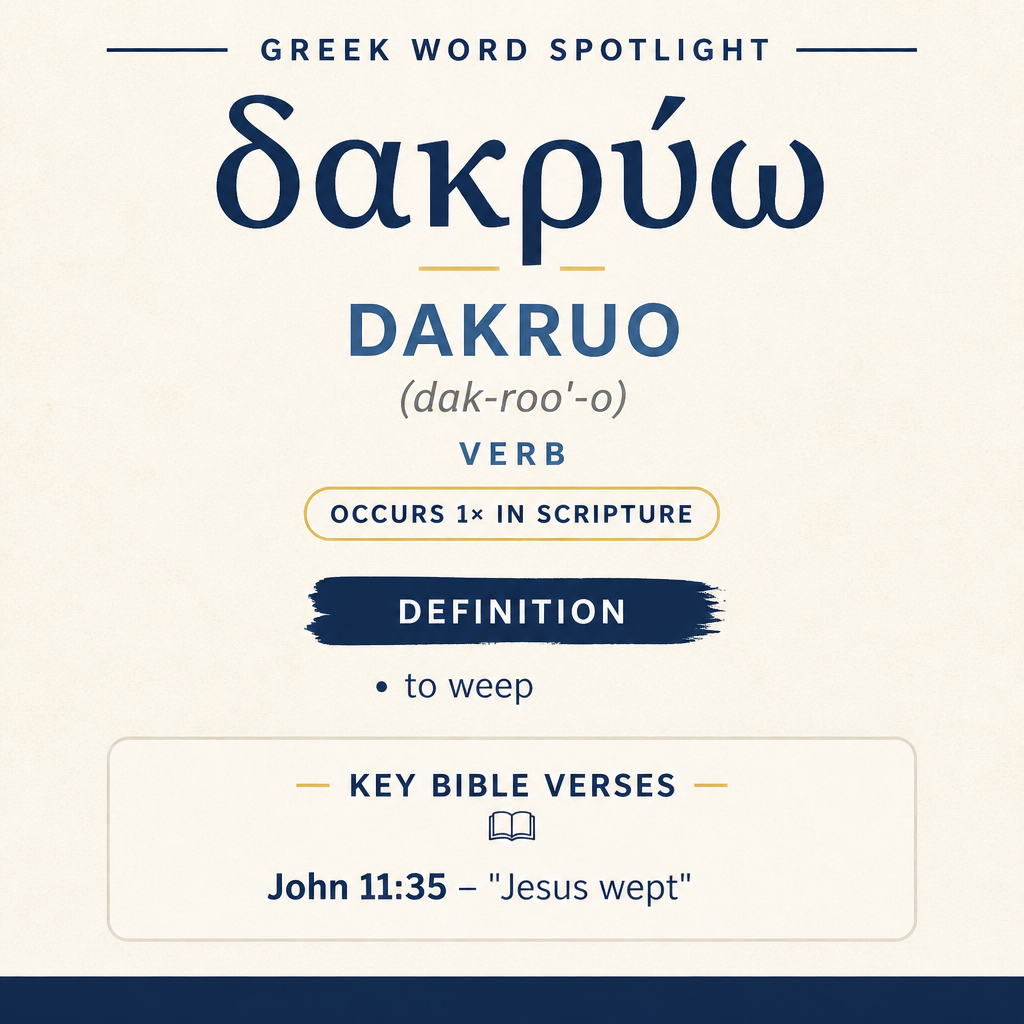
δακρύω means “to weep” and appears once in Scripture, in John 11:35 (“Jesus wept.”).
δακρύω means “to weep” and is attested in the New Testament in a single, stark sentence. Its lone occurrence is in John 11:35, where the verb stands as the entire statement.
Root and Related Words
δακρύω is derived from dakry (δάκρυ, δάκρυον), meaning “teardrop” (Strong’s G1144). The relationship ties the act named by the verb to the concrete reality of tears.

Occurrences
“Jesus wept.” (John 11:35)
In this verse the verb functions without modifiers, explanations, or accompanying speech. The clause contains only the subject (“Jesus”) and the action (“wept”), so the entire focus falls on the reality of his weeping itself. The brevity removes any attempt to account for the emotion in words; instead, the scene is communicated as an observable act. By using a simple past statement, the verse presents weeping as something that truly happened, not as a metaphor or a general description of disposition. The verb contributes a physical and public action—an outward expression that can be seen and reported in the fewest possible words.

Because the sentence is self-contained, the verb also bears the weight of the moment’s tone. John 11:35 does not frame the weeping with an explanation, so the weeping is not presented as merely incidental. The action itself is the emphasis: the reader is meant to stop on the verb and absorb what it says about the moment. The verb’s placement as the final word gives it a sense of closure; it ends the verse and therefore ends the thought with weeping.
Sense and Usage
With the sense “to weep,” δακρύω names the act of shedding tears as an event. In John 11:35 it is not stretched into a figure or broadened into a general idea of sadness; it is used in its straightforward force as a concrete human act. The verse’s grammar underscores this concreteness: a named person performs an action in a simple declarative sentence. The word therefore communicates weeping as something that can be stated plainly and reported as fact, without the need for intensifiers, descriptions of volume, or explanations of motive.
The connection to dakry (“teardrop”) helps explain why the verb carries such a bodily feel even in a very short line: the idea of tears is built into the word’s lineage. Even when the narrative gives no details about the tears themselves, the verb’s inherent association with tears presses the reader toward the physical image of weeping rather than toward an abstract label of emotion. As used here, δακρύω presents grief (or the experience that leads to grief) through the visible sign of tears, leaving the moment to be felt through the action rather than interpreted through commentary.
Because the only attested occurrence is a complete sentence, the usage also highlights how δακρύω can stand on its own without requiring an object (“weep over…”) or an explanatory clause (“because…”). John 11:35 shows the verb in its simplest narrative form: a subject weeps. That simplicity makes the act universal and immediately recognizable, and it gives the statement a kind of solemn restraint. The word does not need embellishment to communicate seriousness; the act of weeping itself is sufficient.
Imagery
John 11:35 supplies an image through an action rather than through description: a person weeping. The verse invites the reader to picture the moment in silence—no reported speech, no narrated gesture besides the tears—so the imagery is concentrated into the single, human act named by δακρύω.
Sources: Lexical data from Strong’s Exhaustive Concordance and the Translators Brief Lexicon of Extended Strongs for Greek (STEPBible, CC BY). Occurrence data from the Translators Amalgamated Greek New Testament (STEPBible, CC BY). Scripture quotations from the World English Bible (public domain).