Understanding the Meaning of Apodokimazo in Greek
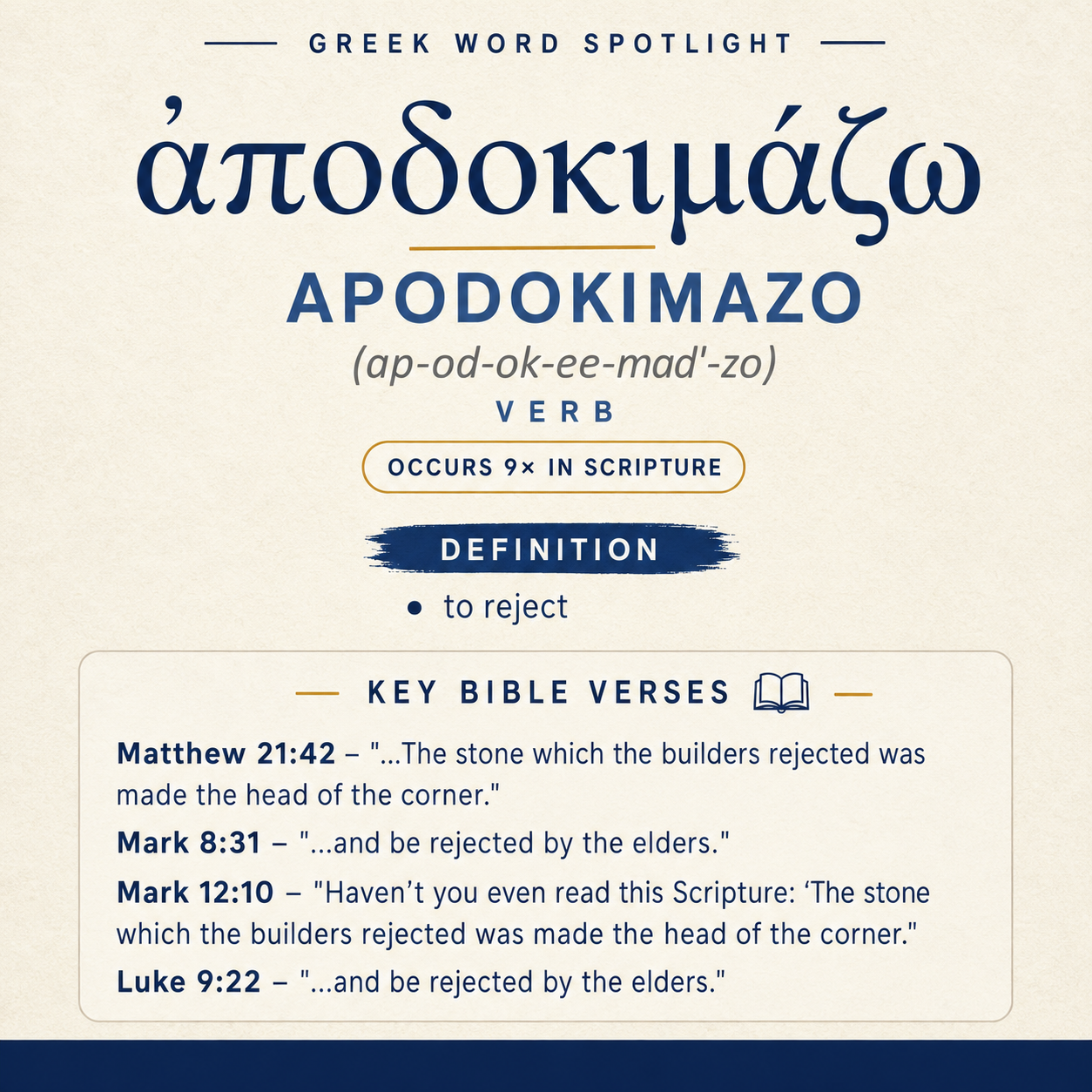
ἀποδοκιμάζω means “to reject” and occurs in Matthew, Mark, Luke, Hebrews, and 1 Peter.
Core Meaning
ἀποδοκιμάζω means “to reject.” It describes the act of refusing or not accepting someone or something.
Learn More →Gospel Usage
In the Gospels, it is used of the stone rejected by builders (Matthew 21:42; Mark 12:10; Luke 20:17). It is also used of the Son of Man being rejected (Mark 8:31; Luke 9:22; Luke 17:25).
Learn More →Other Occurrences
Hebrews 12:17 uses it of someone being rejected when seeking an inheritance blessing. 1 Peter 2:4 uses it of a living stone rejected by men but chosen by God.
Learn More →ἀποδοκιμάζω expresses the act of rejecting, and its New Testament uses cluster around two scenes: the rejection of the Son of Man and the rejection of a “stone” by “builders.” The word also appears once in a family setting where a sought-after blessing is nevertheless refused.
Occurrences
Matthew 21:42 — “Jesus said to them, “Did you never read in the Scriptures, ‘The stone which the builders rejected was made the head of the corner. This was from the Lord. It is marvelous in our eyes?’”
Here rejection is portrayed through construction imagery. “The builders” evaluate a “stone” and refuse it, yet the same stone becomes “the head of the corner.” The word underscores the decisive nature of the builders’ refusal in contrast to the later, surprising elevation of what they had rejected.
Mark 8:31 — “He began to teach them that the Son of Man must suffer many things, and be rejected by the elders, the chief priests, and the scribes, and be killed, and after three days rise again.”
Rejection is presented as one element in a fixed sequence that includes suffering, death, and resurrection. The agents of rejection are named in a threefold list—“the elders, the chief priests, and the scribes”—giving the word a public and institutional setting. In this line of teaching, rejection is not accidental but part of what “must” occur to the Son of Man.
Mark 12:10 — “Haven’t you even read this Scripture: ‘The stone which the builders rejected was made the head of the corner.”
Again the word operates inside the “stone” saying, now framed as a challenge about reading Scripture. The rejection is attributed to “the builders,” whose professional role makes the refusal especially pointed: those expected to recognize what fits are the ones who reject. The punch of the line lies in the reversal that follows—what is rejected becomes foundational.
Luke 9:22 — “saying, “The Son of Man must suffer many things, and be rejected by the elders, chief priests, and scribes, and be killed, and the third day be raised up.””
Luke’s wording parallels Mark’s sequence closely, keeping rejection in the middle of a set of necessary events. The same three groups appear as the rejecting parties, placing the action within recognized leadership structures. The word contributes the idea of a formal repudiation that accompanies suffering and culminates in death, yet does not prevent “the third day” being “raised up.”
Luke 17:25 — “But first, he must suffer many things and be rejected by this generation.”
In this saying, rejection is widened from specific leadership groups to “this generation.” The word marks a collective refusal that is temporally prior—“first”—to what follows in the discourse. The scope of rejection here is social and generational, emphasizing broad resistance rather than a single decision by officials.
Luke 20:17 — “But he looked at them and said, “Then what is this that is written, ‘The stone which the builders rejected was made the chief cornerstone?’”
Luke places the “stone” statement in a direct confrontation: “he looked at them” and presses the force of what “is written.” The rejection is again performed by “the builders,” but now the outcome is phrased as becoming “the chief cornerstone,” sharpening the contrast between rejection and subsequent centrality. The word’s contribution is to highlight the builders’ act as an interpretive failure: they reject what the written word presents as crucial.
Hebrews 12:17 — “For you know that even when he afterward desired to inherit the blessing, he was rejected, for he found no place for a change of mind though he sought it diligently with tears.”
This occurrence is not about a crowd or leaders, but about a person who “afterward desired to inherit the blessing.” The rejection stands as a settled refusal in the face of emotional urgency—“he sought it diligently with tears.” The explanatory clause (“for he found no place for a change of mind”) situates the rejection as tied to an unaltered decision: the sought outcome does not reverse, even with earnest pursuit.
1 Peter 2:4 — “coming to him, a living stone, rejected indeed by men, but chosen by God, precious.”
The word appears within a threefold description of the “living stone”: rejected by humans, yet chosen by God, and precious. “Rejected indeed by men” gives the refusal a broad human dimension, while the adversative “but” sets human rejection against divine choice. The word therefore supports a contrast of evaluations: men reject what God values.
1 Peter 2:7 — “For you who believe therefore is the honor, but for those who are disobedient, “The stone which the builders rejected has become the chief cornerstone,””
Here the rejection of the stone is linked to the response of two groups: “you who believe” and “those who are disobedient.” The “builders” reappear as the rejecting agents, and the result is again elevation to “the chief cornerstone.” In this setting, the word helps frame rejection not merely as a past action but as a marker dividing responses: honor for believers, and a rejecting posture associated with disobedience.

Sense and Usage
Across these passages, rejection is consistently more than a passing dislike; it is an act that carries consequences for the rejected one and exposes the stance of the rejecters. In the passion predictions (Mark 8:31; Luke 9:22; Luke 17:25), rejection is woven into a necessity pattern: it is something that “must” happen, placed alongside suffering, death, and (in two texts) being raised. The word’s force in these lines is public and communal. Whether the agents are delineated as “the elders, the chief priests, and the scribes” or broadened to “this generation,” rejection functions as a shared verdict that shapes the path of the Son of Man.
In the “stone” citations (Matthew 21:42; Mark 12:10; Luke 20:17; 1 Peter 2:7), rejection is expressed through professional and architectural imagery. “Builders” are expected to select and set stones; their rejection therefore implies an evaluative decision by those who claim competence. The narrative tension in each quotation comes from reversal: the refused stone is made “the head of the corner” or “the chief cornerstone.” Rejection, in this cluster, is not the final word about the stone’s role. Instead, it highlights the gap between human assessment and the stone’s eventual status.
Hebrews 12:17 illustrates rejection in a different register: a request is made “afterward,” and though it is pursued “diligently with tears,” the person “was rejected.” The accompanying explanation—“he found no place for a change of mind”—binds rejection to an unwavering decision. In this use, rejection is experienced as irreversible refusal, and the scene emphasizes the intensity of desire without granting it the power to overturn the outcome.
First Peter gathers the construction metaphor into a theological contrast of valuations: “rejected indeed by men, but chosen by God, precious” (1 Peter 2:4). The word thus works as a pivot between two assessments—human rejection and divine choice—without softening the reality of either. The rejection is real (“indeed by men”), yet it stands beside a different verdict that establishes worth and honor (1 Peter 2:7).
Imagery
The dominant picture attached to ἀποδοκιμάζω in these texts is a rejected building stone. The action is concrete: builders refuse a stone, only for that same stone to become central—“the head of the corner” (Matthew 21:42; Mark 12:10) and “the chief cornerstone” (Luke 20:17; 1 Peter 2:7). Alongside that image, the word also carries the social weight of repudiation—leaders and a generation rejecting the Son of Man (Mark 8:31; Luke 9:22; Luke 17:25)—and the personal grief of being refused despite tears (Hebrews 12:17). In each setting, rejection exposes what is valued, who renders judgment, and how that judgment stands or is overturned within the passage’s own logic.
Sources: Lexical data from Strong’s Exhaustive Concordance and the Translators Brief Lexicon of Extended Strongs for Greek (STEPBible, CC BY). Occurrence data from the Translators Amalgamated Greek New Testament (STEPBible, CC BY). Scripture quotations from the World English Bible (public domain).