Exploring the Meaning of Apodoche in Greek
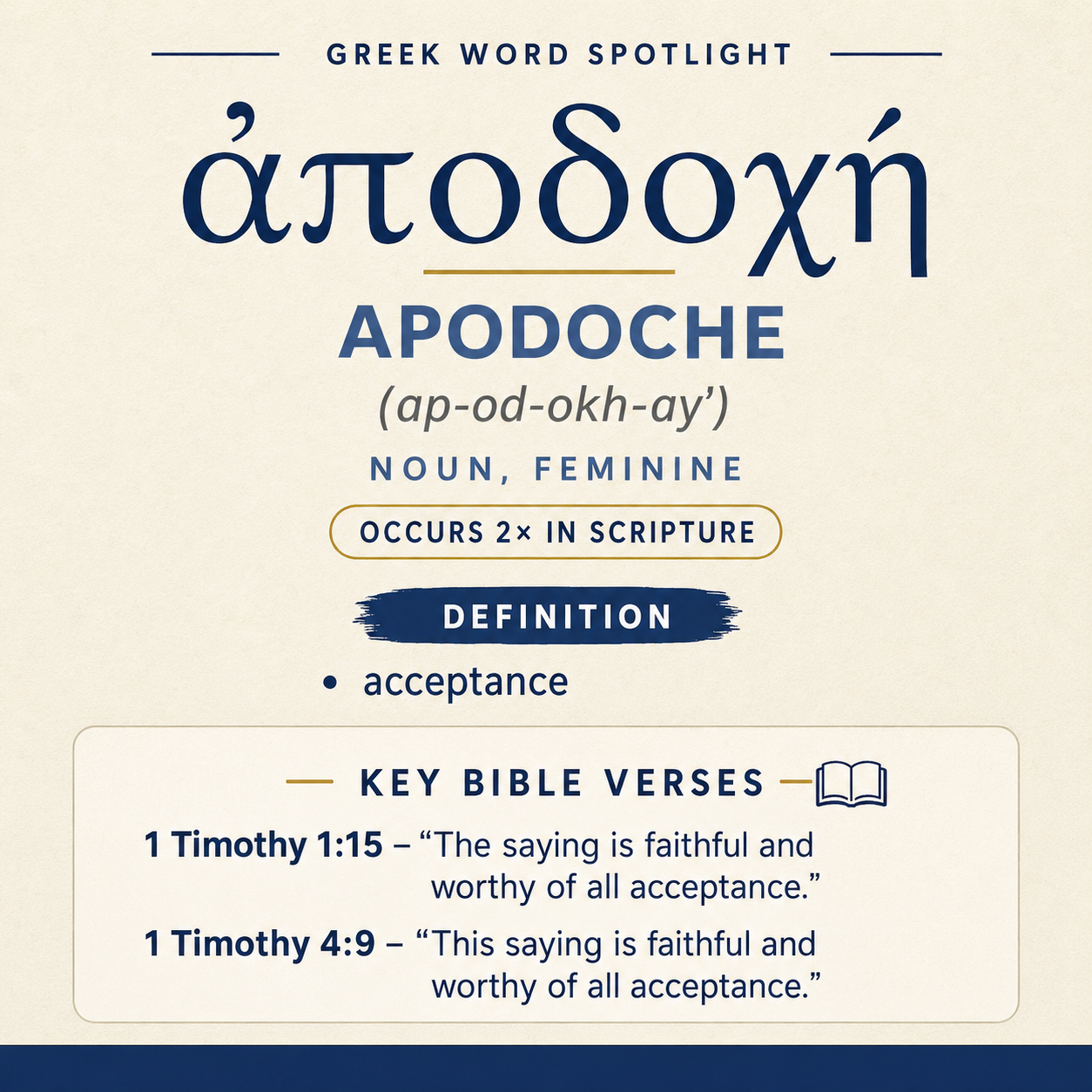
ἀποδοχή means “acceptance” and appears twice in Scripture, both in 1 Timothy (1:15; 4:9).
Scripture Occurrences
It occurs 2 times in Scripture: 1 Timothy 1:15 and 1 Timothy 4:9.
Learn More →Verse Context
In both verses it appears in the phrase “worthy of all acceptance” describing a “faithful” saying.
Learn More →ἀποδοχή means “acceptance” and appears in two closely matched statements in 1 Timothy. In both places it characterizes a “saying” as deserving to be met, not with indifference, but with full reception.
Root and Related Words
ἀποδοχή is derived from apodechomai (ἀποδέχομαι), “to receive.” The noun expresses the action or stance implied by that verb, presenting reception as something that can be spoken of as a quality: a saying can be “worthy of” it.

Occurrences
“The saying is faithful and worthy of all acceptance, that Christ Jesus came into the world to save sinners, of whom I am chief.” (1 Timothy 1:15)
Here ἀποδοχή is attached to a compact, declarative message introduced as “The saying.” Two evaluative terms are stacked before the content of the saying is stated: it is “faithful” and it is “worthy of all acceptance.” The placement matters: acceptance is not described as the response of a particular audience in a particular moment, but as what the saying deserves by its nature. The added modifier “of all” intensifies the claim, presenting the saying as meriting acceptance without reservation or partiality.

The content that follows—“that Christ Jesus came into the world to save sinners”—is presented as the kind of statement that calls for reception rather than mere consideration. The verse then appends a personal confession, “of whom I am chief,” which functions as an embodied example of that reception. The saying’s saving aim is explicitly oriented toward “sinners,” and the speaker’s self-identification as foremost among them makes acceptance concrete: it is not simply approving the sentence, but taking it as a true and relevant word that speaks to the speaker’s own standing. Within the verse’s flow, ἀποδοχή marks the appropriate posture toward a message whose claim and purpose reach beyond the speaker to the category named (“sinners”).
“This saying is faithful and worthy of all acceptance.” (1 Timothy 4:9)
In this shorter instance, ἀποδοχή again qualifies “saying,” but the content of the saying is not included in the quoted line itself. Even without the stated content, the structure repeats the same twofold commendation: “faithful” and “worthy of all acceptance.” The expression “This saying” points back to a specific utterance in the surrounding discourse, and ἀποδοχή signals how it is to be met—received as a reliable word rather than treated as disposable speech.
The repetition of the formula gives ἀποδοχή a quasi-technical feel in these contexts: it belongs to a standard way of commending a saying. “Worthy of all acceptance” portrays acceptance as something owed to the saying because of what it is—something that should be granted fully. The phrase does not describe an emotional reaction; it functions more like a verdict of suitability and trustworthiness that aims to shape the listener’s posture toward the message.
Sense and Usage
Across both occurrences, “acceptance” is framed as the fitting response to a “faithful” saying. The word sits in the evaluative layer of the sentences, not in the narrative layer: it does not depict a scene of someone accepting something, but assigns to a statement the status of being worthy of being accepted. In this way, ἀποδοχή names acceptance as a recognized category of response—something that can be measured (“worthy of”) and intensified (“all”).
The immediate collocation “worthy of all acceptance” shows acceptance functioning as more than bare acknowledgment. Worthiness language implies a standard: the saying meets the criteria that call for reception. The addition of “all” presses toward completeness, portraying the appropriate response as unqualified reception. The sayings are not merely permissible to accept; they deserve full acceptance.
In 1 Timothy 1:15, the word’s force is clarified by the saying’s content and by the appended personal claim. The saying concerns an entry “into the world” with a purpose “to save sinners,” and the speaker’s “of whom I am chief” places him within the saying’s target group. In that setting, acceptance is naturally heard as receiving the saying as true and applicable, not simply admiring it as a well-formed line. The verse’s movement from saying → evaluation (“faithful…worthy”) → content → personal identification makes acceptance the bridge between a general proclamation and a personal stance.
In 1 Timothy 4:9, the same phrase functions without the content stated in the line, which highlights a different feature of ἀποδοχή: it can commend a saying in a way that stands on its own as a summary judgment. Even when the reader does not hear the saying in the same breath, the formula asserts that it deserves to be received fully. Thus ἀποδοχή serves as a marker of authoritative speech: what follows (or what has just been said) is presented as the kind of statement that should be welcomed, trusted, and taken in.
Because both occurrences bind ἀποδοχή to “saying,” the word’s usage is strongly tied to verbal content rather than to objects or persons. It belongs to the world of speech acts—statements offered for reception. The noun captures acceptance as a posture toward words: the words are evaluated, and then the appropriate response is named. The result is a compact expression that commends a message as one that warrants full reception.
Imagery
Although ἀποδοχή is abstract, these passages give it a distinct setting: a “saying” placed before hearers with the expectation of being received. The language evokes a moment when a trusted message is presented and weighed—pronounced “faithful,” then declared deserving of “all acceptance”—so that the audience is invited to take it in as a word meant to be held, not set aside.
Sources: Lexical data from Strong’s Exhaustive Concordance and the Translators Brief Lexicon of Extended Strongs for Greek (STEPBible, CC BY). Occurrence data from the Translators Amalgamated Greek New Testament (STEPBible, CC BY). Scripture quotations from the World English Bible (public domain).