Exploring the Meaning of Apodeiknumi in Greek
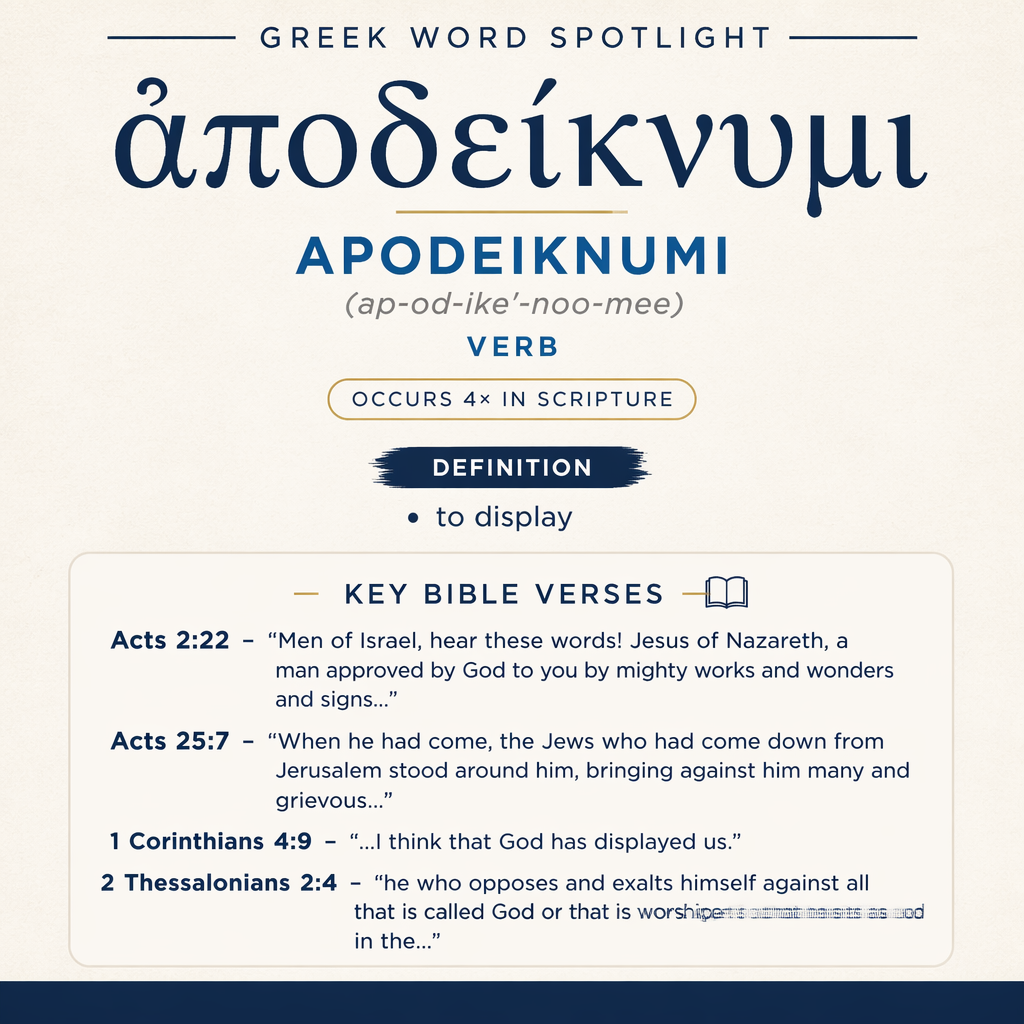
ἀποδείκνυμι means “to display” and occurs four times in Scripture: Acts 2:22; Acts 25:7; 1 Corinthians 4:9; 2 Thessalonians 2:4.
Where It Appears
This word occurs 4 times in Scripture. The references are Acts 2:22; Acts 25:7; 1 Corinthians 4:9; and 2 Thessalonians 2:4.
Learn More →In the Verses
In 1 Corinthians 4:9, it describes God displaying the apostles “like men sentenced to death.” In Acts 2:22, it appears in the statement about Jesus being “approved by God.”
Learn More →ἀποδείκνυμι means “to display” and appears in scenes that range from public validation to courtroom claims and self-exalting imposture. Its four New Testament uses place the action of “displaying” before observers—whether God, accusers, the watching world, or a gathered community.
Root and Related Words
ἀποδείκνυμι is related to ἀπό (apo), “away from” (Strong’s G575), and δεικνύω (deiknyo), “to show” (Strong’s G1166).

Occurrences
“Men of Israel, hear these words! Jesus of Nazareth, a man approved by God to you by mighty works and wonders and signs which God did by him among you, even as you yourselves know,” (Acts 2:22)
In this proclamation, “display” is tied to public recognition: Jesus is presented before “Men of Israel” as “approved by God,” and that approval is connected to observable acts—“mighty works and wonders and signs.” The sentence frames the audience as witnesses (“among you… as you yourselves know”), so the displaying is not hidden or private. The approval is not asserted in the abstract; it is placed on view through deeds done “by him among you,” making the crowd’s shared experience part of what has been set before them.

When he had come, the Jews who had come down from Jerusalem stood around him, bringing against him many and grievous charges which they could not prove, (Acts 25:7)
Here “display” functions in a legal setting shaped by accusation and evidence. The accusers “stood around him,” and their “many and grievous charges” are brought forward into the open, as if laid out for scrutiny in a hearing. Yet the scene emphasizes the failure of what is presented: what they bring is not matched by proof. The verse’s stress on “could not prove” highlights a gap between displaying allegations and substantiating them; the courtroom-like atmosphere makes “display” a matter of public assertion that invites evaluation.
For, I think that God has displayed us, the apostles, last of all, like men sentenced to death. For we are made a spectacle to the world, both to angels and men. (1 Corinthians 4:9)
In Paul’s description, the subject doing the displaying is God, and the objects displayed are “us, the apostles.” The display is pictured as placement “last of all,” compared to “men sentenced to death,” which conveys exposure rather than honor. The second sentence interprets that exposure: “we are made a spectacle,” and the audience is maximal—“to the world, both to angels and men.” The verb therefore carries the sense of being set out where observers can see, and the comparison underscores the vulnerability and public nature of that positioning. The scene is not simply that the apostles are noticed; they are put on view in a way that invites watching from multiple realms.
he who opposes and exalts himself against all that is called God or that is worshiped, so that he sits as God in the temple of God, setting himself up as God. (2 Thessalonians 2:4)
In this portrayal of opposition and self-exaltation, “display” is expressed as a self-directed act: the figure “sets himself up as God.” The surrounding clauses clarify the arena and the aim—he “opposes,” “exalts himself,” and “sits as God in the temple of God.” The display here is therefore bound to a deliberate public posture: occupying a sacred space and adopting a role “as God” so that the claim is enacted, not merely spoken. The verse presents a calculated self-presentation intended to be perceived within the setting of worship and what is “called God.”
Sense and Usage
Across these passages, “display” consistently involves placing something before observers in a way that makes it perceptible within a social setting—an audience, a tribunal, a watching cosmos, or a temple. In Acts 2:22, the content displayed is divine approval, made visible through “mighty works and wonders and signs” experienced “among you.” The effect is communal: the listeners are addressed as those who already share knowledge of what has been put on view.
Acts 25:7 shows that what is displayed can be adversarial: “charges” are brought and placed around a defendant in a scene of pressure (“stood around him”). Yet the verse’s final clause shows that display by itself does not settle the matter; the public presentation of accusations meets the requirement of proof, and in this case that requirement is not met.
In 1 Corinthians 4:9, “display” is not a matter of presenting evidence or signs but of presenting persons. The apostles are shown forth as an object lesson—“like men sentenced to death”—and this becomes “spectacle,” a word that underscores their visibility and the breadth of the viewing audience. The passage joins the act of being displayed to the experience of being watched, so that “display” carries the weight of exposure and public placement.
2 Thessalonians 2:4 uses “display” for a self-constructed presentation, where the figure actively stages a claim by where he sits and how he positions himself. The surrounding verbs (“opposes,” “exalts himself”) frame the display as aggressive and rivalrous. The clause “setting himself up as God” presents the action as an enacted self-representation within “the temple of God,” so the display involves occupying a location associated with worship and thereby making the claim conspicuous.
Taken together, these uses show that “display” can be accomplished by deeds that verify a claim (Acts 2:22), by verbal accusations brought into open hearing (Acts 25:7), by the public exposure of persons to a watching audience (1 Corinthians 4:9), or by a staged posture meant to communicate an identity (2 Thessalonians 2:4). In each case, the verb’s force lies in the movement from what could be hidden to what is set before others to see and reckon with.
Imagery
The word’s imagery in these verses is consistently public and spatial: deeds done “among you,” accusers “stood around him,” apostles placed “last of all” as a “spectacle,” and a usurper who “sits… in the temple of God.” Each picture turns “display” into a scene of visibility—something positioned where observers are present, and where what is shown has consequences for recognition, judgment, or allegiance.
Sources: Lexical data from Strong’s Exhaustive Concordance and the Translators Brief Lexicon of Extended Strongs for Greek (STEPBible, CC BY). Occurrence data from the Translators Amalgamated Greek New Testament (STEPBible, CC BY). Scripture quotations from the World English Bible (public domain).