
Understanding the Meaning of ‘agem in Hebrew
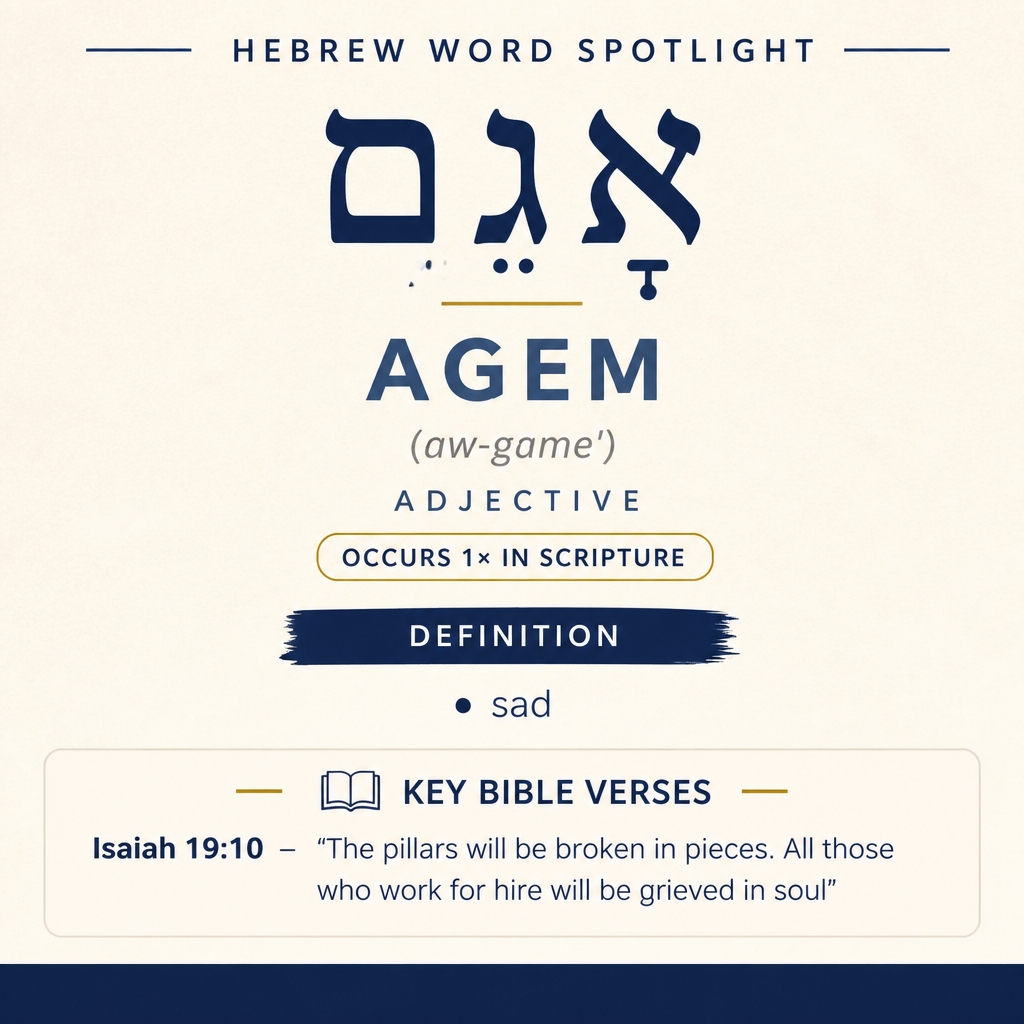
אָגֵם (agem) means “sad” and appears once in Scripture, in Isaiah 19:10.
Biblical Usage
It occurs one time in the Hebrew Scriptures. Its single occurrence is Isaiah 19:10.
Learn More →Verse Context
In Isaiah 19:10, it is used in a context where workers “will be grieved in soul.”
Learn More →אָגֵם (agem) means “sad” and appears in Isaiah 19:10. In that setting it belongs to a description of people whose working life collapses and whose inner life is weighed down by grief.
Occurrences
“The pillars will be broken in pieces. All those who work for hire will be grieved in soul.” (Isaiah 19:10)
In Isaiah 19:10 the language moves from the shattering of what supports a society (“The pillars will be broken in pieces”) to the personal impact on those who depend on that stability for their daily livelihood (“All those who work for hire will be grieved in soul”). אָגֵם (agem), “sad,” belongs to the second half of the verse, where the focus is not merely external damage but the emotional and inward result. The verse presents sorrow as something that reaches beyond a passing reaction; it is located “in soul,” framing sadness as an inner condition tied to the ruin of the structures that make ordinary work and wages possible.
The shift within the verse also shows how sadness is made concrete by social and economic imagery. “Pillars” evoke what holds up and orders life; when those supports are “broken in pieces,” the people most exposed to the consequences are “those who work for hire”—workers who live from one payment to the next. In this scene, sadness is not abstract melancholy detached from circumstance. It is the grief that follows when the dependable framework for earning and living fractures, leaving those who rely on it with a wounded interior response.

Sense and Usage
The sense “sad” is expressed here through the idiom of being “grieved in soul,” which gives the adjective a distinctly inward orientation. The verse does not depict sadness as a private mood with no cause; it is tethered to visible upheaval (“pillars…broken in pieces”) and to the vulnerability of wage labor (“those who work for hire”). In this way, אָגֵם carries the weight of sorrow that follows loss of stability and the disruption of ordinary patterns of work.
Because the sadness is framed as a response to the breaking of “pillars,” the word participates in a cause-and-effect portrayal: structural collapse leads to personal grief. The emotional tone is communal as well as individual. “All those who work for hire” gathers a class of people into one shared condition, suggesting that sadness spreads across a workforce when the foundations of economic life fail. Thus the word functions as a descriptor of a widespread emotional outcome, not merely the feeling of one isolated sufferer.
The verse’s pairing of external and internal language also sharpens the contour of the sadness. The first clause uses tactile, physical imagery (“broken in pieces”); the second clause moves inward (“grieved in soul”). This juxtaposition implies that sorrow is the inner echo of outward ruin. In such a setting, אָגֵם marks the human cost of collapse: the emotional pain that corresponds to the loss of supporting structures and to the insecurity faced by those whose work depends on those structures.
Finally, the expression “grieved in soul” places sadness in the deepest part of the person. The wording suggests more than disappointment or frustration; it frames sorrow as something that touches a person’s inner life. Within Isaiah 19:10, this deep sadness is presented as the natural, even inevitable, response when the supports of livelihood are shattered and hired workers—those with limited control over the larger “pillars”—bear the consequences.
Imagery
Isaiah 19:10 sets the sadness of אָגֵם against the image of pillars breaking apart. The verse paints sorrow as the interior experience that follows the cracking of what once held life up. The worker-for-hire stands in the aftermath of broken supports, and the grief named here is not detached from that scene but embedded within it—an inward heaviness arising from a world whose structures no longer stand.
Sources: Lexical data from Strong’s Exhaustive Concordance and the Open Scriptures Hebrew Lexicon. Occurrence data from the Westminster Leningrad Codex with STEPBible reference data (CC BY). Scripture quotations from the World English Bible (public domain).





