Discovering the Meaning of ‘Agam in Hebrew
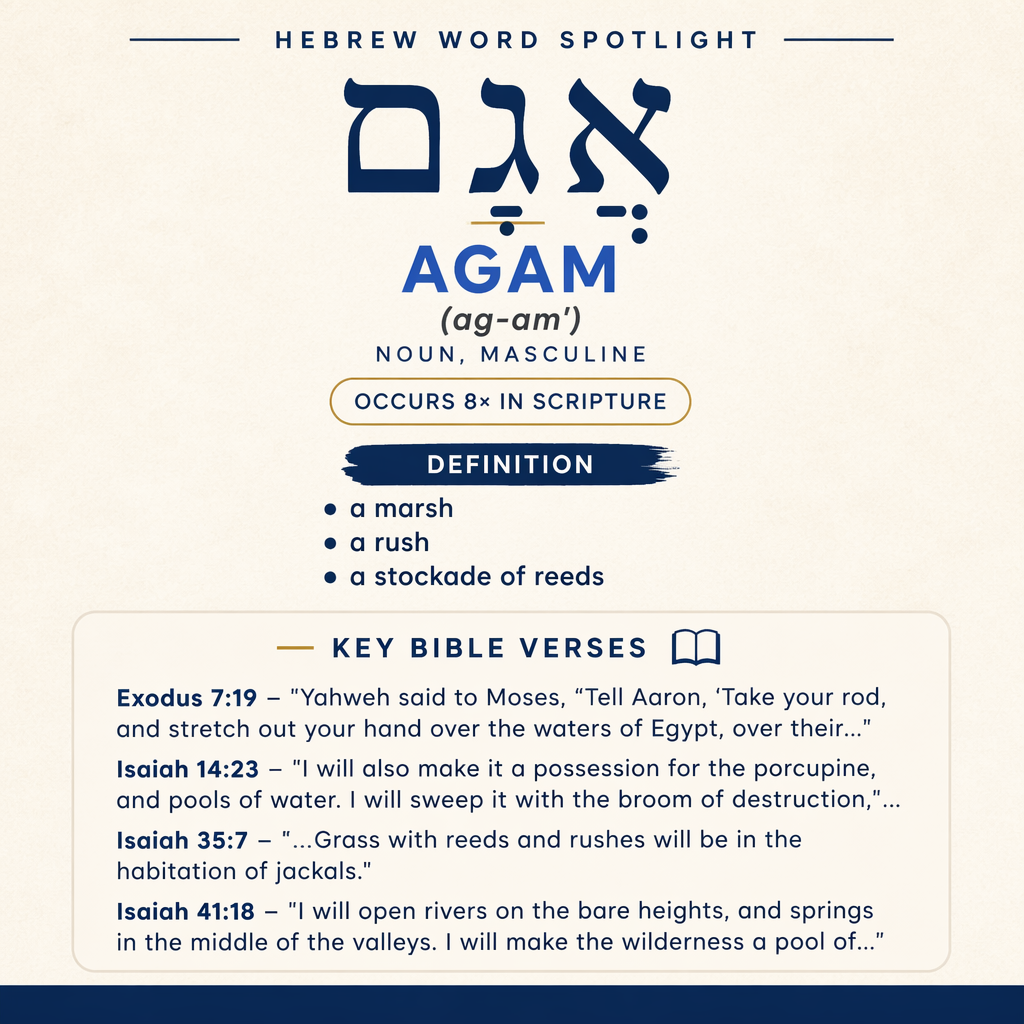
אֲגַם (agam) means a marsh, a rush, or a stockade of reeds, occurring 8 times across Exodus, Psalms, Isaiah, and Jeremiah.
Core Meaning
אֲגַם refers to a marsh and can also denote a rush or a stockade of reeds.
Learn More →Scripture Distribution
It occurs 8 times in Scripture: Exodus 7:19; Psalm 107:35; Psalm 114:8; Isaiah 14:23; 35:7; 41:18; 42:15; Jeremiah 51:32.
Learn More →Usage in Context
In several passages it is rendered “pool of water” (Isaiah 14:23; 35:7; 41:18; 42:15; Psalm 107:35; 114:8). It appears with reeds imagery in Jeremiah 51:32.
Learn More →אֲגַם (agam) names a water feature and what belongs to it: a marsh, a rush, or a stockade of reeds. It appears in narratives of Egypt’s waters and in poetic and prophetic scenes where water is gathered, created, or dried up, and where reeds can be burned.

Occurrences
“Yahweh said to Moses, “Tell Aaron, ‘Take your rod, and stretch out your hand over the waters of Egypt, over their rivers, over their streams, and over their pools, and over all their ponds of water, that they may become blood. There will be blood throughout all the land of Egypt, both in vessels of wood and in vessels of stone.’ ”” (Exodus 7:19)
In this command scene, אֲגַם is part of an expanding list of Egyptian waters targeted for transformation. The verse piles up categories (“rivers… streams… pools… ponds of water”), stressing that the reach is not limited to a single channel but includes gathered, standing water as well. Here agam contributes the idea of water held in place—water that can be counted among the land’s accessible sources and therefore included in the sweeping judgment described (“that they may become blood”).
““I will also make it a possession for the porcupine, and pools of water. I will sweep it with the broom of destruction,” says Yahweh of Armies.” (Isaiah 14:23)
Here אֲגַם appears in an announcement of reversal: what is addressed will become suitable for an animal (“porcupine”) and for “pools of water.” The image is not of ordered irrigation or human settlement, but of a place altered into a different kind of landscape. Agam functions as one of the features of that altered terrain—water lying in pools rather than the built environment implied by normal habitation.
“The burning sand will become a pool, and the thirsty ground springs of water. Grass with reeds and rushes will be in the habitation of jackals, where they lay.” (Isaiah 35:7)
In this transformation oracle, agam stands opposite “burning sand” and alongside “springs of water.” The point is not merely the presence of water but the creation of a pooled, sustained wet place in what had been inhospitable. The verse immediately adds “Grass with reeds and rushes,” linking the pooled water to the kind of vegetation that thrives at the margin of marshy ground. In this setting, agam naturally connects with the definition’s mention of rushes: the pool is the environment in which such plants appear.
“I will open rivers on the bare heights, and springs in the middle of the valleys. I will make the wilderness a pool of water, and the dry land springs of water.” (Isaiah 41:18)
In this promise, the speaker describes deliberate provision: rivers where they are not expected (“bare heights”), springs where they are not expected (“middle of the valleys”), and a “wilderness” changed into an agam. The word helps specify the kind of change envisioned for arid space—not simply a trickle, but water gathered enough to be called a pool or marshy water-body. The parallel with “springs of water” highlights that pooled water and emerging water are both part of the same act of making dry places habitable.
“I will destroy mountains and hills, and dry up all their herbs. I will make the rivers islands, and will dry up the pools.” (Isaiah 42:15)
Here agam occurs in a scene of removal rather than provision. The speech moves from large landforms (“mountains and hills”) to vegetation (“all their herbs”) to waterways: rivers are so diminished that they become “islands,” and the “pools” are dried up. Agam supplies a concrete endpoint for the drying: not only flowing channels but also accumulated waters are subject to being emptied. The line makes pooled water a marker of life in the landscape; to dry it up is to erase a key sign of fertility and growth.
“So the passages are seized. They have burned the reeds with fire. The men of war are frightened.” (Jeremiah 51:32)
In this report, the word is expressed through the element of reeds: “They have burned the reeds with fire.” The focus is no longer directly on the water itself but on what stands in and around it. Agam here resonates with the definition’s “rush” and “stockade of reeds,” since reeds can form natural barriers along watery margins and can also be destroyed. Burning them suggests stripping away cover, access, or defenses associated with such reed growth, fitting the tense setting where “passages are seized” and fear spreads among “men of war.”
“He turns a desert into a pool of water, and a dry land into water springs.” (Psalm 107:35)
In this psalm line, agam is paired with stark opposites: “desert” becomes “a pool of water,” and “dry land” becomes “water springs.” The word conveys the miracle of retained water where none is expected. Its contribution is to portray not a momentary wetting but a lasting change in the character of the land—desert is re-described as something able to hold water in a pooled state.
“who turned the rock into a pool of water, the flint into a spring of waters.” (Psalm 114:8)
Here agam is the product of transformation from the most resistant material in the line: “rock” becomes “a pool of water.” The verse pairs it with a second transformation, “flint into a spring of waters,” again setting pooled water beside flowing emergence. Agam emphasizes the result as water collected and available; the image depends on the contrast between hard, dry stone and a basin-like gathering of water that replaces it.
Sense and Usage
Across these passages, אֲגַם consistently belongs to settings where water is conceived as gathered—standing in pools, marshy pockets, or wet basins—rather than primarily as a current. In Exodus 7:19, that gathered water is simply one category among “the waters of Egypt,” showing that pooled water is part of the ordinary water landscape and thus included when the whole system is struck. In Isaiah, the word becomes a flexible image within prophetic speech: it can describe the reshaping of land into a new habitat (Isaiah 14:23), the reversal of aridity into life-supporting wetlands that sprout reeds and rushes (Isaiah 35:7; Isaiah 41:18), or the opposite movement where even these retained waters are eliminated (Isaiah 42:15). The oscillation between making pools and drying pools underscores that an agam is a recognizable sign of whether a region is being refreshed or stripped.
The definition’s vegetation and structure elements (“a rush” and “a stockade of reeds”) come into view most directly in Jeremiah 51:32, where the reeds themselves are acted upon: they are burned. That line shows that agam can be represented metonymically by what grows there, not only by the water. In the Psalms (Psalm 107:35; Psalm 114:8), agam serves as a vivid result-word: it names the tangible outcome of transformation, especially where the starting point is hostile to water (“desert,” “rock”). In each case, the word anchors the poetry in a concrete environmental feature—water that remains present, gathered, and therefore able to sustain what the surrounding terrain would normally lack.
Imagery
The imagery carried by אֲגַם in these verses is strongly physical: pools formed where dryness dominates, pools counted among a nation’s waters, pools dried up, and reeds associated with such wet places even to the point of being burned. Whether the scene is abundance (a desert made into an agam) or deprivation (agamim dried), the word repeatedly marks the boundary between barrenness and a landscape capable of supporting reeds, rushes, and the life that gathers around water.
Sources: Lexical data from Strong’s Exhaustive Concordance and the Open Scriptures Hebrew Lexicon. Occurrence data from the Westminster Leningrad Codex with STEPBible reference data (CC BY). Scripture quotations from the World English Bible (public domain).