
Discovering the Meaning of Agag in Hebrew
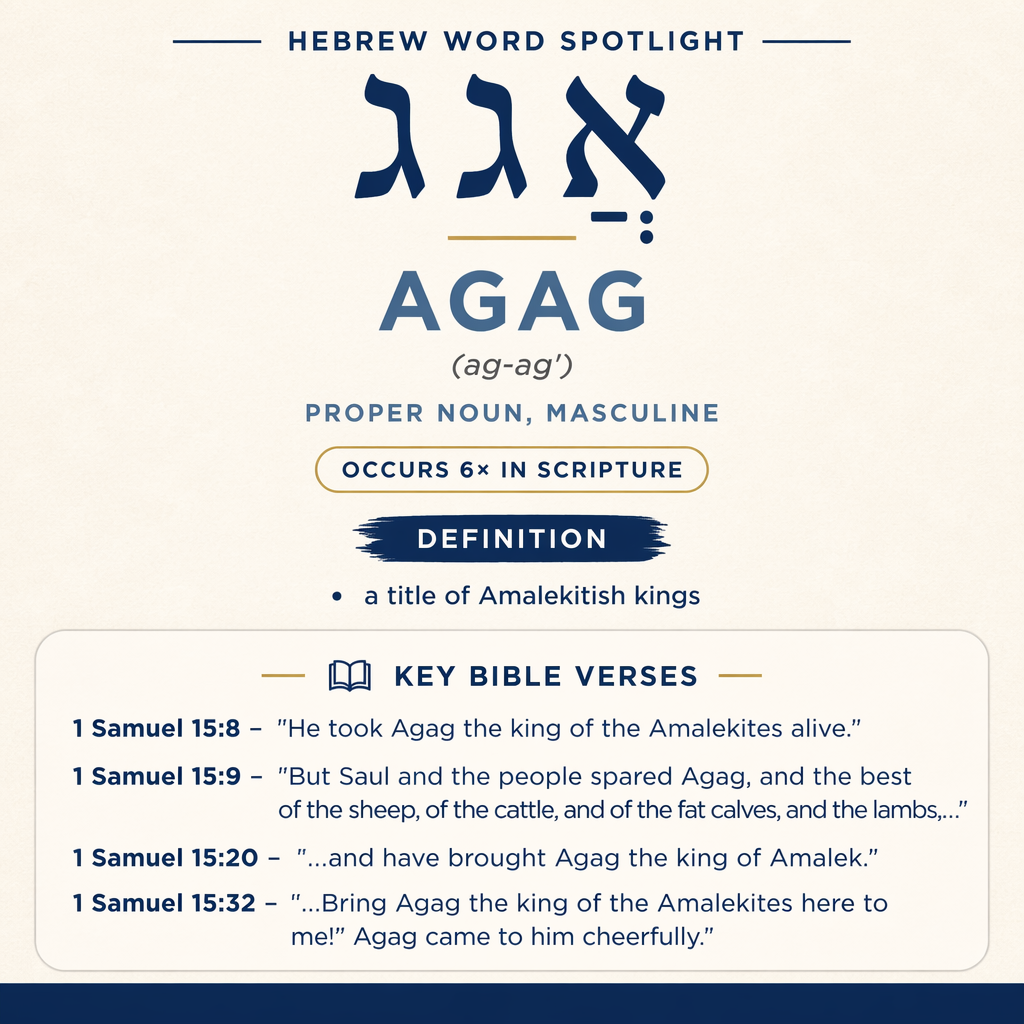
אֲגַג (Agag) is a title of Amalekitish kings, appearing six times in Scripture in 1 Samuel 15 and Numbers 24:7.
Biblical Occurrences
It occurs six times in Scripture. Five occurrences are in 1 Samuel 15, and one is in Numbers 24:7.
Learn More →Narrative Context
In 1 Samuel 15, Agag is named as king of the Amalekites in Saul’s campaign and Samuel’s judgment. In Numbers 24:7, a king is compared as higher than Agag.
Learn More →אֲגַג (Agag) functions as a royal title connected with Amalekite kings. It appears in the narrative of Saul and Samuel’s confrontation with an Amalekite king, and once in a poetic oracle that compares one king’s height and kingdom to “Agag.”
Occurrences
1 Samuel 15:8 — “He took Agag the king of the Amalekites alive, and utterly destroyed all the people with the edge of the sword.”
Here Agag stands as the named—or titled—king captured in war. The verse sets a sharp contrast: Agag is “alive,” while “all the people” are “utterly destroyed.” In this scene, the word marks the surviving royal figure who remains as the visible representative of Amalek after the rest have been put to the sword.
1 Samuel 15:9 — “But Saul and the people spared Agag, and the best of the sheep, of the cattle, and of the fat calves, and the lambs, and all that was good, and were not willing to utterly destroy them; but everything that was vile and refuse, that they destroyed utterly.”
Agag is grouped with the “best” of the livestock as something spared. The verse frames the sparing of Agag as part of a wider pattern: what appears “good” is kept, and what is “vile and refuse” is destroyed. Within that moral sorting, Agag is treated not as a combatant but as a prize—the royal captive preserved alongside valuable animals—so the word contributes the idea of kingship being held back when the rest is eliminated.
1 Samuel 15:20 — “Saul said to Samuel, “But I have obeyed Yahweh’s voice, and have gone the way which Yahweh sent me, and have brought Agag the king of Amalek, and have utterly destroyed the Amalekites.”
Saul’s defense hinges on what he claims to have done: he has “brought Agag the king of Amalek” while also asserting he has “utterly destroyed the Amalekites.” Agag’s title crystallizes the tension inside Saul’s statement. The king is presented as something Saul can “bring” as proof of mission completion, yet the verse’s own wording makes the king’s survival a conspicuous exception to the claim of total destruction.
1 Samuel 15:32 — “Then Samuel said, “Bring Agag the king of the Amalekites here to me!” Agag came to him cheerfully. Agag said, “Surely the bitterness of death is past.””
In this encounter the word becomes part of courtroom-like staging: Samuel commands that Agag be brought “here to me,” and Agag approaches and speaks. The repetition of the name/title in the verse heightens focus on the royal captive’s demeanor (“cheerfully”) and his interpretation of his situation (“Surely the bitterness of death is past”). Agag is not only a political figure but a speaker whose own words reveal expectation of mercy or reprieve.
1 Samuel 15:33 — “Samuel said, “As your sword has made women childless, so your mother will be childless among women!” Then Samuel cut Agag in pieces before Yahweh in Gilgal.”
Agag is addressed directly as one whose “sword” has inflicted devastating loss: “made women childless.” The word thus bears the weight of remembered violence associated with a king’s rule and warfare. The verse then describes a decisive act of judgment carried out “before Yahweh in Gilgal,” where Agag’s death is not private revenge but a public, cultic-location execution. In this setting, the royal title becomes the focal point for recompense: the king himself embodies the consequences of his violence.
Numbers 24:7 — “Water shall flow from his buckets. His seed shall be in many waters. His king shall be higher than Agag. His kingdom shall be exalted.”
Agag appears here as a measuring point in elevated speech about a king and kingdom. “Higher than Agag” uses the title as a known standard of royal height or prominence, so that surpassing Agag conveys superiority. The word therefore functions less as an individual captive and more as an emblematic royal comparator: a king’s greatness is described by being greater than “Agag,” and the line immediately parallels that comparison with “His kingdom shall be exalted.”

Sense and Usage
Across these passages, Agag operates as a title bound to Amalekite kingship, and the contexts show two complementary ways that a royal title can work in Scripture: it can identify a particular king within a narrative, and it can serve as a benchmark within poetry.
In 1 Samuel 15, the repeated phrasing “Agag the king of the Amalekites” (15:8; 15:32) and “Agag the king of Amalek” (15:20) anchors the story’s conflict in a single person who represents a defeated people. The narrative treats that titled king as a remainder after broader destruction: first captured alive (15:8), then spared (15:9), then produced as evidence in Saul’s defense (15:20). Agag’s kingship makes him a trophy of victory and, at the same time, a test case of what “utterly destroy” is taken to mean when applied in practice. The story’s movement from capture to sparing to summons to execution places the title in the center of competing actions—Saul “spared” him (15:9), Samuel commands “Bring” him (15:32), and Samuel finally executes him in a solemn setting (15:33).
The narrative also uses Agag’s speech to deepen what the royal title signifies. In 15:32, Agag approaches “cheerfully” and declares, “Surely the bitterness of death is past.” A titled king does not appear merely as an object moved by others; he has a voice and an assessment of his fate. Yet 15:33 immediately frames him as one responsible for lethal violence (“As your sword has made women childless”), turning the king-title into a shorthand for the human cost of his reign and campaigns. In that way, the title “Agag” gathers up both status (a king captured and handled by Israel’s leaders) and culpability (a sword that has produced childlessness), culminating in a punishment carried out “before Yahweh.”
Numbers 24:7 uses the same title differently. Instead of narrating what an Agag does, it treats Agag as a recognizable apex of royal stature: “His king shall be higher than Agag.” The comparison assumes Agag’s prominence is sufficiently established that surpassing him communicates exaltation. The verse then places that comparison alongside expansive imagery—“Water shall flow from his buckets. His seed shall be in many waters”—so that the line about being “higher than Agag” participates in a broader portrayal of abundance and elevated dominion (“His kingdom shall be exalted”). In this poetic usage, Agag functions as a name of kingship that can carry meaning as a standard without needing narrative detail in the verse itself.
Taken together, these occurrences show that the title can point to a concrete royal captive in a specific episode and also provide a familiar reference point for describing royal superiority. In both uses, Agag is not a general term for kingship; it is a particular royal designation tied to Amalek, and the passages treat it as weighty—either as the living center of a moral and political crisis (1 Samuel 15) or as a high-water mark of kingly eminence that another king surpasses (Numbers 24:7).
Imagery
The word gathers vivid imagery because it is attached to kingship at the moment of reversal. In 1 Samuel 15, Agag moves from being “taken… alive” (15:8), to being “spared” with prized goods (15:9), to being summoned before Samuel, speaking as though danger has passed (15:32), and finally to being cut down “before Yahweh in Gilgal” (15:33). Numbers 24:7, by contrast, places Agag at the summit of comparison—an emblem of royal height—only to have that summit exceeded: “His king shall be higher than Agag. His kingdom shall be exalted.”
Sources: Lexical data from Strong’s Exhaustive Concordance and the Open Scriptures Hebrew Lexicon. Occurrence data from the Westminster Leningrad Codex with STEPBible reference data (CC BY). Scripture quotations from the World English Bible (public domain).





