Exploring the Meaning of ‘Age’ in Hebrew
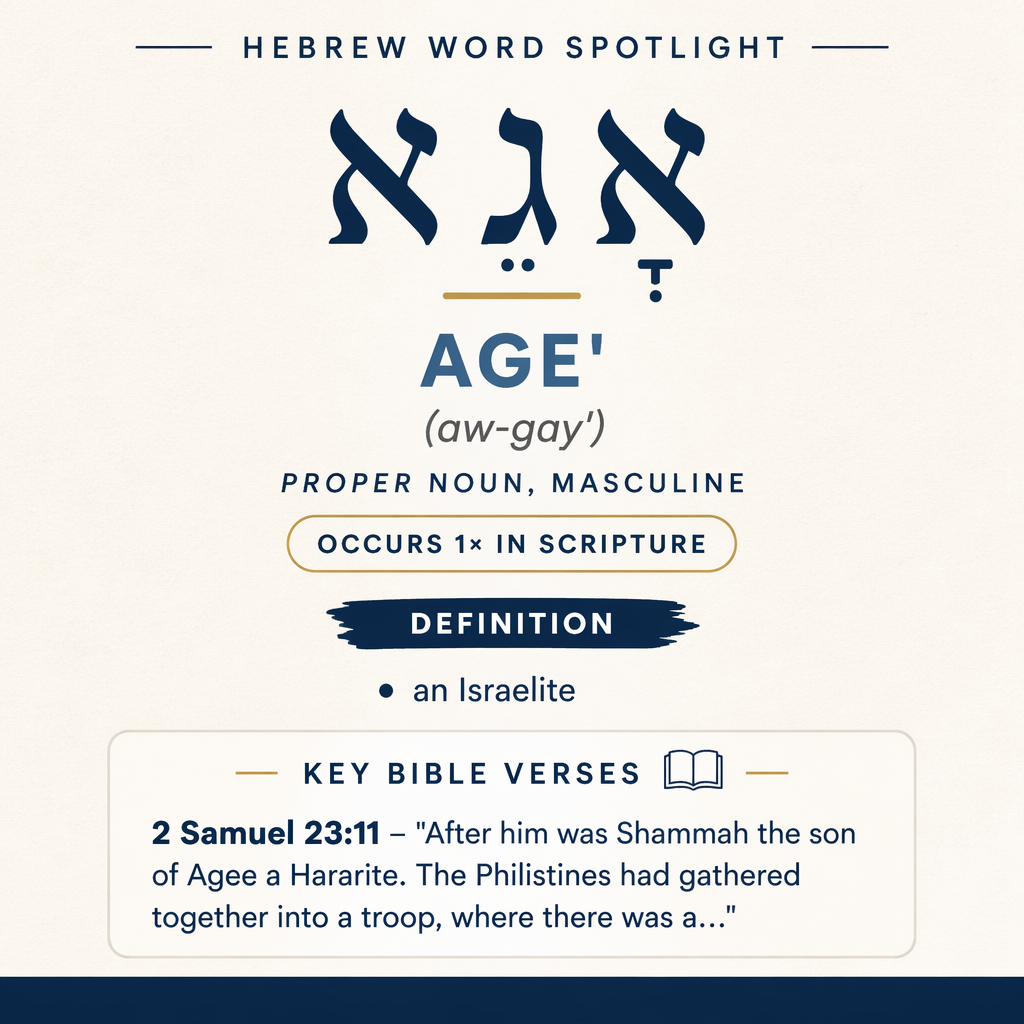
אָגֵא (Age') means “an Israelite” and appears once in Scripture, in 2 Samuel 23:11.
Biblical Occurrence
It occurs 1 time in Scripture. The occurrence is in 2 Samuel 23:11.
Learn More →Verse Context
In 2 Samuel 23:11, Shammah is identified as the son of Agee. The verse notes Philistines gathered together into a troop.
Learn More →אָגֵא (Age’) is a personal name attached to one individual in a brief narrative notice. It appears in 2 Samuel 23:11, where it serves to identify the lineage of a named warrior.
Occurrences
2 Samuel 23:11
After him was Shammah the son of Agee a Hararite. The Philistines had gathered together into a troop, where there was a plot of ground full of lentils; and the people fled from the Philistines. (2 Samuel 23:11)
Here אָגֵא functions as the patronymic point of reference in the clause, “Shammah the son of Agee.” The wording places Shammah within a recognized family line, anchoring the account in concrete identity rather than leaving Shammah as an isolated figure. In this single sentence, the name serves a documentary purpose: it distinguishes which Shammah is meant by tying him to Agee, and then further situates him socially by the descriptor “a Hararite.”
Although Agee himself does not act in the scene, the name contributes to the way the verse sets up the surrounding conflict. The verse quickly shifts from identification (“After him was Shammah the son of Agee”) to the military situation (“The Philistines had gathered together into a troop”), and finally to the crisis for the wider community (“the people fled from the Philistines”). Against this backdrop, the presence of a father’s name in Shammah’s designation helps give the notice the tone of a remembered record: a named individual with a known ancestry is linked to a moment when “The Philistines” press into Israelite space at a specific location (“a plot of ground full of lentils”). Agee’s name is therefore part of the verse’s precision: it is one of the details that marks the warrior as a particular Israelite in a particular episode, not merely a generic combatant.
Within the verse’s phrasing, Agee is also framed in relation to others: Shammah is introduced “After him,” implying an ordered sequence of figures. In such an ordered list, the patronymic “son of Agee” acts as a stable label that can be carried forward in memory and retelling. The immediate narrative does not explain Agee’s deeds or status; the contribution is instead relational and identificatory, giving Shammah an inherited marker of belonging within Israel’s story while the verse proceeds to describe Philistine pressure and Israelite flight.

Sense and Usage
As a proper name defined as “an Israelite,” אָגֵא operates in this verse as an ethnic and communal marker embedded in genealogy. It is not used as a common noun or descriptive term; it is used to locate an individual within Israel through family connection. The definition “an Israelite” plays out not by describing Agee’s actions but by the role the name plays in establishing who belongs to the people whose land is being contested in the verse. Shammah, introduced by paternal descent, stands within Israelite identity, while the opposition is explicitly “The Philistines.”
The syntax of the verse highlights how personal names can function in biblical narrative: a father’s name can be a key element of public identification. In contexts where several individuals might share a given name, a patronymic distinguishes one from another. The verse’s brief form assumes that “Agee” is meaningful as a label of origin: Shammah is not only an individual but the son of a named Israelite. In this way, the name works as a small but weight-bearing component in the notice, grounding the account in particular persons rather than in anonymous roles.
The definition also aligns with the verse’s communal picture. The scene includes “a plot of ground full of lentils” and “the people” who “fled from the Philistines.” In such a setting, the identity of an Israelite is connected to land, community, and conflict; the verse depicts pressure from an outside force and the reaction of the populace. By naming Agee as the father of Shammah, the text connects an Israelite household to the larger national experience portrayed here: threat, flight, and contested ground. Agee’s Israelite identity is therefore carried implicitly through the lineage statement and the contrast with the Philistines.
Because Agee is only referenced as a father, the usage is concentrated: the name is a relational anchor. It signals that Shammah’s story is not detached from family or peoplehood. Even when the main action of the scene is described in broad terms (“The Philistines had gathered together into a troop”), the notice begins with particularity: a specific man, identified through a specific father, placed within an ordered recounting of individuals. That is how the definition comes to expression here—through the way the narrative tags identity, lineage, and belonging.
Imagery and Setting
In this single setting, the name Agee stands quietly at the edge of a vivid scene. The verse paints a tense rural picture: a “plot of ground full of lentils” becomes the focal point where “The Philistines had gathered together into a troop,” and the surrounding community response is fear-driven movement, “the people fled from the Philistines.” Against that imagery of gathered troops and abandoned ground, the patronymic “son of Agee” adds a different kind of concreteness—not geographical, but familial. It suggests remembered names attached to remembered fields, where the identity of an Israelite household is preserved alongside the description of conflict.
Sources: Lexical data from Strong’s Exhaustive Concordance and the Open Scriptures Hebrew Lexicon. Occurrence data from the Westminster Leningrad Codex with STEPBible reference data (CC BY). Scripture quotations from the World English Bible (public domain).