Discovering the Meaning of ‘Adargazer (Aramaic) in Hebrew
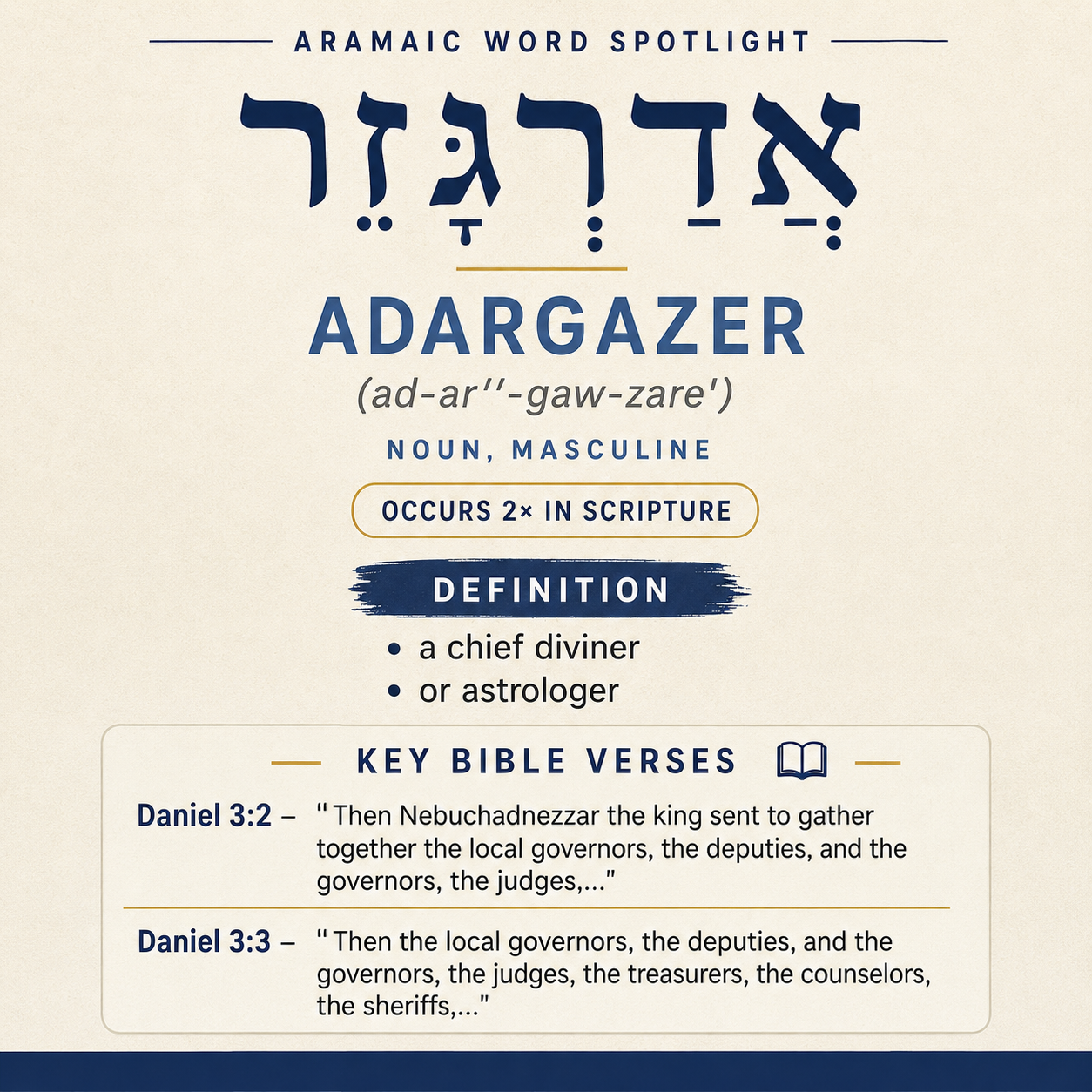
אֲדַרְגָּזֵר means “a chief diviner; or astrologer” and appears in Daniel 3:2–3.
Biblical Occurrences
This Aramaic term occurs 2 times in Scripture, both in Daniel 3:2 and Daniel 3:3.
Learn More →Daniel Context
In Daniel 3:2–3, it appears within a list of officials gathered by King Nebuchadnezzar.
Learn More →אֲדַרְגָּזֵר (adargazer) denotes “a chief diviner; or astrologer.” In Daniel 3 it appears within the formal lists of officials summoned to a royal dedication ceremony for Nebuchadnezzar’s image.
Occurrences
“Then Nebuchadnezzar the king sent to gather together the local governors, the deputies, and the governors, the judges, the treasurers, the counselors, the sheriffs, and all the rulers of the provinces, to come to the dedication of the image which Nebuchadnezzar the king had set up.” (Daniel 3:2)
In this summons, adargazer belongs to the catalog of people the king orders to be gathered. The verse presents the event as an official, state-sponsored assembly: it is initiated by the king (“sent to gather together”), includes a broad range of administrative and judicial roles (“judges,” “treasurers,” “counselors”), and is geographically comprehensive (“all the rulers of the provinces”). Within that framework, a “chief diviner; or astrologer” functions as one of the recognized categories of court personnel expected to attend. The term therefore contributes to the portrayal of a ceremony framed not as a private act, but as a public dedication supported by the king’s whole apparatus—political, legal, and advisory. The word’s presence in the list helps color the gathering as inclusive of specialists whose vocation concerns divination or astrology, standing alongside civil officers who govern, adjudicate, and administer.
“Then the local governors, the deputies, and the governors, the judges, the treasurers, the counselors, the sheriffs, and all the rulers of the provinces, were gathered together to the dedication of the image that Nebuchadnezzar the king had set up; and they stood before the image that Nebuchadnezzar had set up.” (Daniel 3:3)
The following verse narrates the fulfillment of the king’s command: those summoned “were gathered together” and arrive at the dedication, taking their place in a posture of attendance—“they stood before the image.” Here adargazer again appears as part of the same roster of offices, now depicted not merely as invited but present. By including the “chief diviner; or astrologer” among those who stand before the image, the narrative places this figure within the ceremonial witness of the dedication. The term contributes to the sense that the image is confronted by an assemblage representing many layers of the realm’s leadership. It also underscores that the dedication is attended by individuals whose professional identity relates to divination or astrology, suggesting that the gathering embraces more than administrative competence; it draws in courtly expertise that the king recognizes and incorporates into the public life of the empire.
Sense and Usage
The definition “a chief diviner; or astrologer” indicates a recognized specialist role, marked not only by the sphere of practice (divination/astrology) but by an elevated status (“chief”). In Daniel 3 the word does not appear as a solitary character or as a speaker; rather, it functions as a label inside a formal enumeration. That usage shapes how the sense is heard: adargazer is treated as an office, a class of official whose inclusion in a summons is expected and whose presence contributes to the event’s legitimacy and grandeur.
Across both verses, the word is coordinated with a series of other roles by repeated list structure. The repeated pattern—first the king’s dispatch to gather, then the gathered officials standing before the image—frames adargazer as part of a complete governmental and advisory representation. The term therefore carries the nuance of being integrated into the administrative world of the court: the “chief diviner; or astrologer” is counted among those who appear at royal command and who take their place with other leaders at a state dedication.
The scenes also show how the term’s sense is constrained by context. The narrative does not explain the methods, instruments, or particular tasks of the adargazer. What it does show is their social placement: they are grouped among “counselors” and other officers in a setting where attendance itself is a duty. The force of the word in these verses lies in what kind of person the king expects to be there—someone recognized for divination or astrology, and not simply as a practitioner but as a leading one. The ceremony is thus pictured as attracting the realm’s influential personnel in multiple spheres, including those whose expertise would be associated with interpreting signs and counsel of a specialized kind.
Because the word is embedded in a public roll call, it also participates in a literary effect of comprehensiveness. The repeated list in Daniel 3:2–3 creates a sense of breadth and inevitability: many ranks are named, the provinces are represented, and the officials arrive and stand. Within that mass of roles, adargazer adds a particular color—an office tied to divination or astrology—so that the gathering is not only political and legal but also includes a distinct kind of court specialist. The term thereby helps the reader picture the dedication as a fully staged royal occasion, attended by prominent figures whose varied offices together embody the king’s reach.
Imagery
In these verses the word is linked to the image-dedication setting: the king “sent to gather together” the officials, and they “stood before the image.” Adargazer, as “a chief diviner; or astrologer,” is imagined not in a private chamber of consultation but in the open formality of an assembled court, standing with other officials before a monumental object the king has set up. The imagery tied to the term here is therefore institutional and ceremonial: a named specialist rank folded into the visible crowd of rulers and officers gathered at a royal dedication.
Sources: Lexical data from Strong’s Exhaustive Concordance and the Open Scriptures Hebrew Lexicon. Occurrence data from the Westminster Leningrad Codex with STEPBible reference data (CC BY). Scripture quotations from the World English Bible (public domain).