What Does Adar Mean in Hebrew?
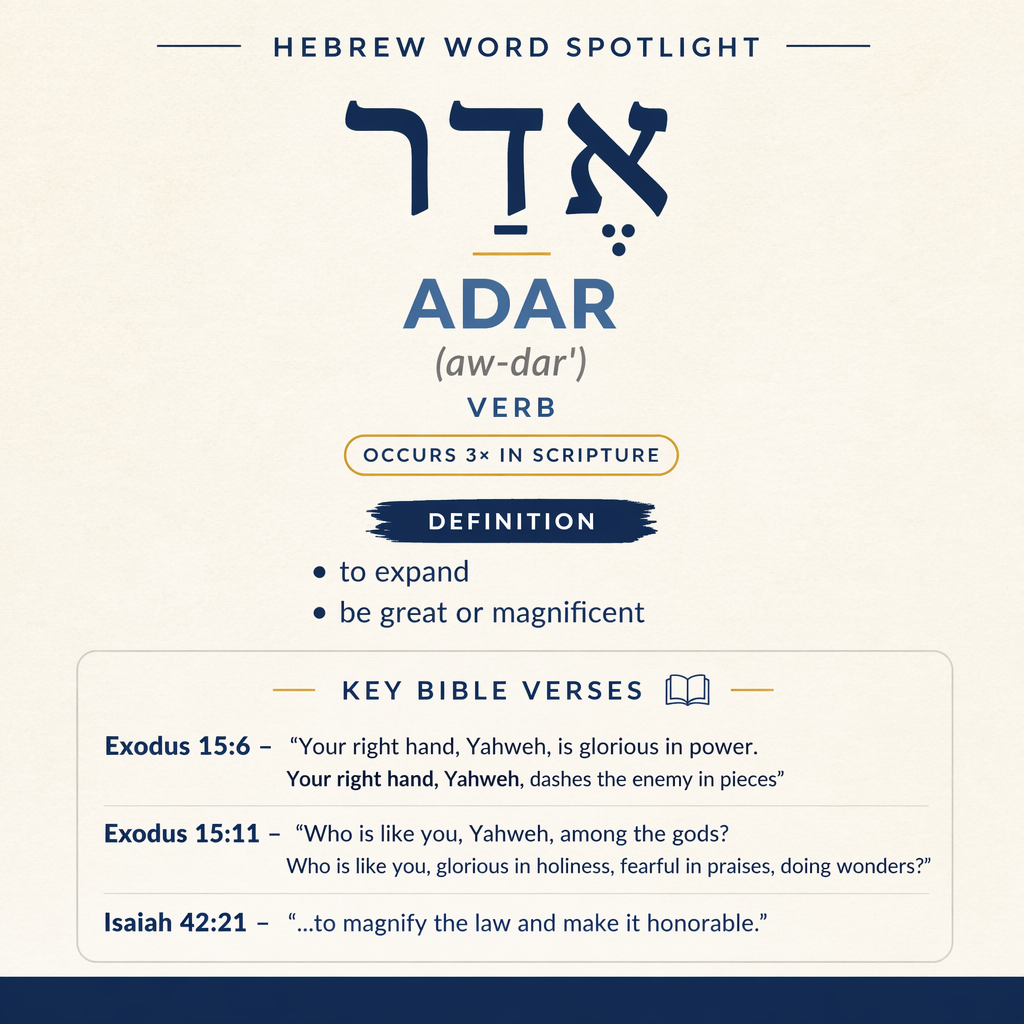
אָדַר (adar) means “to expand; be great or magnificent” and appears three times: Exodus 15:6, Exodus 15:11, and Isaiah 42:21.
Core Meaning
אָדַר expresses expansion and greatness or magnificence. It conveys what is glorious or made honorable.
Learn More →Song of Moses
In Exodus 15:6 and 15:11, it describes Yahweh as glorious in power and glorious in holiness. These lines celebrate his wonders and victory over the enemy.
Learn More →Isaiah’s Use
In Isaiah 42:21, it is used of Yahweh magnifying the law and making it honorable. This occurs for his righteousness’ sake.
Learn More →אָדַר (adar) expresses the idea of expansion into greatness or magnificence, and it appears in three passages that highlight Yahweh’s power, holiness, and the honoring of His law. In Exodus it belongs to the language of praise after deliverance, and in Isaiah it describes an act that elevates what Yahweh has given.
Occurrences
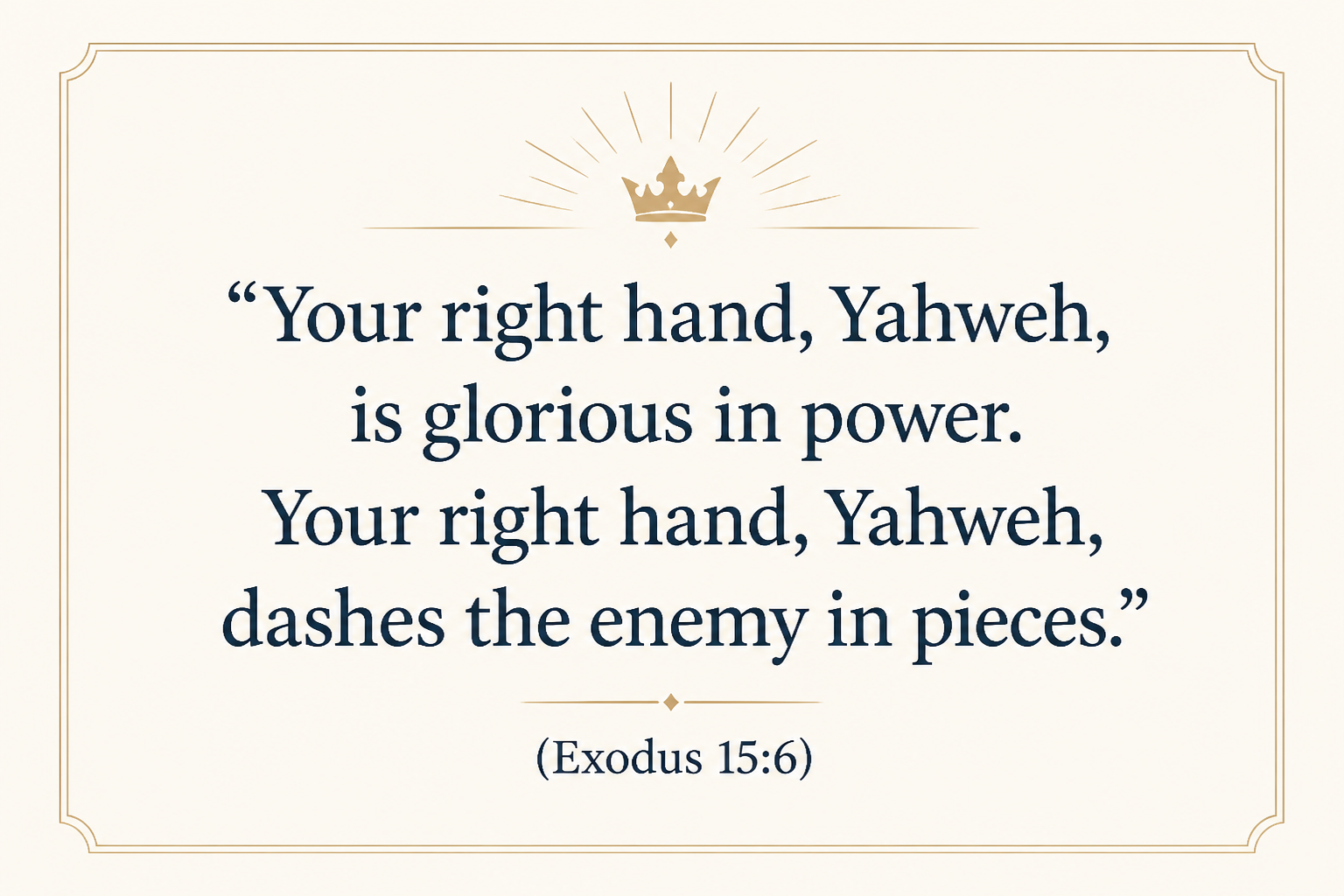
“Your right hand, Yahweh, is glorious in power. Your right hand, Yahweh, dashes the enemy in pieces.” (Exodus 15:6)
In this line of the song at the sea, adar is bound to “Your right hand, Yahweh,” and the verse immediately anchors that glory in concrete action: “dashes the enemy in pieces.” The greatness in view is not abstract admiration but manifested power. The “right hand” functions as a vivid way of speaking about effective might, and the verb’s sense of expanding into magnificence fits the movement from declaration (“is glorious in power”) to outcome (the enemy shattered). Adar therefore contributes the quality of magnificence as a property of Yahweh’s exercised strength, the kind of greatness that shows itself by decisive victory.
“Who is like you, Yahweh, among the gods? Who is like you, glorious in holiness, fearful in praises, doing wonders?” (Exodus 15:11)
Here the same vocabulary of glory is placed inside a pair of rhetorical questions that press Yahweh’s uniqueness: “Who is like you…? Who is like you…?” In this setting adar marks magnificence not primarily in raw force but in “holiness,” with accompanying descriptors—“fearful in praises” and “doing wonders.” The verse gathers together worship (“praises”), awe (“fearful”), and extraordinary deeds (“wonders”) as the arena in which greatness is recognized. Adar thus serves the song’s larger aim: it expands the listener’s sense of Yahweh’s incomparable stature. The greatness it conveys is the kind that makes comparison with other “gods” collapse, because Yahweh’s holiness and wonders stretch beyond any rival category.
“It pleased Yahweh, for his righteousness’ sake, to magnify the law and make it honorable.” (Isaiah 42:21)
In Isaiah, adar is applied to Yahweh’s purpose concerning “the law.” The verse ties that act to Yahweh’s character and intent—“for his righteousness’ sake”—and then pairs two expressions: “to magnify the law” and “make it honorable.” The first presents expansion: the law is made great, lifted up in standing and scope. The second states the resulting status: it becomes “honorable.” Adar therefore frames Yahweh’s action as an enlargement into recognized magnificence, not of an object like a hand or an attribute like holiness, but of what Yahweh gives and upholds. The greatness described is deliberate and pleasing to Yahweh, rooted in righteousness, and it has a public-facing outcome: the law stands as honored.

Sense and Usage
Across these passages adar consistently moves from the idea of greatness as a quality to greatness as something displayed or conferred. In Exodus 15:6, magnificence is attached to Yahweh’s “right hand” and is immediately demonstrated by an act that breaks an enemy. The verb’s sense of expansion into greatness fits the way the verse intensifies: “glorious in power” is not left as a poetic label but opens outward into a portrayal of overpowering action. The greatness is therefore experienced as force that cannot be resisted.
Exodus 15:11 broadens the same field of meaning by locating magnificence in “holiness” and in the sphere of worship and wonder. The greatness is expansive in another direction: it stretches beyond the battlefield into the moral and sacred character of Yahweh. The verse’s stacked descriptions (“glorious in holiness, fearful in praises, doing wonders”) create a widening effect, as though the singer’s words keep reaching for larger categories to express what cannot be matched. In that context adar supports the claim of incomparability: Yahweh’s greatness is not one impressive feature among others but a magnitude that reshapes the entire frame of comparison.
Isaiah 42:21 then shows adar used for an act of elevation: Yahweh “magnify[ies] the law” and “make[s] it honorable.” Here the greatness is not merely perceived by observers; it is advanced by Yahweh’s own intent. The expansion is purposeful—“It pleased Yahweh”—and ethically grounded—“for his righteousness’ sake.” Adar, therefore, can describe greatness that adheres to Yahweh Himself (His power, His holiness) and greatness that Yahweh causes to adhere to something associated with Him (the law’s honored standing). Within these three verses, the semantic movement stays within the boundaries of expansion into magnificence: power expands into victory; holiness expands into incomparable awe and wonder; and the law is expanded in stature into honor.
The three occurrences also show that adar naturally belongs to elevated speech. In Exodus it sits inside direct address (“Your right hand, Yahweh… Who is like you, Yahweh…?”), the language of public praise shaped for confession and remembrance. In Isaiah it appears in a declarative statement about Yahweh’s pleasure and righteousness. In both settings, the verb carries a heightened register suited to describing greatness that stands above ordinary measures, whether ascribed to Yahweh’s attributes or effected by Yahweh’s will.
Imagery and Emphasis
The imagery attached to adar in these passages alternates between action and elevation. The “right hand” that “dashes the enemy in pieces” gives magnificence a kinetic shape: greatness is seen in overpowering effectiveness (Exodus 15:6). The questions “Who is like you…?” place magnificence in the realm of worshipful astonishment, where holiness and wonders draw praise that is itself tinged with fear (Exodus 15:11). Isaiah then frames magnificence as an honoring movement—Yahweh causes the law to stand large and honored—so that greatness appears as something raised up for recognition “for his righteousness’ sake” (Isaiah 42:21). Taken together, these scenes present adar as a verb well suited to describing greatness that becomes visible: in the crushing of an enemy, in the awe of holiness, and in the lifted honor of Yahweh’s instruction.
Sources: Lexical data from Strong’s Exhaustive Concordance and the Open Scriptures Hebrew Lexicon. Occurrence data from the Westminster Leningrad Codex with STEPBible reference data (CC BY). Scripture quotations from the World English Bible (public domain).