
Exploring the Meaning of ‘adamdam in Hebrew
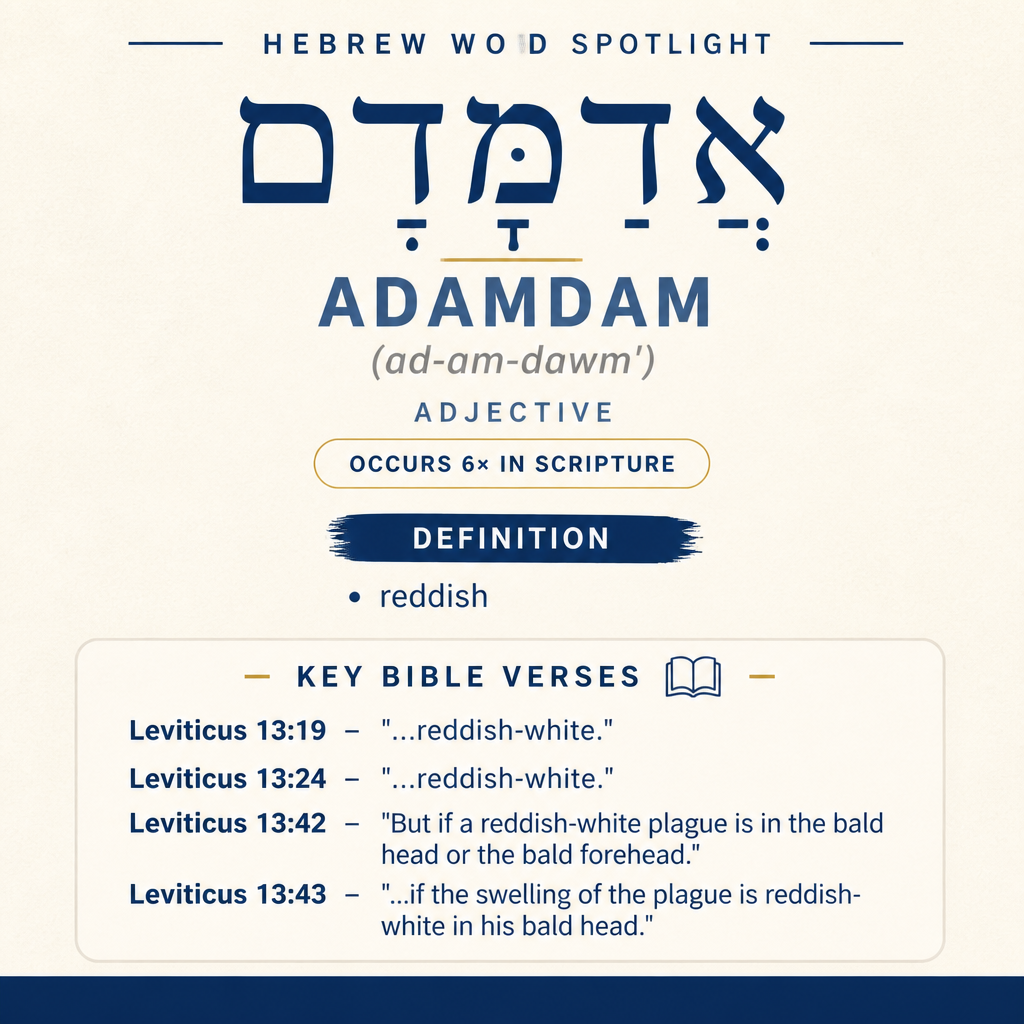
אֲדַמְדָּם means “reddish” and appears six times in Scripture, all in Leviticus (13:19, 13:24, 13:42, 13:43, 13:49; 14:37).
Core Meaning
אֲדַמְדָּם means “reddish.” In Leviticus it describes a visible color in spots or plagues.
Learn More →Leviticus Context
It occurs in priestly examinations of skin conditions and related signs (Leviticus 13:19, 13:24, 13:42–43). It is also used for discoloration in garments and house walls (Leviticus 13:49; 14:37).
Learn More →Observed Descriptions
Several occurrences pair it with “white,” forming “reddish-white” (Leviticus 13:19, 13:24, 13:42–43). Other passages mention “greenish or reddish” when describing a plague (Leviticus 13:49; 14:37).
Learn More →אֲדַמְדָּם (adamdam) means “reddish” and appears in passages that describe visible marks—on skin, garments, and even house walls—within the inspection procedures of Leviticus 13–14. In these scenes it functions as a color-term used to identify and classify a suspected “plague” condition that requires examination.

Occurrences
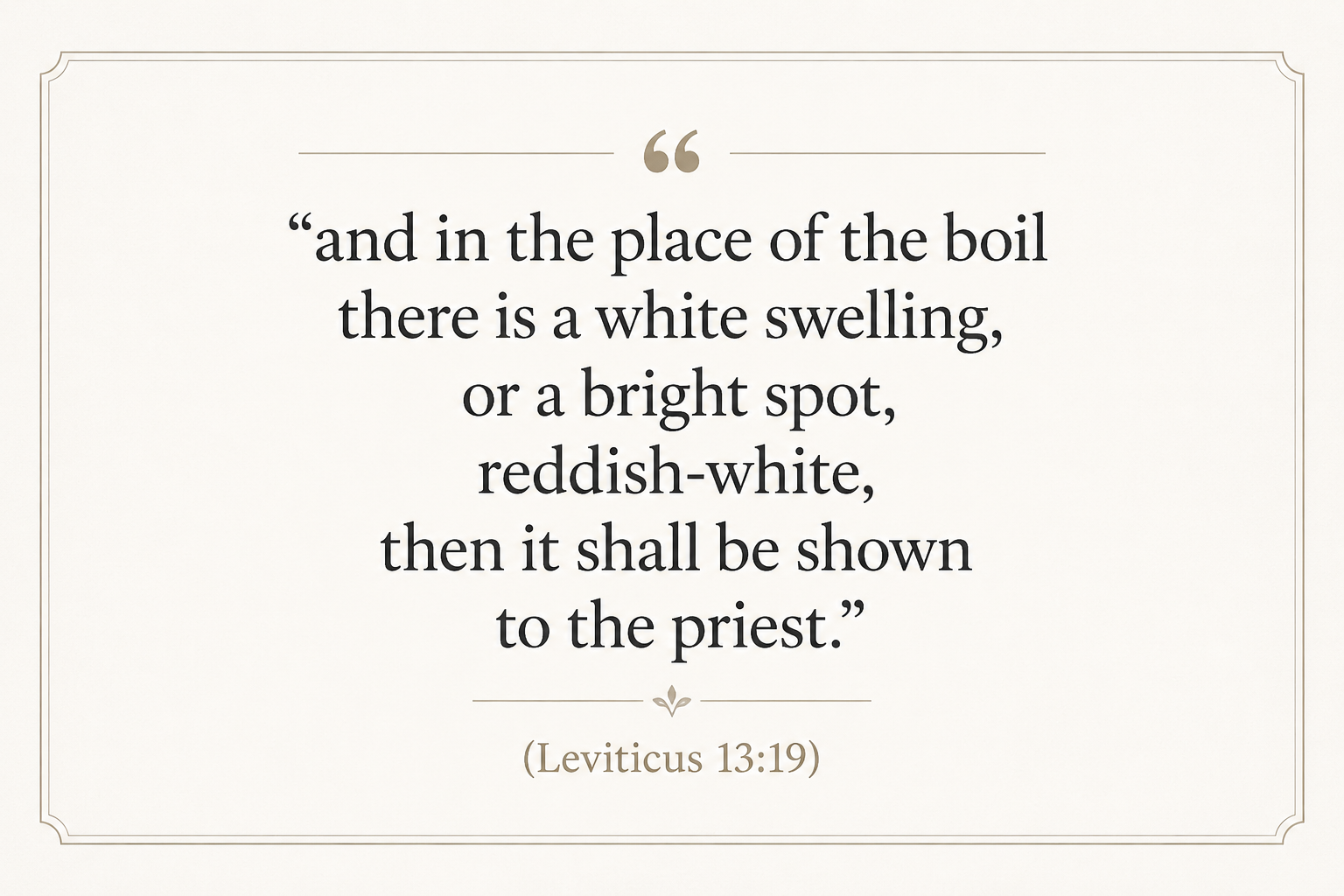
“and in the place of the boil there is a white swelling, or a bright spot, reddish-white, then it shall be shown to the priest.” (Leviticus 13:19)
Here adamdam appears as part of the compound description “reddish-white,” modifying the “bright spot” that has arisen “in the place of the boil.” The verse lists a sequence of visible features—“a white swelling” or “a bright spot”—and then narrows the description by adding the color nuance “reddish-white.” In this setting, the word contributes to a careful, observation-based vocabulary: the mark is not only “bright” and not only “white,” but has a reddish cast that becomes relevant to what happens next: “then it shall be shown to the priest.” The color is tied directly to the decision to bring the case for inspection.
““Or when the body has a burn from fire on its skin, and the raw flesh of the burn becomes a bright spot, reddish-white, or white,” (Leviticus 13:24)
This occurrence places adamdam in the context of a burn: “the body has a burn from fire,” and the “raw flesh” becomes “a bright spot.” The text offers two alternatives for the appearance of that spot: “reddish-white, or white.” The word therefore helps mark a distinction within a broader category of “bright spot” associated with injury. The verse’s wording shows that the inspection criteria attend to subtle differences in color within the same kind of lesion. Adamdam does not stand alone but contributes to a graded palette of observation that differentiates “reddish-white” from plain “white.”
“But if a reddish-white plague is in the bald head or the bald forehead, it is leprosy breaking out in his bald head or his bald forehead.” (Leviticus 13:42)
In this verse adamdam again occurs in the phrase “reddish-white,” now describing a “plague” located “in the bald head or the bald forehead.” The scene is not about a boil or burn, but about a condition occurring in a specific bodily area characterized by baldness. The color description is attached directly to “plague,” and the text immediately draws a conclusion about the case: “it is leprosy breaking out.” Within the verse’s logic, the presence of a “reddish-white” appearance in that location is part of the basis for identifying the outbreak. Adamdam thus serves the diagnostic flow of the passage: observation leads to classification.
“Then the priest shall examine him. Behold, if the swelling of the plague is reddish-white in his bald head, or in his bald forehead, like the appearance of leprosy in the skin of the body,” (Leviticus 13:43)
This passage explicitly foregrounds the act of examination: “the priest shall examine him.” Adamdam appears once more as “reddish-white,” now modifying “the swelling of the plague.” Compared to the previous verse, which states a conclusion, this verse shows the process: the priest looks, and the key criterion includes the swelling being “reddish-white” in the same specified areas. The phrase “Behold, if…” signals a conditional assessment, and the color is one component of what the priest is to look for. The verse further compares it: “like the appearance of leprosy in the skin of the body,” linking the visible color-and-swelling pattern on the scalp/forehead to a recognized appearance in general skin. Adamdam functions here as part of the visual resemblance that guides the examiner’s judgment.
“if the plague is greenish or reddish in the garment, or in the leather, or in the warp, or in the woof, or in anything made of leather; it is the plague of leprosy, and shall be shown to the priest.” (Leviticus 13:49)
This occurrence shifts from the human body to material objects: “the garment,” “the leather,” “the warp,” “the woof,” and “anything made of leather.” Adamdam is translated “reddish” (not “reddish-white” here), paired with “greenish” as alternative color indicators: “greenish or reddish.” The text is concerned with a “plague” that can appear in textiles and leather goods, and the color is a primary observable sign. By placing “reddish” alongside “greenish,” the verse frames adamdam as one pole in a limited set of recognized discolorations that warrant action. The procedure mirrors the earlier bodily inspections: once the sign is observed, “it…shall be shown to the priest.” The word therefore extends the same careful attention to color from skin to manufactured materials.
“He shall examine the plague; and behold, if the plague is in the walls of the house with hollow streaks, greenish or reddish, and it appears to be deeper than the wall,” (Leviticus 14:37)
Here adamdam is again “reddish,” and the scene expands further—from garments to architecture: “the walls of the house.” The examiner (expressed by “He shall examine”) looks for a “plague…in the walls” characterized by “hollow streaks,” with a color described as “greenish or reddish.” The verse adds another visual-spatial criterion: “it appears to be deeper than the wall.” In this context, adamdam contributes to a concrete, almost forensic description of what can be seen on a surface: streaks with a particular hue that also have depth. The word helps define the appearance of the streaking that triggers the house-related inspection procedure.
Sense and Usage
Across these occurrences, adamdam functions as a straightforward color adjective used to specify the visible character of a suspected “plague.” The Leviticus texts consistently tie the color observation to an examination process: marks are noticed, described, and then brought under priestly scrutiny. In Leviticus 13:19, 13:24, 13:42, and 13:43 the term appears in the blended description “reddish-white,” where the redness is presented as a tint within an otherwise white or bright lesion; the passages treat that tint as part of what must be evaluated on the skin, including on the “bald head” and “bald forehead.” In Leviticus 13:49 and 14:37 the word is rendered simply “reddish,” paired with “greenish” to name the kinds of discoloration that may appear in cloth, leather, and even “the walls of the house.”
The distribution of contexts shows that adamdam is not limited to one material: it can describe a bodily spot connected to a boil or burn, a swelling associated with a scalp/forehead condition, discoloration in woven structures (“warp” and “woof”), and streaks on plastered or stoned surfaces (“walls of the house”). In each case the adjective contributes specificity. The texts do not treat “plague” as a purely abstract label; they define it by observable traits—location, texture (“swelling,” “hollow streaks”), brightness (“bright spot”), and color (including “reddish” and “reddish-white”). Adamdam is one element in that descriptive toolkit, enabling a shared vocabulary between the person who notices the mark and the priest who must “examine” it.
Imagery
The imagery attached to adamdam in these passages is the sight of discoloration that stands out against its surrounding surface. Whether “in the place of the boil,” on “raw flesh,” on a “bald head,” within the threads of a garment, or streaking “in the walls of the house,” the reddish hue marks something as abnormal enough to be inspected. Leviticus repeatedly frames such color as a cue for careful looking: “then it shall be shown to the priest,” and “He shall examine the plague; and behold…”.
Sources: Lexical data from Strong’s Exhaustive Concordance and the Open Scriptures Hebrew Lexicon. Occurrence data from the Westminster Leningrad Codex with STEPBible reference data (CC BY). Scripture quotations from the World English Bible (public domain).





