Discovering the Meaning of ‘Adalya’ in Hebrew
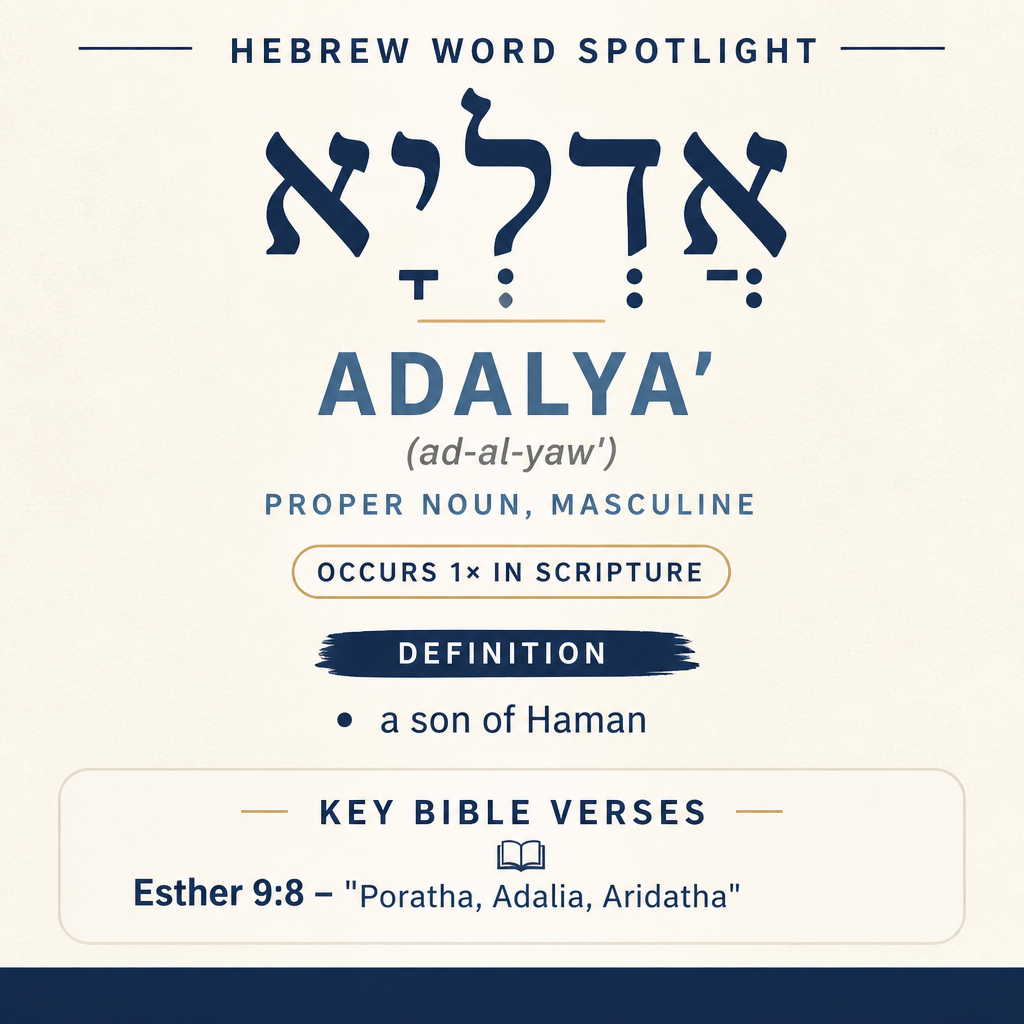
אֲדַלְיָא (Adalya') names a son of Haman and appears in Esther 9:8.
Verse Context
In Esther 9:8, Adalya' is listed among Haman’s sons: “Poratha, Adalia, Aridatha,”.
Learn More →אֲדַלְיָא (Adalya’) names “a son of Haman” and appears in a single list of names in Esther. Its one attestation occurs in Esther 9:8, where it stands among other personal names.
Occurrences
Esther 9:8
“Poratha, Adalia, Aridatha,” (Esther 9:8)
Here אֲדַלְיָא appears as one item within a series of names, set between “Poratha” and “Aridatha.” The verse presents these as discrete individuals, each identified simply by being named. In that setting, the function of אֲדַלְיָא is straightforward: it marks out a particular person in a larger group rather than describing an action, place, or quality.
The literary effect of a name-list like this is to individualize what might otherwise be heard as a single collective. Each name, including אֲדַלְיָא, contributes one more distinct member to the group being enumerated, so that the reader encounters not an anonymous mass but a counted, itemized set. Because the verse offers no verbs or descriptors attached to “Adalia” in this line itself, the name’s contribution is the precision and concreteness of identification: it indicates which person is meant, in the same way the surrounding names do.
The form in English (“Adalia”) reflects a transliterated personal name, treated as a proper noun in the sentence. The commas show the structure of the list and underscore that each element stands independently. In such a sequence, the name does not draw attention by semantic content but by placement: it occupies a slot in an ordered enumeration, a pattern that signals completeness and careful record.

Sense and Usage
As a proper name defined as “a son of Haman,” אֲדַלְיָא functions to identify a specific individual in relation to Haman. That relational definition matters even when the immediate line gives only the bare name: a personal name in a tightly packed list still carries the weight of family association, especially when the list is understood as a set of sons. Within Esther 9:8, the reader is not asked to infer characteristics about Adalya’ as a person; the name serves the narrative’s need to count and specify members of a family line.
Because this word occurs only as a name in a list, its “usage” is shaped by list-style discourse: it is not introduced with a genealogy formula, epithet, or title in the quoted line, but is presented at the same level as the adjacent names. That equal footing is part of how lists work. Each name contributes to the cumulative force of the enumeration; together, the names convey that the group is being identified with care and that the account is interested in particularity. In this way, אֲדַלְיָא participates in a documentary style within the narrative, where the naming itself becomes the principal act.
The definition “a son of Haman” also clarifies what kind of name this is within the story-world. It is not merely a random individual mentioned in passing, but someone positioned within Haman’s household. Even though the line quoted does not repeat “son of Haman,” the sense attached to the name anchors it to that familial frame: the name belongs to a set whose unity is family membership. Thus, the word’s sense is realized not through descriptive language but through its role in a roster of related persons.
Since the attested material gives only the name itself, the word’s semantic range is not expressed through multiple contexts or extended constructions. Instead, its significance is the stable, referential one typical of personal names: it points to one person and distinguishes him from the other named individuals around him. The list format heightens this distinguishing function: the names are separated, not blended, so the reader hears each one as an individual entry.
Imagery
The immediate imagery associated with אֲדַלְיָא in Esther 9:8 is the image of a written register or recited roll of names—an orderly sequence in which each person is called out one by one. The name evokes the concrete scene of enumeration: a set of names arranged with commas, suggesting the careful accounting of persons rather than the description of events or places.
Sources: Lexical data from Strong’s Exhaustive Concordance and the Open Scriptures Hebrew Lexicon. Occurrence data from the Westminster Leningrad Codex with STEPBible reference data (CC BY). Scripture quotations from the World English Bible (public domain).