Unveiling the Meaning of ‘adamah in Hebrew
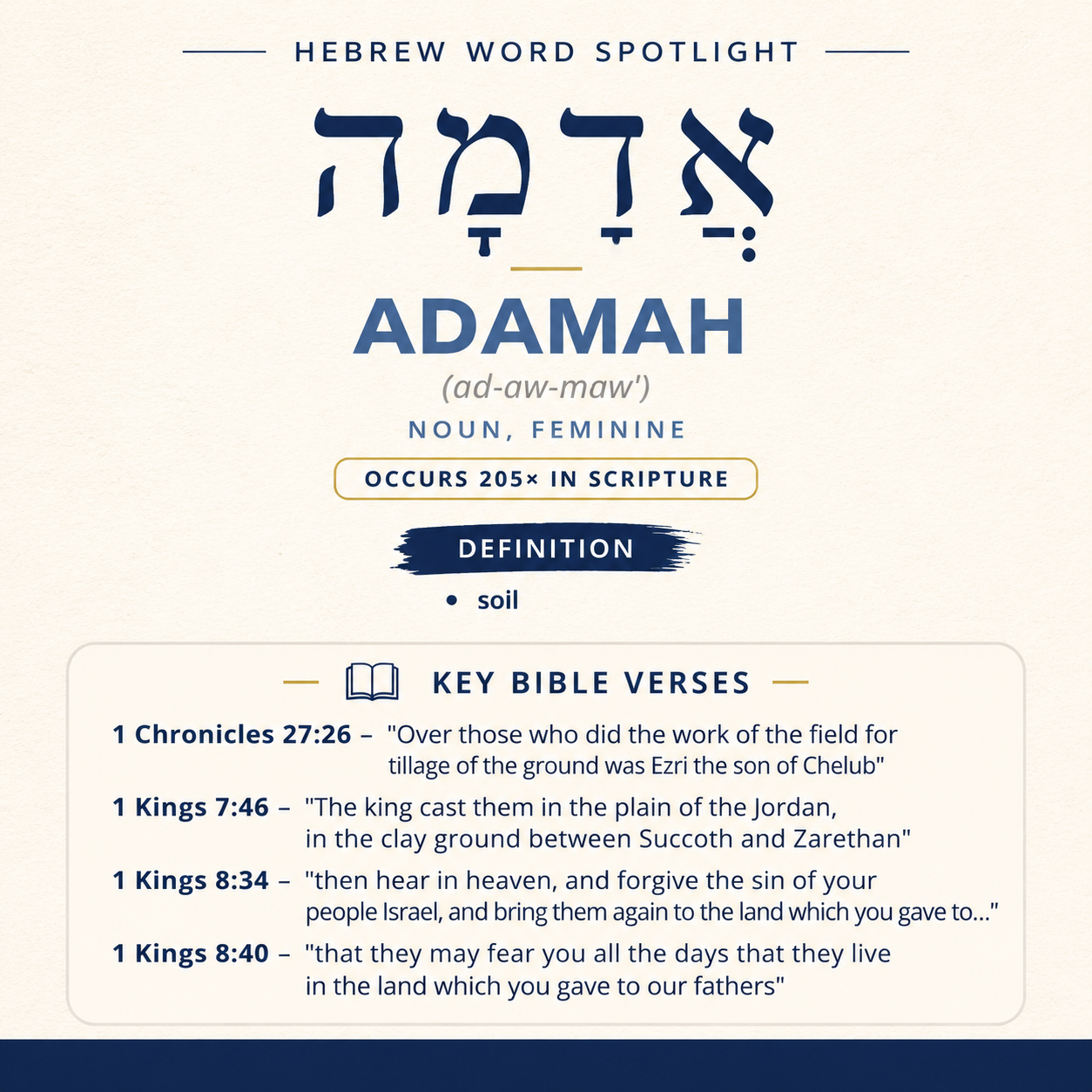
אֲדָמָה (adamah) means “soil” and occurs 205 times in Scripture, including 1 Chronicles 27:26 and 1 Kings 7–17.
Core Meaning
אֲדָמָה means “soil.” It appears in contexts describing ground, land, and the surface of the earth.
Learn More →Scripture Frequency
This word occurs 205 times in Scripture. Example references include 1 Chronicles 27:26 and multiple verses in 1 Kings.
Learn More →Sample Contexts
It can refer to “the ground” for tillage (1 Chronicles 27:26) and “clay ground” in the Jordan plain (1 Kings 7:46).
Learn More →אֲדָמָה (adamah) means “soil.” In the passages quoted below it appears in settings that range from farm labor and clay casting to prayer about life in the land and idioms about the earth’s surface.
Occurrences
“Over those who did the work of the field for tillage of the ground was Ezri the son of Chelub;” (1 Chronicles 27:26)
Here אֲדָמָה is the worked surface that receives “tillage.” The line links soil directly to organized labor: “did the work of the field” is specified as “tillage of the ground,” and an overseer is appointed over that task. The word thus sits in a concrete agricultural frame: soil as the medium being turned and managed, not merely a location.
“The king cast them in the plain of the Jordan, in the clay ground between Succoth and Zarethan.” (1 Kings 7:46)
In this description of royal production, the word identifies “the clay ground” where casting takes place. The phrase anchors the activity geographically (“in the plain of the Jordan”) and materially (“clay ground”), presenting soil not as farmland but as a particular kind of ground suited to shaping and forming by casting. The word contributes an earthy specificity: the work is done on and with ground characterized as clay.
“then hear in heaven, and forgive the sin of your people Israel, and bring them again to the land which you gave to their fathers.” (1 Kings 8:34)
In this prayerful context, the word is bound to return: being “brought again” is being brought back “to the land.” Soil is not the focus as dirt underfoot, but as the tangible place that can be lost and regained. The clause “which you gave to their fathers” ties the land to gift and inheritance, so the term bears the weight of restoration after sin.
“that they may fear you all the days that they live in the land which you gave to our fathers.” (1 Kings 8:40)
Here life is portrayed as lived “in the land,” and the hoped-for outcome (“that they may fear you”) is framed by duration (“all the days”) and location (“in the land”). The word contributes a settled, ongoing setting: soil as a sphere of daily existence across time, not a momentary spot.
“then I will cut off Israel out of the land which I have given them; and I will cast this house, which I have made holy for my name, out of my sight; and Israel will be a proverb and a byword among all peoples.” (1 Kings 9:7)
In this warning, the land is something from which one can be “cut off.” The severity of judgment is expressed spatially: removal “out of the land” parallels the house being cast “out of my sight.” The word thus participates in an expulsion image, where soil is the bounded place of belonging and privilege, and being separated from it signals deep rupture.
“This thing became sin to the house of Jeroboam, even to cut it off, and to destroy it from off the surface of the earth.” (1 Kings 13:34)
Here אֲדָמָה appears in the fixed phrase “surface of the earth.” The emphasis falls on thoroughness: to be destroyed “from off the surface” is to be removed from the visible, inhabitable ground where life and legacy persist. The word contributes a stark, totalizing spatial horizon—earth as the plane on which a house stands and from which it can be erased.
“For Yahweh will strike Israel, as a reed is shaken in the water; and he will root up Israel out of this good land which he gave to their fathers, and will scatter them beyond the River, because they have made their Asherah poles, provoking Yahweh to anger.” (1 Kings 14:15)
In this prophetic pronouncement, the land is called “this good land,” and the action threatens to “root up Israel out of” it. The imagery works like an agricultural reversal: what should be planted and stable is instead uprooted. The word supports the metaphor by framing the people’s relationship to place in terms of being set in soil; judgment is pictured as violent displacement and scattering.
“For Yahweh, the God of Israel says, ‘The jar of meal will not run out, and the jar of oil will not fail, until the day that Yahweh sends rain on the earth.’ ” (1 Kings 17:14)
Here the word forms the stage for rain: “sends rain on the earth.” The immediate concern is provision (“jar of meal,” “jar of oil”), and the timing of that provision is tied to rainfall arriving on the earth. The soil is implied as the recipient realm of rain—the terrestrial sphere affected by weather—so the word connects the promise’s duration to a natural event that touches the ground.
“A man of Benjamin ran out of the army and came to Shiloh the same day, with his clothes torn and with dirt on his head.” (1 Samuel 4:12)
In this scene of urgent report and distress, the word appears as “dirt.” Soil is not landscape or territory but material that can be put “on his head.” The physicality is immediate: ground becomes a visible sign carried on the body, accompanying “clothes torn” as a marker of grief or alarm within the narrative moment.
“but you shall also not cut off your kindness from my house forever; no, not when Yahweh has cut off every one of the enemies of David from the surface of the earth.” (1 Samuel 20:15)
Again the phrase “surface of the earth” appears, this time in a promise-context. The future envisioned includes a time “when Yahweh has cut off every one of the enemies of David,” and their removal is described as being from the earth’s surface. The soil functions as the arena of human presence—where enemies occupy space—and “cut off” is expressed as their disappearance from that shared ground.
“For as long as the son of Jesse lives on the earth, you will not be established, nor will your kingdom. Therefore now send and bring him to me, for he shall surely die!” (1 Samuel 20:31)
Here “on the earth” sets the temporal limit of a political claim: “as long as” David lives on the earth, another kingdom “will not be established.” Soil marks the realm of mortal life and continued existence. The word contributes a blunt, world-level frame: the issue persists as long as the rival remains alive within the earthly sphere.
“The king cast them in the plain of the Jordan, in the clay ground between Succoth and Zeredah.” (2 Chronicles 4:17)
This parallels the casting notice found elsewhere, again locating the work “in the plain of the Jordan” and more narrowly “in the clay ground.” The repetition of the setting highlights the importance of ground-character for the activity: soil is identified by its clay quality and by its position “between” named places. The word thus serves as a technical locator—where the casting happened and what sort of ground it was.
Sense and Usage
Across these passages, “soil” operates on three connected levels. First, it is the worked medium of agriculture and production: it can be tilled (1 Chronicles 27:26) and it can be specifically “clay ground” used in casting (1 Kings 7:46; 2 Chronicles 4:17). In such scenes the word is practical and tactile, describing the kind of ground that supports particular labor.
Second, it denotes the inhabited land as a gift and a place of life, with moral and covenantal overtones arising from the surrounding statements. Prayers ask for forgiveness and return “to the land” (1 Kings 8:34) and portray ongoing life “in the land” (1 Kings 8:40). Warnings and judgments threaten being “cut off” from it or “root[ed] up” out of “this good land” (1 Kings 9:7; 1 Kings 14:15). In these uses the soil is more than dirt; it is the concrete space where a people lives, from which they may be removed, and to which they may be restored.
Third, it appears in idioms that universalize the idea: “surface of the earth” and “on the earth” treat soil as the broad plane of human existence. To be destroyed from the earth’s surface is to be wiped from the realm where a house endures (1 Kings 13:34). To have enemies cut off from the surface of the earth is to envision their complete removal from the shared ground of life (1 Samuel 20:15). To live “on the earth” is simply to remain alive within this world (1 Samuel 20:31). Even the reference to rain coming “on the earth” sets the earthly realm as the receiver of weather that affects life and provision (1 Kings 17:14). The single instance of “dirt on his head” (1 Samuel 4:12) underscores the material side of the same concept: soil is something that can cling, be carried, and signify distress.
Imagery
These texts repeatedly treat soil as the boundary between stability and removal. It can be the productive ground under appointed oversight (1 Chronicles 27:26), the clayey place where objects are cast (1 Kings 7:46; 2 Chronicles 4:17), and the lived-in land given to fathers (1 Kings 8:34; 1 Kings 8:40). Yet the same soil can be the edge from which one is “cut off” or “root[ed] up” (1 Kings 9:7; 1 Kings 14:15), and the “surface of the earth” can serve as a stark measure of total destruction or decisive elimination (1 Kings 13:34; 1 Samuel 20:15). Even when soil is reduced to a handful of dirt placed on a head (1 Samuel 4:12), it remains charged as the physical substance of the world where human fate is enacted.
Sources: Lexical data from Strong’s Exhaustive Concordance and the Open Scriptures Hebrew Lexicon. Occurrence data from the Westminster Leningrad Codex with STEPBible reference data (CC BY). Scripture quotations from the World English Bible (public domain).