
What does Adamiy Mean in Hebrew?
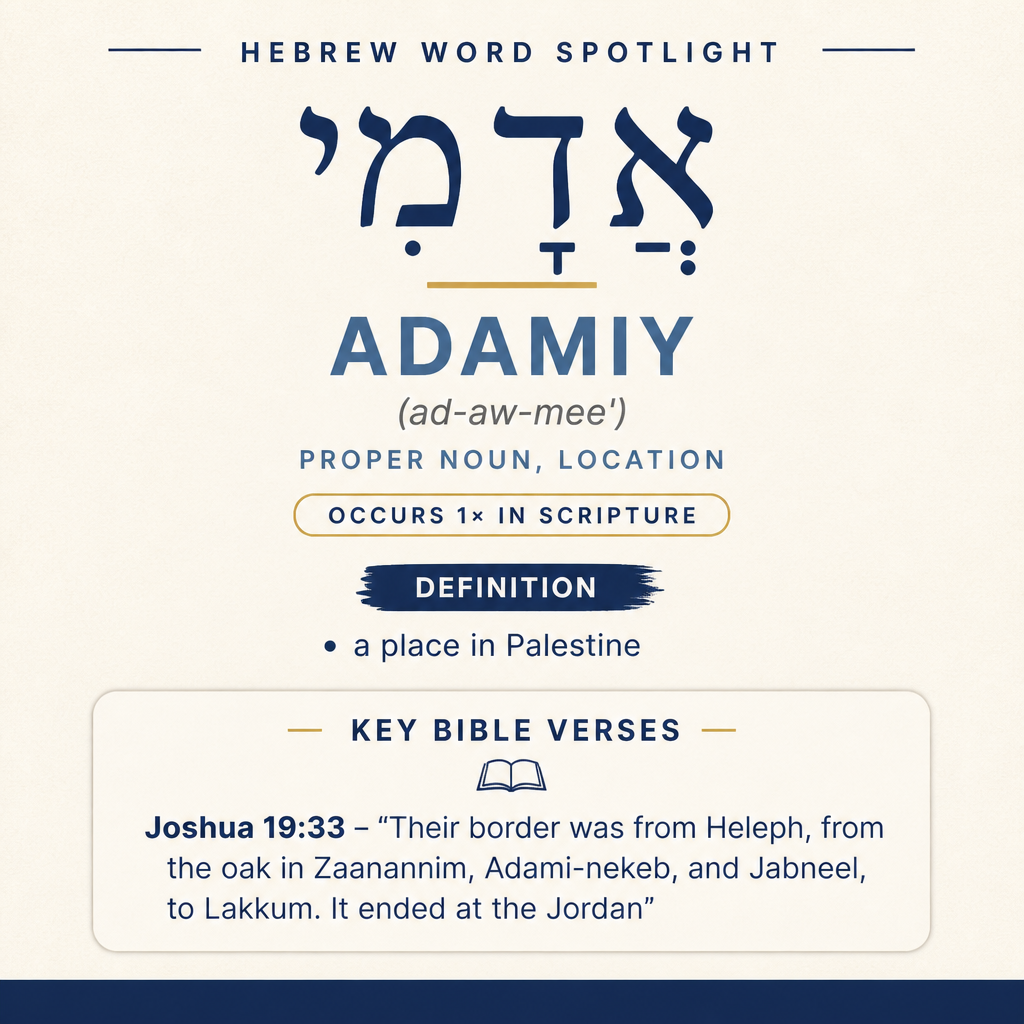
אֲדָמִי (Adamiy) means a place in Palestine and appears in Joshua 19:33.
Context in Joshua
In Joshua 19:33, it appears in the border description: “Adami-nekeb” between Zaanannim and Jabneel.
Learn More →אֲדָמִי (Adamiy) names a place in Palestine. Scripture preserves it within a border list that traces territorial lines from landmark to landmark.
Occurrences
“Their border was from Heleph, from the oak in Zaanannim, Adami-nekeb, and Jabneel, to Lakkum. It ended at the Jordan.” (Joshua 19:33)
Here אֲדָמִי appears as part of a compound place-name, “Adami-nekeb,” set among other locations that together mark a boundary. The verse speaks in the measured style of a survey: the border is traced “from” one point “to” another, with each named site serving as a fixed reference on the ground. Within that chain, Adami-nekeb functions as one of the intermediate boundary points, placed after “the oak in Zaanannim” and before “Jabneel,” and therefore contributes to the step-by-step movement of the line across the landscape. The final clause, “It ended at the Jordan,” frames the whole list as a route that terminates at a major geographic feature; Adami-nekeb stands within the sequence leading to that end.

Sense and Usage
As a place-name, אֲדָמִי serves a practical role: it anchors a description of territory by naming a recognizable site. Joshua 19:33 treats borders as a chain of concrete points—trees, towns, and regional markers—so that a listener can imagine the line’s course. In that setting, the value of Adami is not an abstract idea but its usefulness as a known location that can be paired with other landmarks to specify where a boundary runs.
The verse also shows how a single place-name can appear within a larger toponym. The form “Adami-nekeb” presents Adami joined to a second element, producing a more specific designation than “Adami” alone. In the flow of the boundary list, this combined name behaves like the other points named: it is one link in a sequence introduced by repeated directional language (“from … to …”), allowing the border to be traced without narrative explanation. The effect is to portray the land as mapped and ordered, with each place-name contributing a precise coordinate in the mental geography of the passage.
Geographic Imagery
Joshua 19:33 places Adami within a landscape described by tangible features: “the oak in Zaanannim” and the termination “at the Jordan.” Between a distinctive tree and a great river, Adami-nekeb belongs to a network of named places that turn open country into a charted border. The imagery is that of measured movement across real terrain, where a list of names makes the boundary visible by stages.
Sources: Lexical data from Strong’s Exhaustive Concordance and the Open Scriptures Hebrew Lexicon. Occurrence data from the Westminster Leningrad Codex with STEPBible reference data (CC BY). Scripture quotations from the World English Bible (public domain).





