
Discovering the Meaning of ‘Abiyram in Hebrew
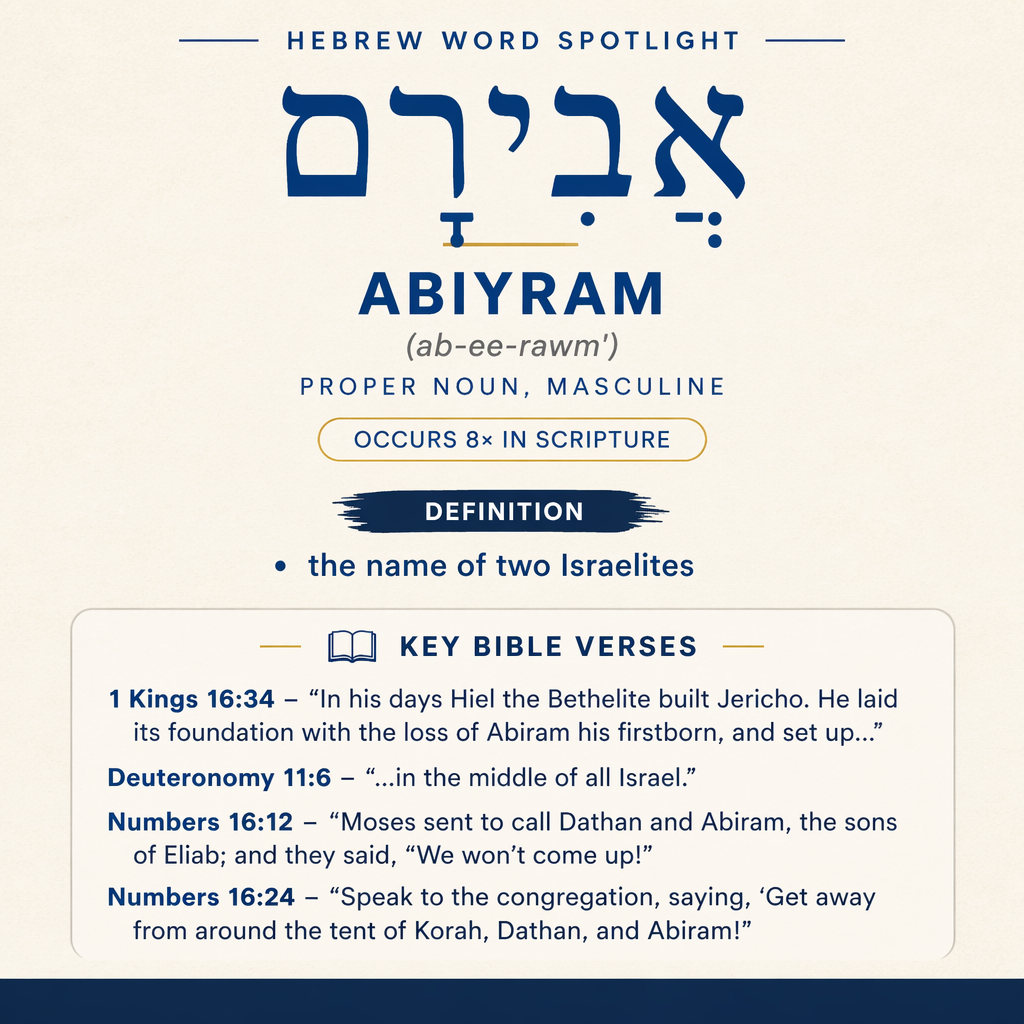
אֲבִירָם (Abiyram) is the name of two Israelites, appearing 8 times in Scripture in Deuteronomy, Numbers, 1 Kings, and Psalms.
Name & Referents
אֲבִירָם is a Hebrew name applied to two Israelites. One is Abiram, firstborn of Hiel the Bethelite (1 Kings 16:34).
Learn More →Korah Narrative
In Numbers 16 and 26, Abiram appears with Dathan as sons of Eliab of Reuben, in the events involving Korah. Moses calls Dathan and Abiram, and the congregation is told to move away from their tents.
Learn More →Earth Swallowed
Deuteronomy 11:6 and Psalm 106:17 recall that the earth opened and swallowed Dathan and Abiram. These passages summarize the judgment described in the wilderness narratives.
Learn More →אֲבִירָם (Abiyram) is a personal name borne by two Israelites. In Scripture it appears in narratives and recollections where the name identifies a firstborn son lost in judgment and a prominent figure in a rebellion that ends in a catastrophic swallowing by the earth.
Occurrences
1 Kings 16:34 — “In his days Hiel the Bethelite built Jericho. He laid its foundation with the loss of Abiram his firstborn, and set up its gates with the loss of his youngest son Segub, according to Yahweh’s word, which he spoke by Joshua the son of Nun.”
Here Abiram is named as “his firstborn,” the son lost when Hiel “laid its foundation.” The name functions to individualize the cost of the building project: the loss is not abstract but bound to a particular child, the eldest. The verse frames the event as the fulfillment of “Yahweh’s word,” so Abiram’s naming anchors the scene in remembered divine warning and its realized consequence.
Deuteronomy 11:6 — “and what he did to Dathan and Abiram, the sons of Eliab, the son of Reuben—how the earth opened its mouth and swallowed them up, with their households, their tents, and every living thing that followed them, in the middle of all Israel;”
Abiram is paired with Dathan and located within a lineage: “the sons of Eliab, the son of Reuben.” The name appears in a recital of divine action—“what he did”—and the scene is described with physical vividness: “the earth opened its mouth and swallowed them up.” Abiram’s presence in the list marks him as one of the central figures whose fate becomes a public lesson enacted “in the middle of all Israel,” extending beyond the individuals to “their households, their tents, and every living thing that followed them.”
Numbers 16:12 — “Moses sent to call Dathan and Abiram, the sons of Eliab; and they said, “We won’t come up!”
In this exchange Abiram is one of the two addressed directly by Moses and one of the voices refusing the summons. The naming tightens the confrontation: the narrative does not speak of an anonymous crowd but of identifiable men, again “the sons of Eliab.” The brief response, “We won’t come up!” presents a public defiance, and the mention of Abiram ties him personally to that refusal.
Numbers 16:24 — ““Speak to the congregation, saying, ‘Get away from around the tent of Korah, Dathan, and Abiram!’ ”
Abiram’s name is placed alongside Korah and Dathan to identify the danger zone: “around the tent of Korah, Dathan, and Abiram.” The name functions as a marker of location (“the tent of … Abiram”) and of association: his dwelling is treated as implicated in the crisis such that the congregation must distance themselves.
Numbers 16:25 — “Moses rose up and went to Dathan and Abiram; and the elders of Israel followed him.”
Abiram is one of the two men to whom Moses deliberately goes, with “the elders of Israel” in attendance. The naming emphasizes the gravity and formality of the approach: this is an official, witnessed confrontation. Abiram stands as a principal party in a dispute important enough to draw the elders’ presence.
Numbers 16:27 — “So they went away from the tent of Korah, Dathan, and Abiram, on every side. Dathan and Abiram came out, and stood at the door of their tents with their wives, their sons, and their little ones.”
Abiram’s name appears twice, first in the description of the crowd’s withdrawal “on every side,” then in the portrayal of the two men’s stance. The verse depicts Abiram not hidden away but coming out and taking position “at the door of their tents.” The mention of “their wives, their sons, and their little ones” places Abiram’s household in the scene, giving weight to the earlier warnings to move away: what is about to happen threatens not only leaders but the family circle gathered at the threshold.
Numbers 26:9 — “The sons of Eliab: Nemuel, Dathan, and Abiram. These are that Dathan and Abiram who were called by the congregation, who rebelled against Moses and against Aaron in the company of Korah when they rebelled against Yahweh;”
Abiram is listed among Eliab’s sons and then singled out with Dathan as an example remembered by name. The verse interprets their identity through their actions: they “were called by the congregation,” and they “rebelled against Moses and against Aaron,” doing so “in the company of Korah.” The name Abiram therefore carries a memorial function within a genealogical setting, fixing a story of rebellion to an identifiable person within a family line.
Psalm 106:17 — “The earth opened and swallowed up Dathan, and covered the company of Abiram.”
In this poetic recollection Abiram is again linked with Dathan, but the line distinguishes between the individuals and their group: the earth “swallowed up Dathan,” and it “covered the company of Abiram.” Abiram’s name thus represents not only a person but also an associated “company,” suggesting followers or an attached group whose fate is bound up with his. The imagery of being “covered” by the opened earth reinforces the terror and finality of the judgment remembered in Israel’s worship.

Sense and Usage
Across these passages אֲבִירָם functions strictly as a personal name, but it does two different kinds of work depending on which Abiram is in view. In 1 Kings 16:34 the name marks a firstborn son whose loss accompanies the laying of Jericho’s foundation; Abiram is not an actor in the story but the named cost borne by his father’s actions, and his identity as “firstborn” heightens the impact of the loss within the household.
In Deuteronomy 11:6, Numbers 16, Numbers 26:9, and Psalm 106:17 the name belongs to Abiram the son of Eliab, repeatedly paired with Dathan. These texts present a consistent profile through the way they place the name: (1) within lineage (“the sons of Eliab, the son of Reuben”), (2) within public confrontation (Moses sending for them, going to them with elders), (3) within spatial markers (“the tent of … Abiram,” “door of their tents”), and (4) within communal memory of rebellion and judgment. The repeated pairing “Dathan and Abiram” makes Abiram’s identity inseparable from a shared stance and a shared end; even when Korah is included (Numbers 16:24, 16:27; Numbers 26:9), Abiram’s name remains one of the key points by which the community is instructed where to move and what to remember.
The references also show how a personal name can stand for more than the person named, without becoming a common noun. Deuteronomy’s description includes “their households, their tents, and every living thing that followed them,” and Psalm 106:17 speaks of “the company of Abiram.” In these lines Abiram’s name gathers relational circles—household, dwelling, followers—so that the memory attached to him is corporate as well as individual. Yet the texts keep Abiram anchored in concrete identifiers: family (“sons of Eliab”), place (his tent), and visible stance (standing at the door with family present).
Imagery
The name Abiram is set within two stark images. One is domestic loss at a construction site: a father building and a firstborn son named as the one lost when the foundation is laid (1 Kings 16:34). The other is a public, terrifying rupture in the ground: “the earth opened its mouth and swallowed them up” (Deuteronomy 11:6), echoed as the earth “opened and swallowed up” and “covered” (Psalm 106:17). In Numbers 16:27 the narrative slows to show Abiram at the threshold of his tent, family beside him, while the congregation withdraws on every side—an image of exposure and imminent consequence focused by the repeated naming of Abiram.
Sources: Lexical data from Strong’s Exhaustive Concordance and the Open Scriptures Hebrew Lexicon. Occurrence data from the Westminster Leningrad Codex with STEPBible reference data (CC BY). Scripture quotations from the World English Bible (public domain).




