
Discovering The Meaning of ‘Abiydan in Hebrew
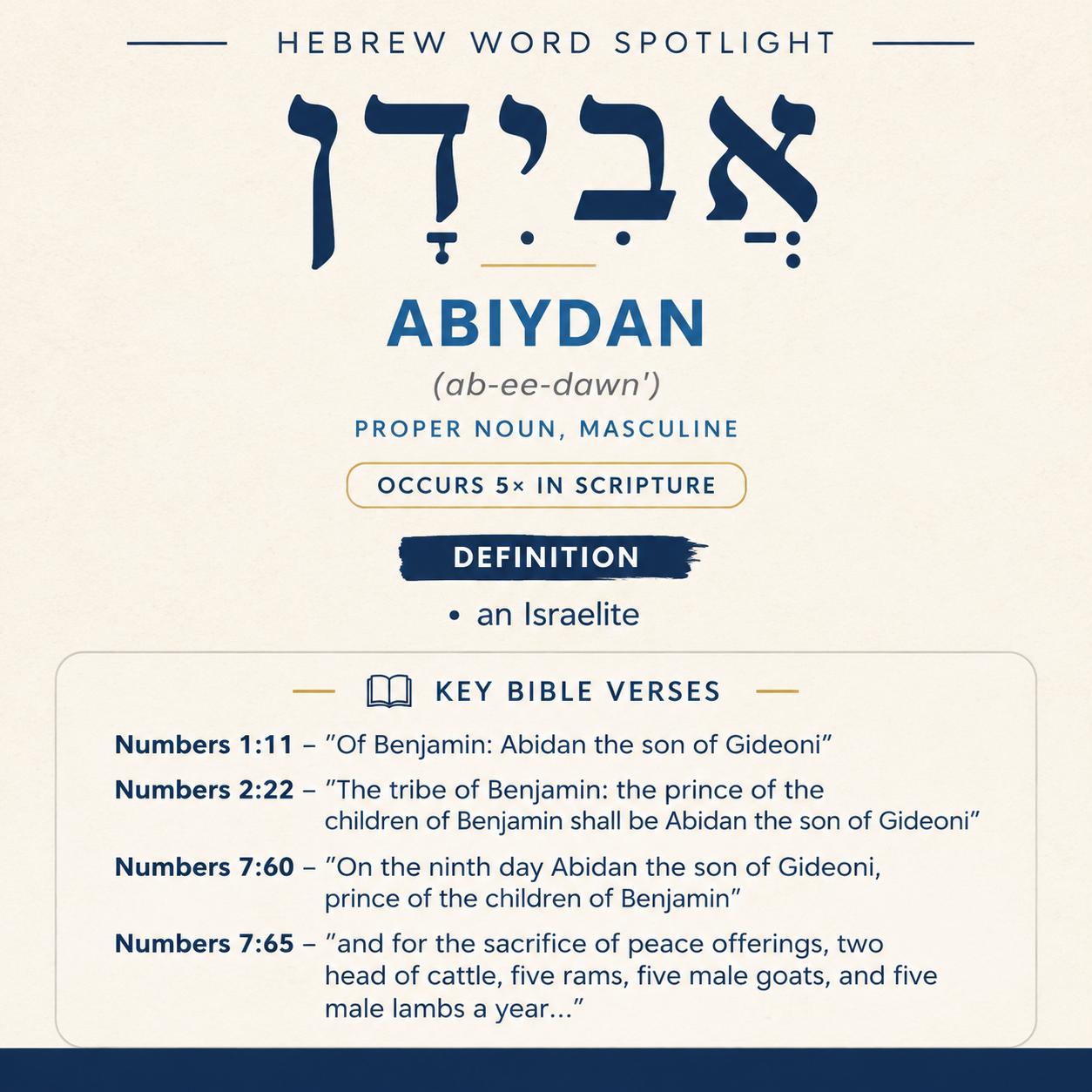
אֲבִידָן (Abiydan) means “an Israelite” and appears five times in Numbers (1:11; 2:22; 7:60; 7:65; 10:24).
Meaning
אֲבִידָן (Abiydan) is defined as “an Israelite.” It is a masculine proper noun in Hebrew.
Learn More →Numbers References
Abidan is named in Numbers 1:11 and 2:22 in connection with the tribe of Benjamin. He also appears in Numbers 7:60, 7:65, and 10:24.
Learn More →Context
Numbers identifies him as the son of Gideoni and “prince of the children of Benjamin.” He was over the army of the tribe of the children of Benjamin (Numbers 10:24).
Learn More →Abiydan is a personal name borne by an Israelite in the book of Numbers. In the passages where it appears, it identifies a man repeatedly named in connection with the tribe of Benjamin and with ordered responsibilities among the Israelites.
Occurrences
“Of Benjamin: Abidan the son of Gideoni.” (Numbers 1:11)
Here Abiydan appears in a terse register that links him to the tribe (“Of Benjamin”) and to his father (“the son of Gideoni”). The name functions as a marker of identity within a structured listing: the text is not interested in his actions yet, but in locating him within Israel’s tribal and familial framework.
“The tribe of Benjamin: the prince of the children of Benjamin shall be Abidan the son of Gideoni.” (Numbers 2:22)
Abiydan is singled out as “the prince of the children of Benjamin,” again tethered to Gideoni as his father. In this setting the name does more than label an individual; it anchors a public office for a defined group (“the tribe of Benjamin”). The wording presents him as the designated representative through whom the tribe is organized and addressed, so the name stands for recognized leadership within Israel’s encampment arrangement.
“On the ninth day Abidan the son of Gideoni, prince of the children of Benjamin,” (Numbers 7:60)
This occurrence places Abiydan in a sequence marked by time (“On the ninth day”), with his identity stated in a formal style: name, patronymic, and title. The partial verse introduces him in the role already assigned in Numbers 2:22 (“prince of the children of Benjamin”), but now within an ordered calendar of presentation. The name therefore signals not only who he is, but also his turn in an established procession of leaders.
“and for the sacrifice of peace offerings, two head of cattle, five rams, five male goats, and five male lambs a year old. This was the offering of Abidan the son of Gideoni.” (Numbers 7:65)
Abiydan’s name closes a detailed description of sacrificial items with a summarizing line: “This was the offering of Abidan the son of Gideoni.” In this context the name functions almost as a heading for accountability and remembrance—these specific offerings are attached to him as the presenting prince. The patronymic again stabilizes identification, so there is no confusion about which Abiydan is meant, and the repeated formula binds the individual to a concrete act carried out for the community.
“Abidan the son of Gideoni was over the army of the tribe of the children of Benjamin.” (Numbers 10:24)
In the marching context implied by “army,” Abiydan is described as being “over” the force belonging to Benjamin. The name here is tied to operational oversight: leadership expressed not merely as an honorific but as command responsibility for a tribal contingent. The phrase “the tribe of the children of Benjamin” reiterates the collective he represents, while the personal name identifies the one who stands at the top of that unit’s organization.

Sense and Usage
Across these texts Abiydan operates as a stable personal identifier for an Israelite whose public standing is repeatedly stated and reinforced. The consistent pairing of the name with “the son of Gideoni” gives the reader a fixed point of reference, the kind of specificity used when individuals are presented in formal lists, appointed roles, and recorded duties. The name is not presented in isolation; it is repeatedly set within two coordinate systems: kinship (“son of Gideoni”) and communal belonging (“Benjamin,” “the tribe of Benjamin,” “the children of Benjamin”). That combination shows how a named individual can function in Scripture as a node within larger structures—family lines and tribal identity.
In Numbers 1:11 the name belongs to a list-like setting that introduces him as a Benjaminite within an organized census context. The reader learns first who he is by affiliation: tribe and father. Numbers 2:22 moves from identification to designation, attaching the title “prince” to him as the one who represents Benjamin. The name thus becomes associated with formal authority in a way that is publicly stated (“shall be Abidan”). Numbers 7:60 and 7:65 then place that same prince within an ordered sequence of days and offerings. The narrative does not expand on Abiydan’s private life; instead it records him as the responsible party for a specified presentation, so his name functions as a label for a distinct set of sacrificial gifts. Finally, Numbers 10:24 shows his leadership in a mobilized setting, describing him as “over the army” of Benjamin. The same personal name spans administrative listing, appointment, ritual presentation, and military oversight—different spheres of communal life—without needing any change in meaning; the name remains the identifier of the same Israelite as he appears in each sphere.
The way these passages reuse Abiydan’s full identification has a documentary feel. In each context, the text ties the name to an office or responsibility and then anchors that office to a particular collective (“children of Benjamin”). This pattern lets the reader track continuity: the person introduced in a list is the same person assigned as prince, the same person whose offering is recorded, and the same person placed over the tribe’s army. The repeated phrasing also highlights that leadership is not abstract; it is attached to particular named Israelites. Abiydan’s name therefore carries the weight of representation: when his offering is described, it stands as Benjamin’s prince presenting; when he is “over the army,” it is Benjamin’s contingent ordered under a specific leader.
Imagery in Numbers
Although Abiydan is a personal name, the scenes around it are concrete. One scene is the orderly camp and tribal arrangement implied when “the tribe of Benjamin” is named and a “prince” is appointed (Numbers 2:22). Another is the measured rhythm of communal worship, where specific animals and quantities are listed and then attributed—“This was the offering of Abidan the son of Gideoni” (Numbers 7:65). A third is the readiness of movement and coordination conveyed by the statement that Abiydan “was over the army of the tribe of the children of Benjamin” (Numbers 10:24). In these settings the name is repeatedly spoken as part of order: named people, assigned roles, counted days, and defined groups.
Sources: Lexical data from Strong’s Exhaustive Concordance and the Open Scriptures Hebrew Lexicon. Occurrence data from the Westminster Leningrad Codex with STEPBible reference data (CC BY). Scripture quotations from the World English Bible (public domain).





