
Unraveling the Meaning of ‘Abiyhuw in Hebrew
אֲבִיהוּא means “a son of Aaron” and appears 8 times in Scripture, including Exodus 6:23 and Numbers 3:2–4.
Identity
אֲבִיהוּא is named as a son of Aaron, alongside Nadab, Eleazar, and Ithamar. Exodus 6:23 lists him among the sons borne to Aaron by Elisheba.
Learn More →Narrative Mentions
He appears with Moses, Aaron, Nadab, and seventy elders who went up in Exodus 24:9. Genealogical lists also record him in 1 Chronicles 6:3 and Numbers 26:60.
Learn More →Death Account
Numbers 3:4 and Numbers 26:61 state that Nadab and Abihu died before Yahweh when they offered strange fire in the wilderness of Sinai. 1 Chronicles 24:2 adds that Abihu died before his father and had no children.
Learn More →אֲבִיהוּא (Abiyhuw’) designates a son of Aaron, appearing in genealogical lists and narratives that frame Aaron’s household and priestly succession. Across these passages, Abihu is named alongside his brothers and is especially remembered in connection with his death before Yahweh.

Occurrences
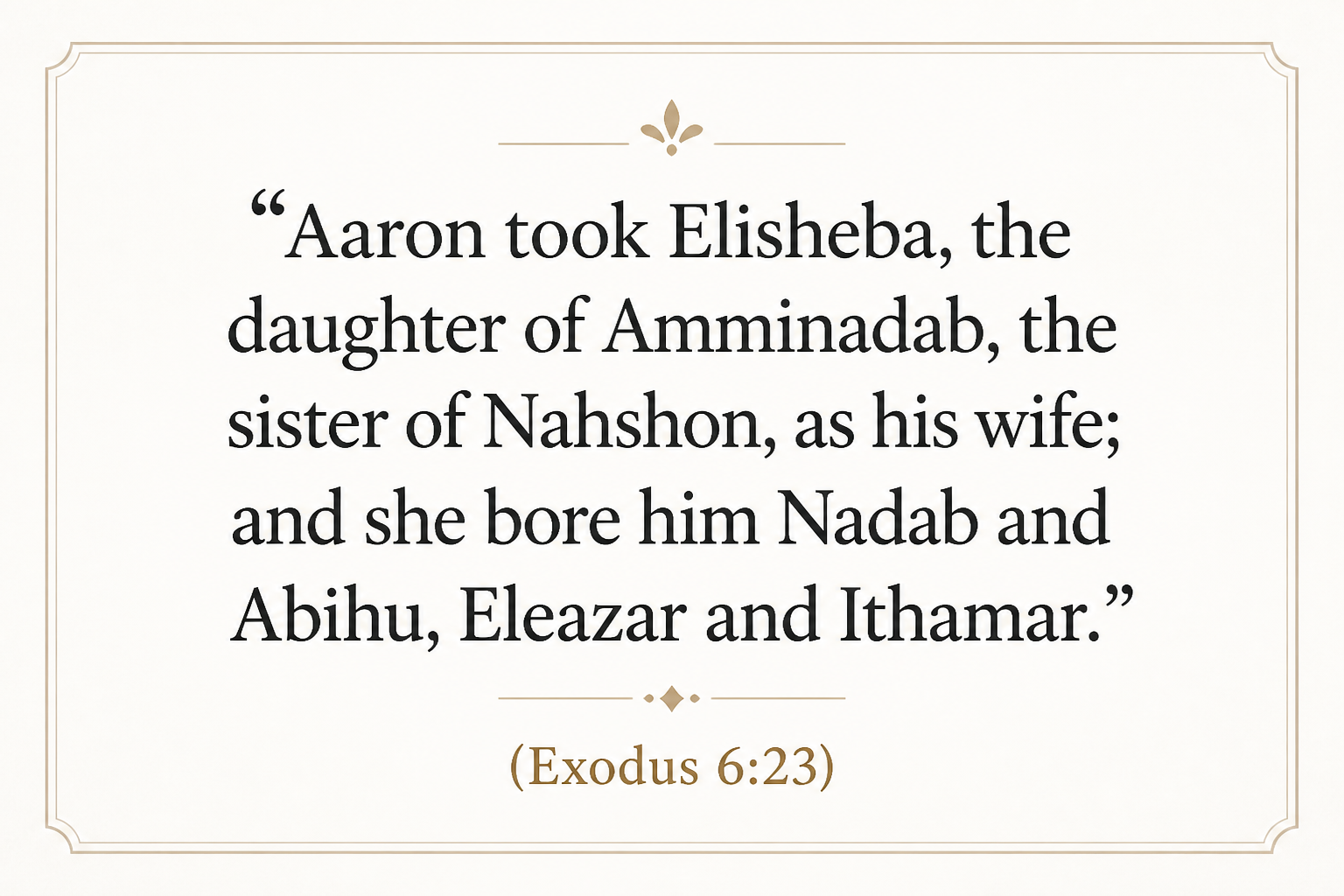
“Aaron took Elisheba, the daughter of Amminadab, the sister of Nahshon, as his wife; and she bore him Nadab and Abihu, Eleazar and Ithamar.” (Exodus 6:23)
Here Abihu is introduced within Aaron’s immediate family line: he is one of the sons borne to Aaron by Elisheba. The verse places Abihu among four brothers in a single household, establishing him as part of the core priestly family associated with Aaron.
“Then Moses, Aaron, Nadab, Abihu, and seventy of the elders of Israel went up.” (Exodus 24:9)
In this scene Abihu is singled out, together with Nadab, alongside Moses and Aaron and a representative group of elders. The inclusion of Abihu among these named figures presents him as belonging to the inner circle that ascends with Israel’s leadership, distinguishing him from the broader group (“seventy of the elders of Israel”) by explicit naming.
“These are the names of the sons of Aaron: Nadab the firstborn, and Abihu, Eleazar, and Ithamar.” (Numbers 3:2)
Abihu appears in a formal naming formula that identifies Aaron’s sons as a set. The ordering (“Nadab the firstborn, and Abihu…”) situates Abihu immediately after the firstborn, marking his place within the sibling group as the family is presented in an official register.
“Nadab and Abihu died before Yahweh when they offered strange fire before Yahweh in the wilderness of Sinai, and they had no children. Eleazar and Ithamar ministered in the priest’s office in the presence of Aaron their father.” (Numbers 3:4)
This verse supplies the most detailed narrative characterization attached to Abihu in these occurrences. Abihu is paired with Nadab in both action and outcome: they “offered strange fire before Yahweh” and, as a result, “died before Yahweh.” The location (“in the wilderness of Sinai”) places the event within Israel’s wilderness setting, and the note “they had no children” links Abihu’s death to the family’s future. The final sentence contrasts the deceased brothers with the surviving sons, as “Eleazar and Ithamar ministered in the priest’s office,” showing how Abihu’s removal affects priestly service in Aaron’s presence.
“The children of Amram: Aaron, Moses, and Miriam. The sons of Aaron: Nadab, Abihu, Eleazar, and Ithamar.” (1 Chronicles 6:3)
Abihu is again listed as one of Aaron’s sons, but this time within a broader genealogy that begins one generation higher (“The children of Amram”). Abihu’s name functions as a link in the chain that moves from the household of Amram to the household of Aaron, setting Abihu within an extended family context that includes Moses and Miriam as part of the same generation.
“But Nadab and Abihu died before their father, and had no children: therefore Eleazar and Ithamar executed the priest’s office.” (1 Chronicles 24:2)
This statement combines family loss and institutional consequence. Abihu, again paired with Nadab, is described as having “died before their father” and as having had “no children.” The verse then draws a direct implication for priestly administration: “therefore Eleazar and Ithamar executed the priest’s office.” Abihu’s identity as a son of Aaron is thus tied to a turning point in which the priestly office is carried forward through the surviving brothers.
“To Aaron were born Nadab and Abihu, Eleazar and Ithamar.” (Numbers 26:60)
Abihu is presented in a succinct birth formula that restates Aaron’s sons as a complete set. The verse’s compact wording emphasizes lineage and descent (“To Aaron were born…”), reinforcing Abihu’s place within Aaron’s household without narrating further detail in this line.
“Nadab and Abihu died when they offered strange fire before Yahweh.” (Numbers 26:61)
This final occurrence condenses Abihu’s remembered end into a brief causal link: death is connected to the act of offering “strange fire before Yahweh.” By pairing Abihu with Nadab and repeating the action as the defining circumstance, the verse anchors Abihu’s memory within the community’s recollection of a specific offense and its outcome.
Sense and Usage
Across these passages, Abihu’s sense as “a son of Aaron” is not merely a label of parentage; it functions as a narrative and genealogical identifier that repeatedly positions him within a four-brother group: “Nadab and Abihu, Eleazar and Ithamar” (Exodus 6:23; Numbers 3:2; Numbers 26:60; 1 Chronicles 6:3). The recurring fourfold listing gives Abihu a stable place in Aaron’s family structure, and the repeated pairing with Nadab creates a consistent association between the two brothers.
Two distinct kinds of contexts dominate the occurrences. First are genealogical or registrational statements that preserve family membership and ordering. These passages treat Abihu as part of a named set, often in a fixed sequence, and they embed the household of Aaron within larger family lines (Exodus 6:23; Numbers 26:60; 1 Chronicles 6:3). In these contexts, Abihu’s name serves to establish continuity: he belongs to Aaron’s line, and his inclusion helps define the composition of that line.
Second are the passages that interpret Abihu’s place in relation to priestly service and succession. In Numbers 3:4 and 1 Chronicles 24:2, Abihu’s death is narrated with two additional elements that shape how “son of Aaron” plays out socially: the timing (“before Yahweh” / “before their father”) and the absence of descendants (“they had no children”). Those details lead directly to an administrative outcome: “Eleazar and Ithamar ministered in the priest’s office” (Numbers 3:4) and “executed the priest’s office” (1 Chronicles 24:2). Within these verses, Abihu’s identity as Aaron’s son is intertwined with a potential role in priestly continuity that is cut off, leaving the priestly function to be carried by the remaining brothers.
Exodus 24:9 stands somewhat apart, because it places Abihu in a named group that goes up with Moses and Aaron. Here the significance of being a son of Aaron is expressed through inclusion among leaders whose movements are narrated: “Moses, Aaron, Nadab, Abihu, and seventy of the elders of Israel went up.” Abihu’s name, positioned between Aaron and the elders, situates him between the central priestly figure (Aaron) and the broader leadership of Israel (the elders), highlighting his closeness to the principal leaders at a key moment of ascent.
When the same decisive memory is repeated—“they offered strange fire before Yahweh”—it becomes the principal narrative marker attached to Abihu (Numbers 3:4; Numbers 26:61). The repetition in two separate settings (one within a register that also discusses ministering in the priest’s office, and one within a brief death notice) shows how Abihu’s identity is preserved both as a member of Aaron’s family and as one whose death shaped the family’s ministerial future.
Imagery in Context
The imagery attached to Abihu in these verses is concrete and communal: a household named in orderly sequence; leaders ascending together; and an act of offering “strange fire before Yahweh” followed by death “before Yahweh.” Alongside these are familial notes with lasting weight—“they had no children”—and the visible continuation of priestly work as “Eleazar and Ithamar ministered in the priest’s office in the presence of Aaron their father” (Numbers 3:4). Within the quoted passages, Abihu’s name therefore carries both the dignity of proximity to Israel’s leadership and the sobering association with a failed offering that altered priestly succession.
Sources: Lexical data from Strong’s Exhaustive Concordance and the Open Scriptures Hebrew Lexicon. Occurrence data from the Westminster Leningrad Codex with STEPBible reference data (CC BY). Scripture quotations from the World English Bible (public domain).




