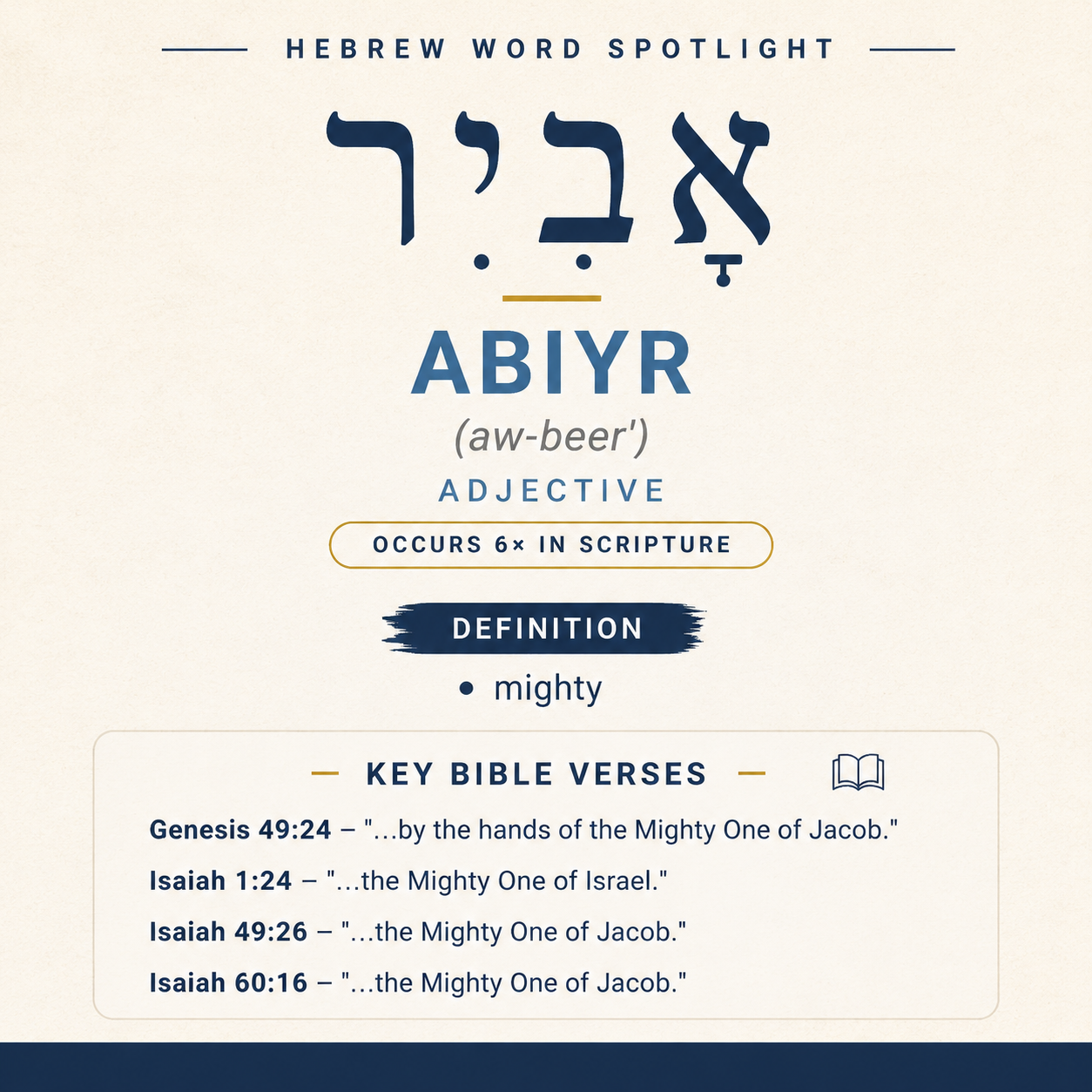
אָבִיר (abiyr) means “mighty.” It appears in a small set of passages where the phrase “the Mighty One of Jacob” (and once “the Mighty One of Israel”) functions as a reverent designation for Yahweh in contexts of strength, rescue, and covenant commitment.
Occurrences
“But his bow remained strong. The arms of his hands were made strong, by the hands of the Mighty One of Jacob, (from there is the shepherd, the stone of Israel),” (Genesis 49:24)
Here “the Mighty One of Jacob” appears inside a cluster of strength language: a bow that “remained strong” and hands whose “arms…were made strong.” The designation contributes a personal source for the strength described: the strengthening does not arise from Joseph’s own resources but is attributed “by the hands of” the Mighty One. In this scene, the word’s force is not abstract power; it is power that acts—strength that steadies weapons and reinforces human arms for endurance. The title also binds that power to Jacob’s family line (“of Jacob”), placing might within the story of Israel’s ancestors and their preservation.
“Therefore the Lord, Yahweh of Armies, the Mighty One of Israel, says: “Ah, I will get relief from my adversaries, and avenge myself on my enemies.” (Isaiah 1:24)
In this prophetic announcement, “the Mighty One of Israel” stands alongside “the Lord” and “Yahweh of Armies,” stacking names that emphasize authority and capacity to act. The spoken resolve—“I will get relief from my adversaries, and avenge myself on my enemies”—frames might as the ability to confront opposition and execute justice. The term marks Yahweh not merely as stronger in principle, but as the one able to end hostility and settle accounts. The national identifier (“of Israel”) ties this might to a people, making the claim public and communal rather than private: Israel’s God asserts power in the face of enemies.
“I will feed those who oppress you with their own flesh; and they will be drunk on their own blood, as with sweet wine. Then all flesh shall know that I, Yahweh, am your Savior and your Redeemer, the Mighty One of Jacob.” (Isaiah 49:26)
This verse sets the title at the climax of a severe reversal: oppressors are made to consume what destroys them, and the outcome is universal recognition—“Then all flesh shall know.” “The Mighty One of Jacob” is placed in apposition to “your Savior and your Redeemer,” so might here is the effective power that accomplishes deliverance and redemption in the face of oppression. The scene is not about raw force for its own sake; it is might expressed as decisive rescue, vindication, and the public exposure of Yahweh’s identity. Calling him the Mighty One of Jacob anchors that rescue in the covenantal story-world of Jacob’s descendants, implying continuity between ancestral protection and later deliverance.
“You will also drink the milk of the nations, and will nurse from royal breasts. Then you will know that I, Yahweh, am your Savior, your Redeemer, the Mighty One of Jacob.” (Isaiah 60:16)
Here the language turns to nourishment and abundance: drinking “the milk of the nations” and nursing “from royal breasts.” The title “the Mighty One of Jacob” is again paired with “your Savior” and “your Redeemer,” but the immediate imagery is not battle; it is provision that reverses deprivation. Might, in this setting, is the strength to bring about a transformed condition for Zion—sustained, honored, and supplied from beyond itself. The closing “Then you will know” connects experienced provision with recognition of Yahweh’s identity: the people’s knowledge is grounded in concrete change, and the title signals that the one who brings that change possesses the power to do so.
“how he swore to Yahweh, and vowed to the Mighty One of Jacob:” (Psalm 132:2)
Psalm 132 recalls a solemn commitment directed toward Yahweh, with parallel reference to “the Mighty One of Jacob.” The word contributes a tone of gravity: the vow is made to one characterized by might, implying that the vow is not casual and not to be taken lightly. The verse also shows the title functioning within worship language—oath and vow—where the speaker addresses God with an honorific that highlights strength. In this scene, might is not displayed through an immediate act; it is the acknowledged quality of the one to whom the promise is made.
“until I find out a place for Yahweh, a dwelling for the Mighty One of Jacob.” (Psalm 132:5)
This continuation of the vow specifies its goal: securing “a place for Yahweh, a dwelling for the Mighty One of Jacob.” The title is set in a temple-oriented context—locating a “dwelling” for the one called mighty. The word contributes a striking juxtaposition: the Mighty One is not depicted as needing shelter, yet the vow’s purpose is to prepare a fitting place for him. In this scene, might heightens the significance of the dwelling project: preparing a place is presented as a weighty undertaking precisely because of who the intended resident is.
Sense and Usage
Across these six occurrences, “mighty” is expressed through titles rather than descriptive clauses. אָבִיר (abiyr) does not label human heroes in these verses; it serves as a confessional designation for Yahweh, identifying him by the quality of might in relation to Israel’s story (“of Jacob,” “of Israel”). The scenes show several dimensions of what “mighty” does in practice without adding new meanings beyond the word itself. In Genesis 49:24, might is the source of strengthening—hands that make hands strong—so the term is linked to enabling endurance and stability. In Isaiah 1:24, might stands behind the resolve to oppose adversaries and avenge wrongs, presenting divine action as effective and authoritative. In Isaiah 49:26 and Isaiah 60:16, the title is explicitly paired with “Savior” and “Redeemer,” showing might as the capacity to rescue and to reverse conditions: oppression is turned back on oppressors, and destitution is replaced with abundance and honor. In Psalm 132:2 and 132:5, might shapes worship and devotion: it is the quality of the one to whom vows are made and for whom a dwelling is sought, lending weight to the speaker’s commitment and to the sanctuary’s significance.
The recurring phrase “the Mighty One of Jacob” also functions as a bridge between themes. It can stand beside martial-sounding resolve (avenging enemies), beside deliverance language (Savior, Redeemer), and beside temple language (dwelling). The title’s consistency suggests that the same might is recognized in different arenas of life: personal or tribal strengthening (Genesis), public justice (Isaiah 1), redemption from oppression (Isaiah 49), provision and restoration (Isaiah 60), and the solemnity of worship commitments (Psalm 132). In each case, the word’s contribution is to name Yahweh as the one whose strength is sufficient for the action or outcome the text highlights.
Imagery
The passages attach “the Mighty One” to vivid bodily and material images: strong arms and hands (Genesis 49:24), adversaries and enemies (Isaiah 1:24), oppressors brought low (Isaiah 49:26), nourishment from nations and royalty (Isaiah 60:16), and the pursuit of a “dwelling” (Psalm 132:5). These images keep might from remaining an invisible attribute. In the quoted scenes, it is the acknowledged strength behind preservation, judgment, deliverance, provision, and the honor given to Yahweh through vowed devotion.
Sources:
Lexical data from Strong’s Exhaustive Concordance and the Open Scriptures Hebrew Lexicon. Occurrence data from the Westminster Leningrad Codex with STEPBible reference data (CC BY). Scripture quotations from the World English Bible (public domain).